Read carefully.
Follow the sources.
Change the conclusion when the evidence changes.
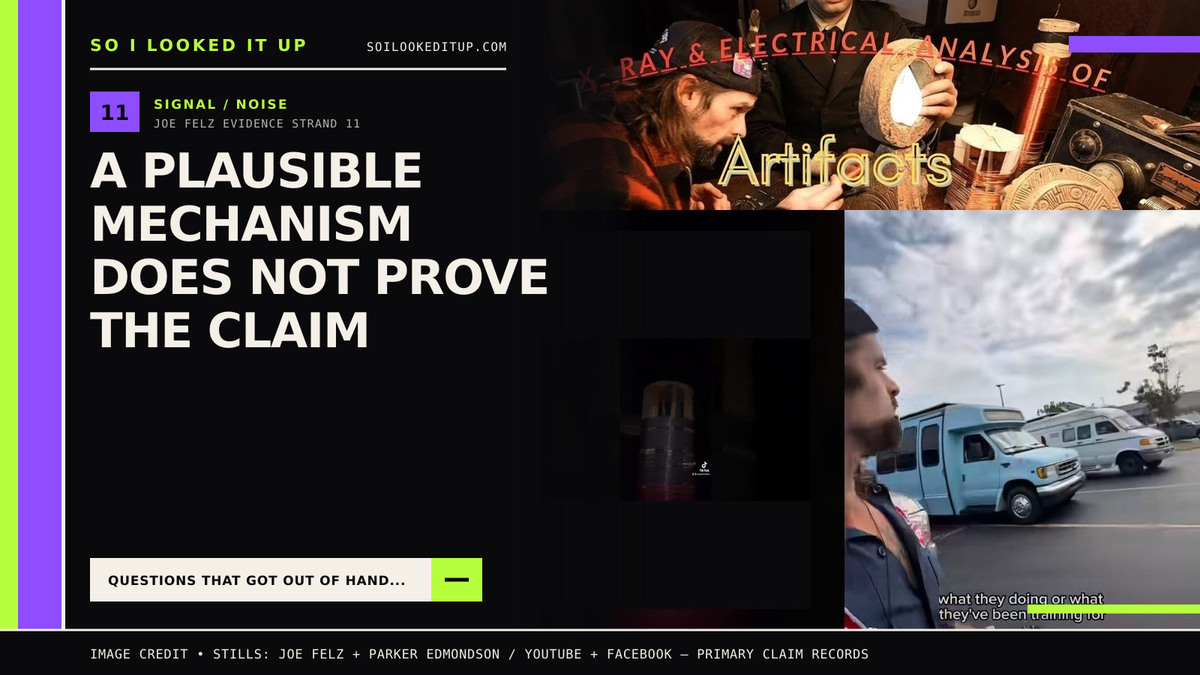
SIGNAL / NOISE / JOE FELZ SATELLITE 11
The most persuasive extraordinary claims contain something real. The mistake is letting that real mechanism prove a different, much larger proposition.
Wireless power exists. Microwave pyrolysis exists. Falling water makes electricity. X-rays reveal the inside of objects. Radiocarbon can date ancient organic material. LiDAR can expose landscapes hidden beneath forest.
Every sentence is true.
None proves that a particular device creates free energy, a particular object is 45,000 years old or a particular set of ruins is a lost civilisation.
This is the connective tissue running through the Joe Felz investigation. The claims rarely begin with pure fantasy. They begin with a valid mechanism and quietly ask it to carry more weight than it can bear.
A mechanism answers only one question
A mechanism is an account of how one state could produce another. It makes a claim physically, chemically, biologically or historically intelligible.
It can answer: could this kind of effect happen this way?
It does not automatically answer:
- Did it happen in this case?
- Is this the mechanism that caused the observation?
- How large and efficient was the effect?
- Does the system work outside the demonstration?
- Is the object what its owner says it is?
- Are rival explanations less likely?
- Was the result independently reproduced?
That distinction sounds obvious when written down. In a compelling video, the steps collapse. The apparatus is moving; the mechanism can produce movement; therefore the apparatus performs exactly as described.
Possible, plausible and demonstrated are different states
| State | What has been shown | What has not |
|---|---|---|
| Logically possible | The claim contains no immediate contradiction | Whether nature permits it |
| Physically possible | A known process can produce that class of effect | Whether it occurred here |
| Plausible | The mechanism and context fit the observation reasonably well | Whether alternatives fit as well or better |
| Observed | A relevant output was measured | Its cause, accuracy and full system balance |
| Demonstrated | A controlled test supports the defined performance claim | General reliability and scale |
| Replicated | Independent teams obtain compatible results | Commercial or operational readiness |
| Validated in use | The integrated system performs under relevant conditions | Every future deployment |
NASA’s technology-readiness system makes the same distinction operationally. Basic principles, a formulated concept, a proof-of-concept model, an integrated laboratory test and a system demonstrated in its actual environment occupy different levels. A working component does not make the finished system flight-ready.
The mechanism substitution
The reasoning error usually takes this form:
- A real mechanism is named.
- A visually compatible effect is shown.
- The mechanism is assumed to explain that effect.
- The effect is assumed to have the advertised magnitude.
- The entire product, history or conspiracy claim inherits the mechanism’s credibility.
The real mechanism acts like an evidential passport. It crosses borders the test never crossed.
Case 1: an X-ray can reveal structure without revealing identity
X-radiography can show differences in density, voids, joins, inserts, fractures and internal construction. Computed tomography can turn many projections into a three-dimensional attenuation map. X-ray fluorescence can identify elements near a surface.
Those are powerful tests. An internal shape may distinguish a hollow casting from a solid object. A seam may reveal assembly. A hidden wire may explain a glow.
But an unusual X-ray does not independently establish:
- the object’s age;
- its excavated context;
- who made it;
- what culture used it;
- whether it is unique;
- what the internal feature was for.
The mechanism—different materials attenuate X-rays differently—supports the image. The larger historical identity requires provenance, materials analysis, manufacturing comparison, secure dating and independent expertise.
Case 2: a dating method can be valid while the date is not attached to the object
Radiocarbon dating genuinely can estimate the age of once-living material. Thermoluminescence can estimate when certain minerals were last heated. Dendrochronology can date wood under the right conditions.
“The laboratory used carbon dating” does not tell us what was sampled. Charcoal beside an object dates the carbon in the charcoal, not automatically the object. Old wood can be reused. Adhesive, conservation material and handling can contaminate a sample. Near the practical limit of radiocarbon dating, very small modern contamination can shift the apparent result dramatically.
The missing link is not the existence of the clock. It is the chain connecting sample, object, context, laboratory procedure, calibration and interpretation.
Case 3: wireless electricity is not wireless energy creation
Inductive coupling, resonant coupling, capacitive transfer, radio-frequency beaming and optical power transmission are real. Energy can cross a gap without a metal wire connecting source and receiver.
Every version still has an input, a field or beam, a receiver and losses. A fluorescent tube lighting near a high-voltage coil shows coupling. It does not reveal total transmitter input, useful receiver output, field exposure, efficiency or maximum range.
That is how a true statement—“electricity was transmitted through the air”—can be made to imply “energy arrived without a source”, “the device powers a house efficiently” or “the inventor solved long-range free power”. Those are separate measurements.
Case 4: making oil from plastic does not make road-ready petrol
Pyrolysis can break some plastics into gases, liquid hydrocarbons, waxes and char. Microwaves can supply heat through a suitable absorber. Joe and Julian Brown demonstrably built and operated relevant hardware.
The existence of that chemistry does not answer the questions a transport or climate claim requires:
- Which polymers went in, and how were PVC and contaminants controlled?
- What mass of each product came out?
- How much electricity and auxiliary heat entered?
- What energy remained in gas, char and residue?
- Was the liquid distilled, stabilised and tested to a fuel standard?
- What emissions, waste and catalyst replacement occurred?
- Did the continuous system maintain that balance at scale?
A flame from a liquid fraction establishes combustibility. It does not establish composition, engine compatibility, net energy benefit or commercial economics.
Case 5: gravity can power a generator because something first gained height
Hydroelectric generation is ordinary physics. Water falling through a head releases gravitational potential energy. The maximum available power depends on density, gravitational acceleration, flow and height, reduced by efficiency losses.
A water-and-gravity machine can therefore produce useful output when a river, reservoir, elevated tank, wave, tide or other external process supplies the head. In a closed loop, pumping the water back up requires at least the energy recovered on the way down, and real pumps and generators lose energy.
A wheel that continues turning is not an energy balance. Stored height, pressure, a hidden pump, a battery, transient momentum or changing reservoir level can all maintain a demonstration. The test has to define the system boundary and measure every energy crossing it over long enough that stored energy cannot masquerade as production.
Case 6: the right survey method cannot identify a lost city by itself
LiDAR can map ground elevation beneath vegetation. Ground-penetrating radar and electrical methods can reveal subsurface contrasts. Satellite imagery can identify patterns invisible from the path.
But a geometric anomaly becomes archaeological evidence through ground truth: mapped architecture, controlled excavation, stratigraphy, datable material, artefact distributions and a defensible cultural interpretation. A technology capable of detecting ruins does not turn every detected pattern into ruins.
A mechanism matters when it makes risky predictions
This does not mean mechanisms are decorative. They become strong evidence when they predict observations that rival explanations do not.
If a claimed process is responsible, what should happen when we vary one input? What signature should appear? What should disappear when we block the proposed pathway? What quantitative relationship should hold?
| Weak use of a mechanism | Strong use of a mechanism |
|---|---|
| It could explain the effect | It predicted a result before the test |
| The device resembles known technology | Measured inputs and outputs match a quantitative model |
| The output changed | The output changed only when the proposed pathway was available |
| No obvious alternative was mentioned | Competing explanations were actively separated |
| One striking run was filmed | Repeated blinded or independently controlled tests agreed |
Bradford Hill included plausibility among his famous viewpoints for assessing causation, but explicitly warned against treating any one viewpoint as indisputable proof. In medicine, regulators distinguish proof of concept from demonstrated efficacy. The same discipline belongs in a garage, excavation and archive.
The measurement chain is part of the claim
A number on a screen is not a free-standing fact. It inherits uncertainty from the instrument, calibration, operator, environment, sampling and calculation. NIST measurement practice treats those contributions as part of the result, not paperwork added afterward.
For an extraordinary performance claim, ask:
- What exactly is the measurand? Power, energy, temperature, age, composition or something else?
- Where is the system boundary? What crosses it?
- Was the instrument appropriate? A clamp meter can miss waveform and power-factor problems.
- Was it calibrated? Against what traceable reference and when?
- What was sampled? The claimed object, associated material or an unidentified fragment?
- What was subtracted? Background, baseline and control values matter.
- What is the uncertainty? Does the claimed excess exceed the measurement error?
- Was the analysis decided before seeing the result? Flexible choices can manufacture significance.
- Can an independent team reproduce it? Repetition by the same setup tests consistency; replication elsewhere tests portability.
The fastest honest test: ask what would kill the claim
Claims become unfalsifiable when every outcome confirms them. Low output means suppression. Missing documentation means seizure. Failed replication means the tester lacked the correct frequency. A family denial means a cover-up. That structure protects the story by sacrificing the test.
A serious hypothesis names its own defeat condition:
- If total output does not exceed calibrated total input plus uncertainty, the over-unity claim fails.
- If the dated sample cannot be tied securely to the object, the object-age claim remains unsupported.
- If the “fuel” fails compositional and performance standards, it should not be called road-ready petrol.
- If excavation shows the geometry is geological or modern, the archaeological interpretation changes.
- If the alleged forbidden text is catalogued in ordinary libraries and living canons, global erasure is not a sufficient description.
Why smart people make this jump
The error is attractive because it rewards real understanding. Once someone learns that resonant coupling works or that spectral imaging can reveal hidden writing, they possess a genuine explanatory tool. Applying it to the mystery feels like moving beyond the dismissive sceptic who says nothing unusual is possible.
Often that is progress. The mechanism may convert “impossible” into “worth testing”. The mistake comes one step later, when being able to tell a coherent story is confused with having tested the story against the world.
Videos intensify the effect because they show outputs and hide boundaries. We see the lamp, flame, wheel, scan or excavation. We do not see every cable, rejected run, calibration certificate, sample transfer, laboratory blank or alternate trench.
A language audit for claim inflation
| If the evidence shows… | Say… | Do not silently upgrade it to… |
|---|---|---|
| A component responds | “The component produced a response” | “The system works” |
| A mechanism is known | “This could explain the observation” | “This caused it” |
| A prototype runs | “Proof of concept” | “Commercial solution” |
| An unusual scan appears | “Internal feature requiring identification” | “Ancient technology” |
| A nearby sample has a date | “Associated material dated to…” | “Object is this age” |
| A text is absent from one edition | “Not included in this canon/printing” | “Erased from history” |
What this means for Joe
Joe’s body of work deserves to be separated into testable claims, not accepted or rejected as one package.
His ordinary solar work demonstrates practical competence. The microwave-pyrolysis apparatus demonstrates a real engineering effort. His wireless experiments sit inside genuine electrical physics. The artefact scans may contain useful observations. The excavation may preserve leads worth documenting. The book archive was a real digitisation project.
None of those facts supplies missing evidence for the others. Joe being right that a mechanism exists does not show that every proposed performance, age, origin or suppression narrative was right. Equally, one unsupported leap does not make every machine fake.
That is why the satellite articles exist. They prevent the bundle from becoming its own proof.
The conclusion
A plausible mechanism is not nothing. It is a reason to replace ridicule with a well-designed test.
But it is not the test.
The discipline is to keep asking what each piece of evidence actually reaches. A mechanism supports possibility. A controlled measurement supports a defined effect. Independent replication supports robustness. Provenance supports identity. None should be made to impersonate the others.
The extraordinary claim does not fail because one ordinary mechanism inside it is real. It becomes precise enough to investigate.
Sources & further reading
- NASA — Technology Readiness Levels
- National Academies — Reproducibility and Replicability in Science
- NIST — selected laboratory and measurement practices
- Shimonovich et al. — revisiting Bradford Hill’s causal viewpoints
- Aronson et al. — use of mechanistic evidence
- FDA — proof of concept compared with evidence of efficacy
- FDA — case studies where later trials did not confirm earlier promise
- Royal Society — reproducibility and research integrity
Related rabbit holes: the full Joe Felz reconstruction · how claims mutate online · why provenance matters