Read carefully.
Follow the sources.
Change the conclusion when the evidence changes.
Feature image: editorial composition based on the 1983 U.S. Army report page held by the Monroe Institute Archives and preserved by the Internet Archive. U.S. government document used for reporting, criticism and research; AI-assisted layout, with no invented document offered as evidence.
The government PDF reaches the bottom of page 24, stops halfway through a thought about the Holy Spirit—and then jumps to page 26.
There is no black box. No “REDACTED” stamp. No Freedom of Information Act exemption code. Page 25 is simply absent.
That is almost perfect conspiracy fuel. The missing sheet sits inside a 1983 report about altered consciousness, out-of-body experience, a “universal hologram” and what its author called the Absolute. Remove one page at precisely that moment and the gap begins to feel more meaningful than the text around it.
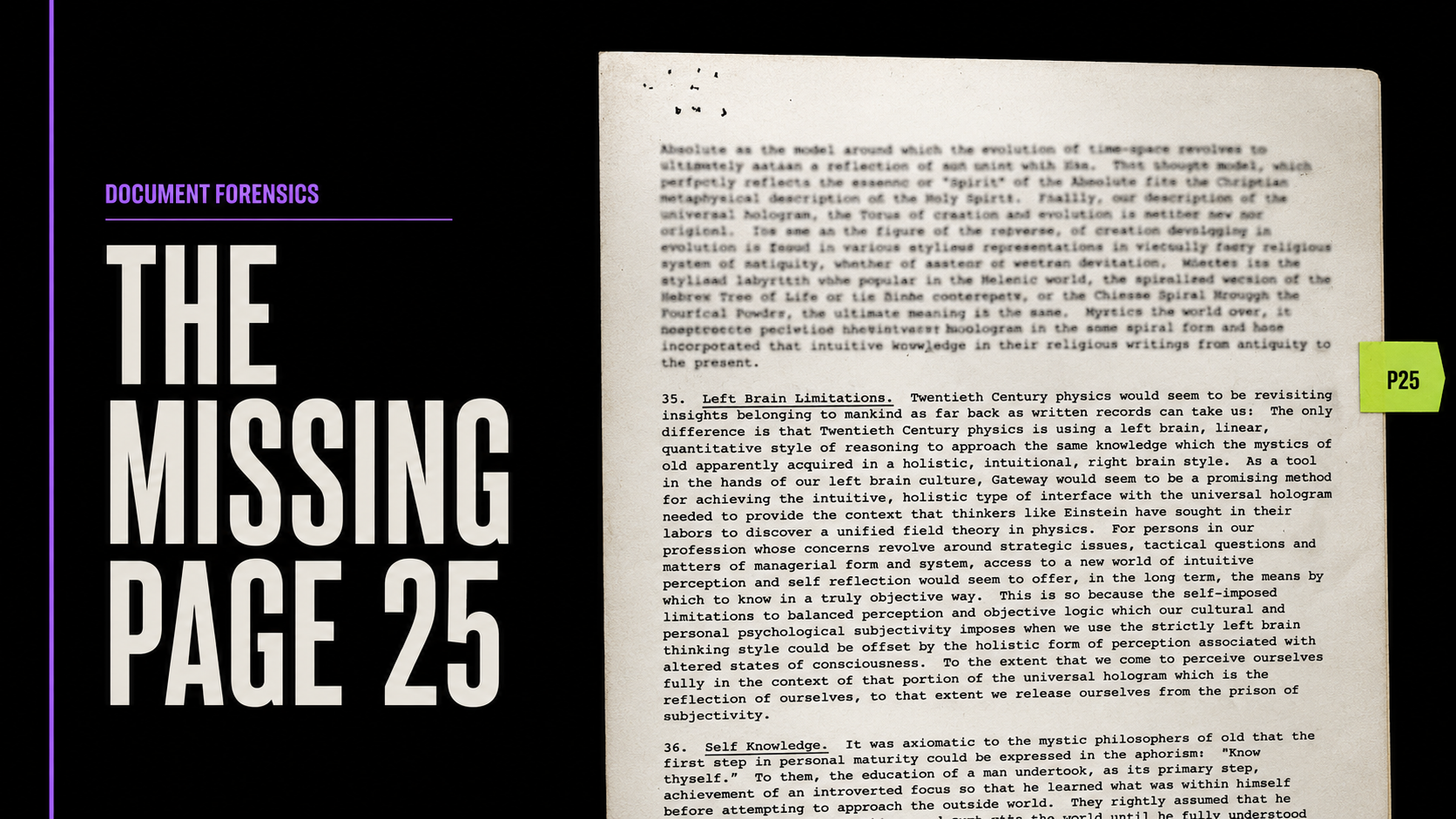
In 2021, a complete copy surfaced from the Monroe Institute’s own archive. Page 25 was finally readable. But finding the page answers only one question. It does not answer the more dramatic one.
Was it deliberately suppressed?
The short answer is: the omission is real; deliberate CIA suppression is not established.
Evidence status
The CIA Reading Room scan of Analysis and Assessment of Gateway Process jumps from numbered page 24 to numbered page 26. The complete Monroe archive copy contains page 25 with sections 35 and 36 in the correct sequence.
An incomplete copy or scanning omission fits the available record better than a targeted redaction. The recovered page is philosophically striking but contains no obvious operational secret, source identity or intelligence method.
Exactly when and where the sheet dropped out of the CIA copy chain; whether the agency ever received a complete original; and whether an accession, transmission or processing log survives that could settle the cause.
First: this is not a report written by the CIA
The document is real, but its internet nickname is misleading.
Analysis and Assessment of Gateway Process is dated 9 June 1983. Its letterhead is the U.S. Army Operational Group, U.S. Army Intelligence and Security Command, Fort Meade. Lieutenant Colonel Wayne M. McDonnell wrote it in response to a tasking from his commander to assess the Monroe Institute’s Gateway Experience—an audio-assisted programme intended to alter consciousness.
The CIA later became the public archive through which the document was released. That makes it a genuine declassified government record in the CIA Reading Room. It does not make every sentence a CIA finding, a controlled experiment or an official declaration that astral projection works.
McDonnell describes his own job clearly: build a model that might make the process intelligible and judge whether it could have practical value. The report mixes descriptions of hypnosis and biofeedback with Itzhak Bentov’s speculative physics, Monroe Institute claims, religious parallels and recommendations for possible training.
That distinction matters before we even reach the missing page. A government archive proves provenance. It does not automatically prove the archived argument.
What the CIA copy actually does
The CIA file carries the identifier CIA-RDP96-00788R001700210016-5 and release markings dated 10 September 2003.
Its numbered page 24 contains section 34, “Belief System Considerations”. McDonnell argues that his model of a universal hologram resembles ideas found in Tibetan Buddhism, Hindu imagery, Hebrew mysticism and Christianity. The final sentence continues onto the next sheet.
But the next scanned page is numbered 26. It begins with section 37, “Motivational Aspect”.
Two section numbers and one physical page have vanished together: section 35, section 36 and page 25.
That makes this more than a printer inventing the wrong numeral. Something is genuinely missing from that copy.
The form of the absence is also important. The scan does not show a page covered by redaction boxes. It does not insert a withdrawal sheet or cite a statutory exemption. It simply presents an incomplete sequence.
That is consistent with several possibilities: a loose page omitted during copying, an incomplete source packet, a scanning mistake, or a sheet lost before the document reached the archive. It is also compatible with intentional removal in the very broad sense that absence cannot disprove intent. What it does not provide is positive evidence of intent.
The page was not recovered from a secret CIA cache
The chain of custody changes in 2021.
Vice reporter Thobey Campion wrote that the Monroe Institute contacted him after his earlier article about the report. According to Campion, the institute said it held a complete copy in its Virginia archive and eventually supplied the full report by email.
On 14 April 2021, the Monroe Institute Archives uploaded three related files to the Internet Archive: its complete report, page 25 as a separate scan, and the incomplete CIA copy. That upload date, uploader name and three-file structure are recorded on the item page.
This is a stronger provenance trail than a page passed anonymously around social media. It identifies a source institution with an obvious reason to possess the report: the report evaluates that institution’s own programme.
It is still not perfect provenance. We do not have a public page-by-page custody log running from McDonnell’s typewriter to the Monroe archive shelf. The recovered sheet also lacks the CIA’s 2003 release stamp because it comes from a different physical copy.
So the page can answer “what belongs between 24 and 26?” much more confidently than it can answer “what exact sheet did the CIA possess?”
The document-forensics test
A replacement page should not be trusted merely because it says “25” at the bottom. It has to fit.
This one does.
- Textual continuation: page 24 ends in the middle of McDonnell’s comparison between the Absolute and Christian metaphysics. Page 25 begins by completing that exact sentence and continues the same argument.
- Section sequence: page 24 carries section 34. The recovered page contains sections 35 and 36. Page 26 begins with section 37.
- Page sequence: the recovered sheet is numbered 25 in the same position and typewriter style used elsewhere.
- Mechanical appearance: in the complete Monroe copy, pages 24, 25 and 26 share the same typeface, margins, line spacing, underlined subheads and small dark copying artefacts near the top edge.
- Argument structure: section 35 moves from religious parallels to McDonnell’s “left brain” versus “right brain” framing. Section 36 turns that into a claim about self-knowledge. Section 37 then explains why a user might remain motivated to practise Gateway. The bridge is coherent.
These tests make a modern, freshly written insertion unlikely. They strongly support the narrower conclusion that the recovered page belongs to this report.
They cannot show that the CIA selected it for removal. Physical consistency authenticates placement; it does not identify the cause of absence from another copy.
What was supposedly too explosive to release?
The answer is less like an operational secret than the internet mythology suggests.
Page 25 finishes McDonnell’s discussion of religious symbols. He says that spiral or torus-like images across traditions resemble his “universal hologram”. Section 35 then argues that twentieth-century physics was approaching, through linear reasoning, knowledge that mystics had reached intuitively. Gateway, he proposes, might help a “left brain culture” gain holistic perception.
Section 36 is titled “Self Knowledge”. It invokes “Know thyself” and argues that altered consciousness could give a person a fuller view of the self than personality testing.
That is philosophically ambitious. It is not a weapons diagram, a named intelligence source, a collection method, a budget, a location or a test result.
It also does not contain the report’s most operationally provocative material. Page 26 and the pages after it remain in the released copy. They recommend steps involving Hemi-Sync audio, REM sleep, hypnosis and controlled out-of-body practice, and they discuss possible encounters with “non-corporeal energy forms”. If an agency intended to hide the report’s strangest or most actionable passages, leaving those sections visible would be an odd way to do it.
The page’s science has aged badly
Authenticating a page is not the same as validating its claims.
Page 25 relies heavily on a familiar split: the left hemisphere as linear, logical and culturally dominant; the right as holistic and intuitive. Real brains do show lateralisation. Language, attention and visuospatial processing can recruit the hemispheres differently.
But the global personality story—some people or cultures being fundamentally “left-brained” while others are “right-brained”—does not survive modern network evidence. A 2013 resting-state fMRI study analysed 1,011 people and found lateralisation to be a property of local connections and subnetworks, not a whole-brain left- or right-dominant personality type.
McDonnell’s page also moves from resemblance to equivalence: ancient spiritual symbols, twentieth-century physics and Gateway experiences are treated as if they converge on the same underlying reality. That may be an interesting philosophical proposal. It is not a controlled demonstration that the traditions independently measured one mechanism.
The page supplies no new experiment, raw data, comparison group or falsifiable result. Its evidential role is argumentative. It tells us what McDonnell thought belonged in his model, not what the U.S. government proved.
Why the suppression story became irresistible
The strongest part of this mystery may be its timing.
The report became easily shareable in an era primed for declassified files, simulation theory, government secrecy and consciousness content. The gap appears at the exact narrative moment when the document turns from speculative physics toward religion and self-knowledge. Then a page titled “Left Brain Limitations” reappears years later from the very institute whose method was being assessed.
That sequence feels designed.
But narrative neatness is not evidence of administrative intent. Archive mistakes are usually boring; online stories select the mistakes that look meaningful. A missing appendix about stationery does not become a TikTok mystery. A missing page about the structure of reality does.
The CIA’s own published FOIA case logs show that requesters were asking specifically for Gateway page 25 by 2019 and again in 2020. That proves public interest and an unresolved gap. It does not, by itself, prove why the gap existed.
Once “the CIA hid page 25” became the headline, every repetition increased the apparent witness count while tracing back to the same absent sheet. This is the same mutation problem that appears in extraordinary artefact stories: repetition expands faster than provenance.
That is why the first useful question is not “what did they not want us to know?” It is “which physical copy are we looking at, and what happened to it?”
What evidence would actually change the answer?
A deliberate-suppression claim should leave a trace beyond the gap itself.
The strongest evidence would be an accession record showing that the CIA received a complete 29-page copy; an internal processing note identifying page 25; a withdrawal or exemption record; an earlier CIA-held scan containing the page; or correspondence ordering that specific sheet removed.
There is another useful negative-evidence question: if page 25 was removed because its content was uniquely sensitive, why were the adjacent metaphysical claims and later operational recommendations released?
Absence is not proof that no deliberate act occurred. Records can be incomplete too. But a hypothesis that predicts administrative traces should eventually produce administrative traces.
At present, the public record offers a cleanly matching page from the Monroe archive and an incomplete CIA scan. It does not expose the missing step between them.
So was page 25 suppressed?
There is no good public evidence that it was deliberately suppressed.
There is good evidence that page 25 is authentic to the report. It completes the sentence, section numbering, pagination, typography and argument. There is equally good evidence that the CIA Reading Room copy was incomplete.
The most economical explanation is a missing sheet somewhere in copying, transmission or scanning. The precise point of failure remains unknown, so “accidental” cannot be proved with absolute confidence either.
And the recovered content is not a scientific revelation hidden from the world. It is a bridge between McDonnell’s religious analogies and his argument for Gateway as a route to intuition and self-knowledge—written through a left-brain/right-brain model that neuroscience has since made much less tidy.
The real rabbit hole is not that page 25 contains the secret of the universe.
It is that one absent sheet can turn an incomplete archive into a complete story about intent.
Sources & further reading
- Monroe Institute Archives (uploaded 14 April 2021), complete report, separate page 25 and CIA Reading Room copy, Internet Archive.
- Full OCR text of the recovered page 25, Monroe Institute Archives / Internet Archive.
- OCR text of the incomplete CIA Reading Room copy, document ID CIA-RDP96-00788R001700210016-5.
- Thobey Campion (8 April 2021), account of receiving the complete report from the Monroe Institute, Vice.
- CIA FOIA case logs, April–June 2019, document 06835030, including request F-2019-01812 for page 25. The Reading Room record is retained here by identifier because its current public link loops instead of loading reliably.
- CIA FOIA case logs, FY2020, document 06871085, including request F-2020-01965 for page 25. The Reading Room record is retained here by identifier because its current public link loops instead of loading reliably.
- Nielsen et al. (2013), “An Evaluation of the Left-Brain vs. Right-Brain Hypothesis with Resting State Functional Connectivity Magnetic Resonance Imaging”, PLOS ONE.