Read carefully.
Follow the sources.
Change the conclusion when the evidence changes.
SCIENCE & STRANGE / JOE FELZ SATELLITE 02
An X-ray can reveal that something dense, hollow, cracked, joined or repaired is inside an object. It cannot look at a bright rectangle and tell you “ancient battery”, “modern electronics” or “45,000 years old”. The image is evidence. The label is an interpretation.
The X-ray looked genuinely strange.
Inside an object presented as ancient, there appeared to be metal and a rectangular structure. Joe Felz compared part of it to a 9V battery. Later retellings travelled in the opposite direction and said the imaging had proved there was no battery or ordinary electronics inside.
Those cannot both be what the same image proved. So what can an X-ray actually tell us?
I looked that up too.
The short answer
A conventional radiograph records how strongly different parts of an object attenuate X-rays. That can expose hidden structure: voids, cracks, metal, fasteners, casting cores, repairs, joins, changes in thickness and sometimes the sequence in which an object was assembled.
But a bright or dark shape is not a self-interpreting material label. Its appearance depends on density, elemental composition, thickness, beam energy, detector response, orientation and the other material in the beam path. A two-dimensional radiograph also collapses everything through the object onto one plane.
An X-ray therefore answers “where does the object attenuate radiation differently?” far better than it answers “what civilisation made this, how old is it and what was it for?”
What happened in the Joe Felz investigation
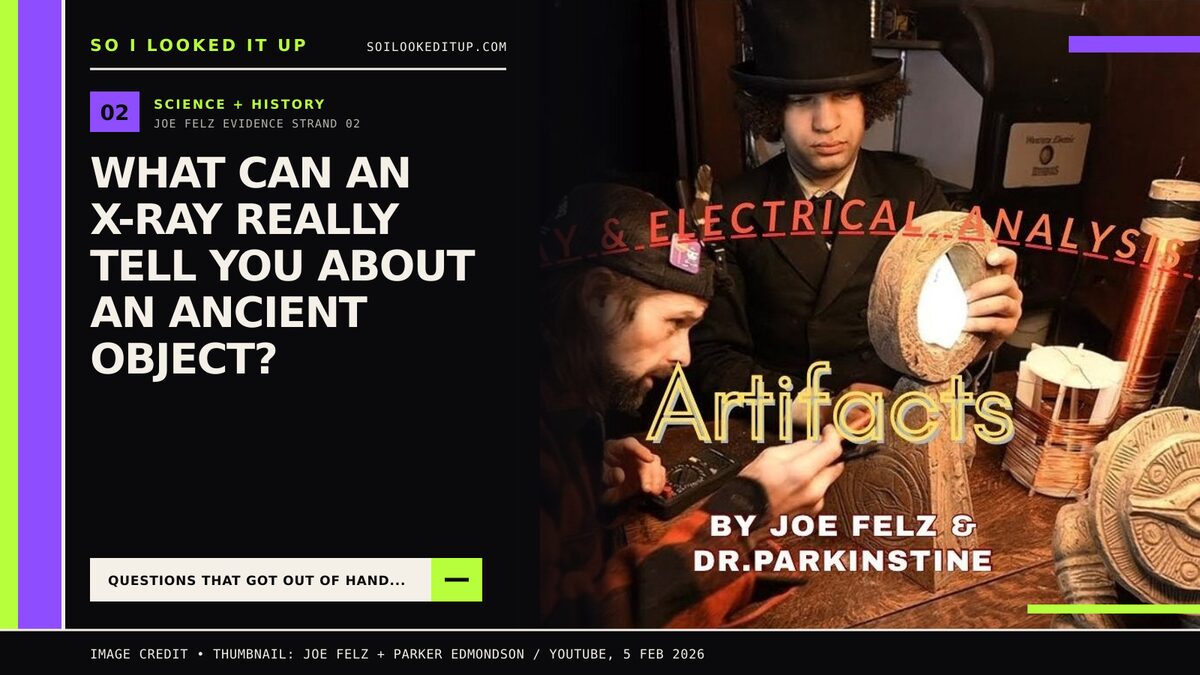
This is one branch of the wider Weekly Rabbit Hole into Joe Felz’s artefact, energy and publishing work. Joe and electrical experimenter Parker Edmondson physically examined objects and published “X-Ray & Analysis of Ancient Artifacts” on 5 February 2026. A follow-up titled “Is there a battery inside?” appeared on 25 February.
That first point is worth preserving. There really were physical objects and real X-ray examinations. This was not merely an AI-generated picture invented after Joe’s death.
The second point is equally important. Joe’s own description included internal metal and a rectangular feature reminiscent of a 9V battery. A later statement that the scan “proved no battery or electronics” strengthens the evidence beyond his original interpretation. The surviving material supports an interesting internal structure, not a settled identification.
How a radiograph is made
X-rays pass through an object toward a detector. Different materials and thicknesses absorb or scatter different proportions of the beam. NIST expresses the underlying relationship through the exponential attenuation law: the transmitted intensity falls according to the material’s attenuation coefficient and the mass thickness in the beam.
In an ordinary radiograph, strongly attenuating regions generally appear lighter. Dense material, thick sections and elements with higher atomic numbers often stand out; less dense regions and voids allow more radiation through and appear darker. The Getty’s definition of X-radiography in cultural-heritage imaging makes the practical point: density and composition both affect the image.
This produces a shadow map, not a photograph of a sliced-open object. If a dense object sits behind another dense feature, the two overlap. Turn the object and the shape may change. Change the beam energy or exposure and details can appear, disappear or merge.
What an X-ray can establish
- Internal geometry: cavities, channels, cores, hidden components and variation in wall thickness.
- Construction: joins, pins, nails, welds, casting features, layered materials and separately assembled pieces.
- Condition: fractures, corrosion pockets, insect damage, delamination and earlier repairs.
- Relative attenuation: one area is more or less X-ray-opaque than another under the recorded exposure.
- Targets for further analysis: where to scan in 3D, sample, inspect microscopically or analyse composition.
Museums use those capabilities constantly. The British Museum’s X-ray laboratory rotates objects and compares projections to reveal manufacturing details that cannot be seen from the surface. Getty research combines radiography with X-ray fluorescence, metallography and other techniques to reconstruct how bronzes were cast, patched and altered.
That is the scientifically interesting possibility in Joe’s images. They may reveal how the objects were assembled and whether the visible exterior continues uniformly inside. They can identify questions worth testing.
What an X-ray cannot establish by itself
| Claim | Can a conventional radiograph prove it? | Why not? |
|---|---|---|
| The object is ancient | No | Old and modern objects can share the same internal materials and construction features |
| The bright region is a particular metal | Not uniquely | Attenuation depends on composition, density, thickness and exposure |
| The rectangle is a battery | No | Shape suggests candidates; it does not identify chemistry, wiring or function |
| There are no electronics | Not necessarily | Small, low-contrast or overlapped components may be unresolved; scan quality matters |
| The object generated light or energy by an ancient mechanism | No | A static image does not show an operating mechanism or energy source |
| The object came from a particular site or culture | No | That requires provenance, archaeology and comparative evidence |
| The object is 45,000 years old | No | Radiography is structural imaging, not an archaeological dating method |
This is a recurring internet error: the scan is real, therefore the most exciting explanation of the scan must also be real. That is exactly the reasoning problem explored in the companion piece, why a plausible mechanism does not prove the bigger claim.
A rectangle is not a material analysis
Humans are excellent at recognising familiar forms. Once someone says “9V battery”, a rectangular patch with two brighter regions becomes difficult to see neutrally. But the image could represent a discrete component, an overlap, a casting core, a repair, a different wall thickness, a mounting feature or several structures aligned in projection.
Even computed-tomography density values do not always produce a unique chemical identity. A NIST study notes that broad-spectrum X-ray attenuation is fairly insensitive to chemical bonds and primarily reflects the elements present. Different materials can produce similar attenuation under particular conditions.
So the correct first statement is descriptive: “There is a rectangular region with different X-ray attenuation.” “Battery” is a hypothesis to be tested, not text hidden in the pixels.
Radiography, CT and XRF are not the same test
Radiography: a two-dimensional projection
This is the familiar shadow image. It is fast, non-destructive and often an excellent first look. Several views at different angles are much stronger than one.
Computed tomography: reconstructed slices and volume
CT combines many projections taken while the object rotates. The IAEA’s accelerator guidance describes using thousands of two-dimensional views to reconstruct a three-dimensional interior. CT can separate overlapping features and show the true shape of a cavity or component, although object size, very dense material, motion, beam-hardening and reconstruction choices can still create limitations or artefacts.
X-ray fluorescence: elemental clues, usually near the surface
XRF measures characteristic secondary X-rays emitted by elements in the object. It can indicate copper, tin, lead, iron and other elements, but it is not the same as a radiograph and usually samples only a shallow region. Getty’s technical review warns that corrosion and altered surfaces may not represent the original bulk alloy and that the relevant penetration can be millimetres or less.
The broader lesson is that no single impressive machine “authenticates an artefact”. The IAEA describes cultural-heritage characterisation as a combination of methods using X-rays, gamma rays, neutrons and ion beams—not one magic scan.
What would a serious test programme look like?
- Identify and document the object. Dimensions, weight, high-resolution photographs, ownership and custody history.
- Preserve the original radiographs. Uncompressed files, exposure settings, equipment, operator, date, scale and object orientation—not screenshots from a video.
- Repeat radiography from several angles. Determine whether the rectangular feature is a real discrete component or a projection overlap.
- Use CT or micro-CT where physically suitable. Reconstruct the component’s three-dimensional form, connections and relationship to the outer shell.
- Map composition. Use XRF carefully, then SEM-EDS, XRD, Raman, FTIR or other appropriate methods where the question and conservation limits justify them.
- Examine manufacture. Tool marks, casting seams, fasteners, solder, corrosion layers, adhesives and modern machining signatures.
- Test any claimed operation. If the object glows or transfers energy, record the complete environment and measure electrical, magnetic, thermal and optical inputs and outputs under independent controls.
- Restore archaeology to the analysis. No internal feature can supply the missing provenance or the missing dating chain.
Some of those tests are non-destructive; others may require microscopic sampling. Any destructive work should be justified, documented and carried out with lawful owner and heritage-authority permission. Testing an unprovenanced object more aggressively does not repair an illicit or unknown excavation history.
Could an X-ray rule out hidden electronics?
It can make ordinary electronics more or less likely. Clear batteries, wires, coils, boards and fasteners may be visible. A well-designed CT scan may show that a solid object has no cavity large enough to contain a proposed device.
But “not visible in this image” is only as strong as the image. The detector resolution, exposure, object thickness, component orientation and contrast all matter. A tiny wire aligned with a dense feature may be hard to separate. A circuit printed as a thin conductive layer is not equivalent to a chunky battery. An external induction source would not need to sit inside the object at all.
That is especially relevant to the glowing-object claims. Imaging can look for hidden components; it cannot by itself exclude external fields, phosphorescent material, fluorescence, concealed demonstration conditions or optical effects. The claimed phenomenon has to be tested while it happens.
Evidence status: Joe’s X-rayed objects
| Proposition | Attribution confidence | Factual confidence | Status |
|---|---|---|---|
| Joe and Parker X-rayed physical objects | High | High | Confirmed activity |
| The images contained unusual internal features and metal | High that Joe described this | Moderate from the published imagery; raw files unavailable | Supported but incompletely documented |
| One feature resembled a 9V battery | High as Joe’s comparison | Low as an identification | Interpretation, not result |
| The X-rays proved there was no battery or electronics | Low | Low | Later overstatement |
| The images prove ancient technology | None | Very low | Unverified |
The imaging is worth taking seriously precisely because it is not proof of everything. It is a surviving experimental record that narrows some questions and opens better ones. Where are the raw radiographs? Which exact objects were scanned? Who owns them now? Can the same features be reproduced from new angles or in CT? What do independent materials scientists see before they are told what the shapes are supposed to represent?
The conclusion
The mistake is to demand that the X-ray be either a revelation or worthless. It is neither.
It can reveal a hidden structure that deserves investigation. It cannot supply the object’s date, origin, cultural identity or function. And it certainly cannot turn a rectangle into a battery—or the absence of an obvious battery into ancient technology—without the rest of the test programme.
The most scientific sentence in this entire rabbit hole may be the least dramatic one: there is something in the image we have not identified yet.
Sources & further reading
- Joe Felz — X-Ray & Analysis of Ancient Artifacts (5 February 2026)
- Joe Felz — Is there a battery inside? (25 February 2026)
- IAEA — Studying and Preserving Cultural Heritage Using Nuclear Science and Technology
- IAEA — Accelerator-Based Techniques for Cultural Heritage
- British Museum — Secrets from the X-ray Lab
- Getty — Investigating Ancient Bronzes: Non-Destructive Analysis
- NIST — X-Ray Mass Attenuation Coefficients
Related rabbit holes: can an artefact really be dated to 45,000 years? · why provenance matters more than a spectacular photograph · why a plausible mechanism is not proof