Read carefully.
Follow the sources.
Change the conclusion when the evidence changes.
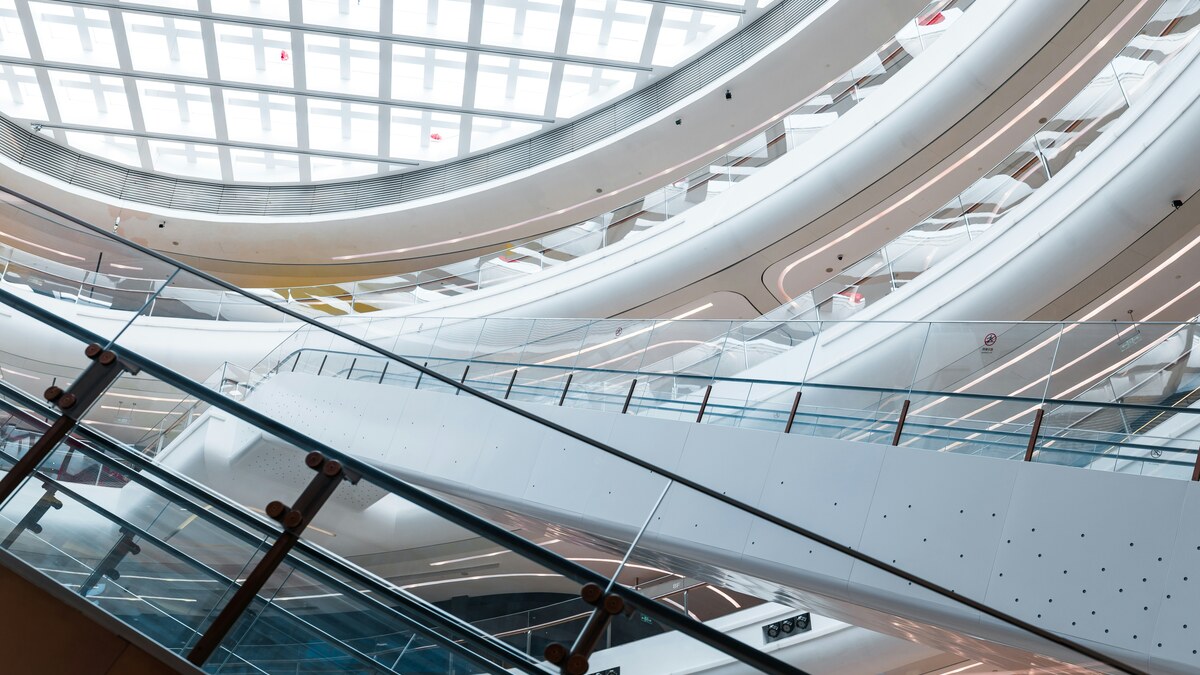
Image: Modern escalator and atrium in a shopping mall, Pudong, Shanghai. Declan Sun / Unsplash · Unsplash License. Cropped to 16:9; no generative alterations.
I did not start with a mall.
I started with old or haunted hotels, ships, anonymous Travelodge-like corridors and skyscrapers. Stairs and lifts mattered. Places that seemed separate could turn out to be connected. Sometimes I was trapped there with other people.
The architecture changed, yet it carried the peculiar certainty of somewhere revisited. Inside the dream, I did not feel as if my mind had improvised another corridor. I felt as if I had gone back.
Then I found people online describing enormous, recurring dream environments: malls joined to hotels, airports, schools, water parks, transport systems, bathrooms, hidden rooms and floors that should not fit inside the building. They had a name for the loose collection of places: Mall World.
That recognition is unnerving. It also creates a temptingly simple question: are people visiting the same place?
So I looked for the maps.
Evidence status
Recurrent dreams occur. Dream reports commonly contain visual-spatial environments, including indoor public places. Spatial learning and recent experience can enter dreams. Mall-like accounts predate the current large community.
Shared architectural templates, self-selection, category expansion, community vocabulary and reconstructive memory could make separate dream reports look more alike in retrospect. This full explanation has not been tested directly in Mall World participants.
Whether one dreamer’s recurring world preserves stable topology; whether separate dreamers’ maps match above base rates; and how community exposure changes later reports.
The reports did not begin with the latest subreddit
The first useful surprise was that these descriptions are not merely copies of a recent viral post.
In February 2016, before the current Mall World community existed, someone on r/Dreams described an “infinite shopping center.” In August 2017, an early r/mallworld page grouped a labyrinthine mall with a university campus and a highway world. The post said that some details had been copied from an older forum thread, so it is not a clean origin point, but it is a traceable early example of people trying to compare recurring dream locations.
Other reports followed: a recurring imaginary mall in 2019; an “infinite hotel” in 2020. The larger r/TheMallWorld community was created in September 2021 and explicitly describes itself as a place for “shared dream spaces.”
That sounds like evidence that the pattern existed before people had one dominant community in which to learn it. It is—but only for the motifs. It does not tell us that the dreamers were reporting the same geography.
The category also became very broad. A clarification in the 2021 community said Mall World dreams did not have to contain a mall; it could mean any dream that felt more realistic or emotionally powerful than ordinary dreaming or even waking life. In practice, members discuss airports, hotels, schools, hospitals, roads, tunnels, bathrooms, oceans and other connected or liminal places.
That inclusiveness is understandable. It is also a measurement problem. The more different settings the label can absorb, the easier it becomes for a new dreamer to recognise something familiar inside it.
Malls really do recur in dream reports
There is a genuine pattern underneath the internet mythology.
A 2025 analysis of 44,213 reports posted to r/Dreams identified 217 topics arranged into 22 broader themes. Indoor locations formed one prominent theme, and malls appeared within it. Recurrent-dream research also finds repeated settings and problems, although the best-studied recurrent dreams tend to involve threat, failure, helplessness or being chased rather than one universal building.
The Reddit analysis cannot tell us how common malls are in everybody’s dreams; people choose which dreams to post, and unusual ones are likely to be overrepresented. But it does establish that mall-like interiors are not an invention of one tiny group.
Dreams are also intensely spatial. A 2026 prospective study followed 207 adults for 15 days and collected 1,687 dream reports. The reports were strongly perceptual and visual-spatial, and their content varied with stable personal traits as well as recent experiences.
Laboratory work adds another piece. In a 2010 experiment, people learned a virtual maze and then either napped or stayed awake. Dreaming about the task was associated with greater improvement when participants tried the maze again. A later overnight study found the same basic association. These experiments do not show that dreams preserve a navigable replica of a place, much less that two people enter the same one. They show something narrower and still interesting: spatial learning can be incorporated into dreams.
So the sleeping brain has all the raw material it needs—visual scenes, learned routes, familiar building types, personal concerns and recent experiences—to construct somewhere that feels coherent.
That sounds like the answer. It is not quite.
A recurring theme is not a recurring place
Online conversations tend to slide between four different claims:
- the same kind of setting appears repeatedly;
- one dreamer experiences a place as familiar across several dreams;
- the layout of that personal place remains stable enough to map;
- different dreamers independently report the same map.
Each claim is stronger than the one before it. Evidence for the first does not establish the fourth.
Imagine two people say they dream of a multi-level mall with an escalator, a food court, a hotel and a flooded lower floor. The resemblance feels specific. But those are still objects and themes. A shared map would require relationships: the hotel entrance is behind the third escalator; the flooded level can be reached only through a service corridor; the cinema sits above the same atrium; taking a particular lift produces the same impossible transition.
In other words, the useful comparison is not a list of nouns. It is topology—what connects to what, in what order, by which route.
The closest research project I found was a 2015 paper called Toward Dream Cartography. It proposed a method for recording and visualising dream places and produced proof-of-concept maps. That is a valuable start. It did not demonstrate that one person’s dream layout remains stable for months, or that maps from separate dreamers match.
In the literature I could locate, there was no prospective, pre-exposure test of cross-person Mall World maps. That is a search result, not proof that no relevant study exists anywhere. But it leaves the central online claim without the measurement it most needs.
The community changes the evidence
This is where the neat version starts to fold in on itself.
By the time someone joins a Mall World discussion, they have seen at least one shared description; many posts explicitly begin with a moment of recognition. That creates at least three filters. People with the strongest apparent matches are most likely to join. A broad label allows many partly matching experiences to fit. And once inside, members can acquire a shared vocabulary for details they may previously have described differently—or not noticed at all.
None of that means people are lying. It means the reports are no longer independent.
Dream recall makes the problem sharper. Remembering can change a memory, and remembering a dream is not the same as replaying a recording. In a small 2015 laboratory study, researchers were able to induce false dream memories in 15% of 26 people who completed the experiment. In that particular design, the authors estimated that 3% to 7% of long-term dream reports were likely to be naturally occurring false memories.
That study was small. It did not investigate Reddit, recurring dream worlds or mass suggestion, and it does not justify dismissing Mall World accounts as invented. What it does show is that later information can alter the very evidence people use to argue that their earlier dreams matched.
The community is therefore two things at once: the phenomenon we want to understand and a possible source of contamination. By the time dreamers compare notes, the cleanest version of the evidence may already be gone.
The experiment Mall World actually needs
A serious test would begin before participants read a list of Mall World features.
Researchers would recruit people who report recurrent dream places, record their prior exposure to the online communities, and collect timestamped morning voice reports and maps for months. The scoring rules would be registered in advance. A “match” could not merely mean that two people drew escalators, hotels or water. It would have to include spatial relationships, landmark order, routes and repeated impossible transitions.
Blind raters could then compare three things:
- how stable each person’s own map is over time;
- how much different people’s maps overlap;
- how often equally impressive matches appear when reports are paired at random.
An independent dream corpus would supply base rates for common settings. A held-out group would test whether the result replicates. Only after the baseline period would some participants be shown community descriptions, allowing researchers to measure whether exposure changes their vocabulary, detail or sense of continuity.
The possible outcomes are more interesting than a simple real-or-fake verdict.
If an individual’s routes remain stable but do not match anyone else’s, that would support persistent personal dream geography. If the maps drift while the feeling of familiarity survives, the brain may be rebuilding a place rather than retrieving a fixed plan. If vocabulary converges after exposure, the community is helping construct the apparent world. And if independently recorded maps match above carefully measured base rates, then the shared-map claim would finally have evidence proportionate to how strange it is.
At present, we do not know which of those is true.
The stranger truth underneath the shared-world story
The literal version of Mall World is unsupported. No verified evidence shows separate dreamers travelling through one external place, and recurring malls are not evidence of a covert programme, psychic experiment or CIA connection.
But stripping away that claim does not make the phenomenon boring. It reveals a better one.
Human beings can experience a powerful sense of returning to somewhere whose geometry has never been checked. The sleeping brain can bring spatial learning into a dream, reuse personal themes and familiar architectural templates, and produce a world that feels larger than the scene immediately in view. Later, memory and community may help turn several visits into one continuous story.
The compelling part may not be that thousands of people share a secret mall. It may be that a brain can create place recognition without a verified place.
That leaves a question more useful than “Is Mall World real?”
What happens when people map their dream worlds before they ever find one another?
Sources & further reading
- Das et al. (2025), “Dream content discovery from social media using natural language processing”, EPJ Data Science.
- Elce et al. (2026), “Individual traits and experiences predict the content of dreams”, Communications Psychology.
- Wamsley et al. (2010), “Dreaming of a learning task is associated with enhanced sleep-dependent memory consolidation”, Current Biology.
- Wamsley and Stickgold (2019), replication in an overnight sleep study, Journal of Sleep Research.
- Beaulieu-Prévost and Zadra (2015), “When people remember dreams they never experienced”, Dreaming.
- Iosifescu Enescu, Montangero and Hurni (2015), “Toward Dream Cartography”, Cartographica.
- Schredl, Germann and Rauthmann (2022), “Recurrent Dream Themes”, Dreaming.
- r/Dreams, “Weird dream about an infinite shopping center” (2016). Community provenance only.
- r/mallworld, “Common locations” (2017). Community provenance only.