Read carefully.
Follow the sources.
Change the conclusion when the evidence changes.
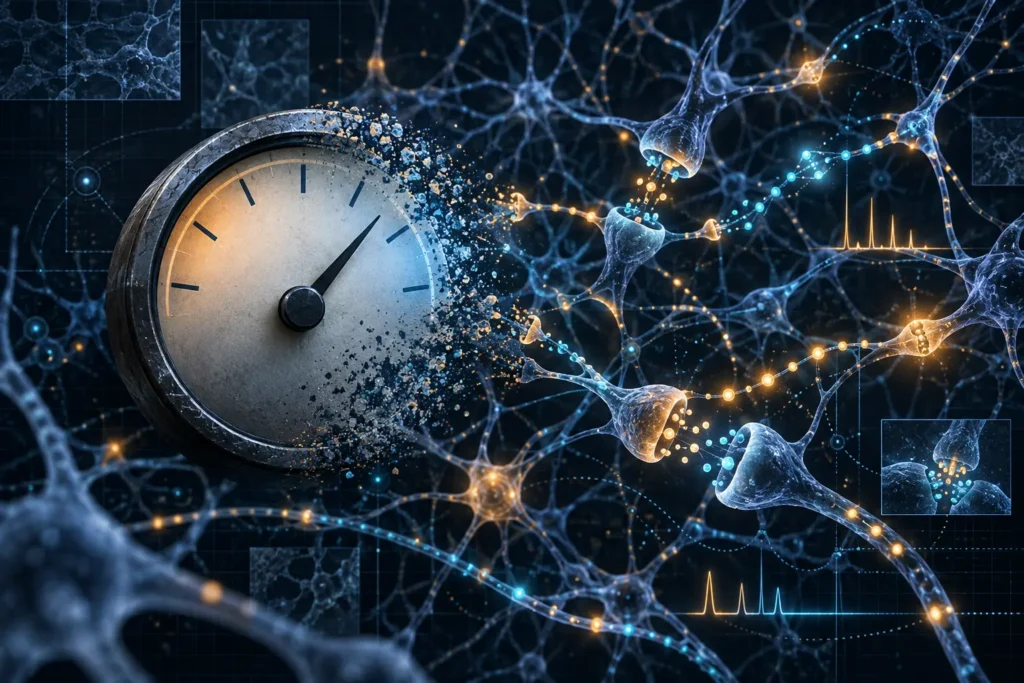
Feature image: original editorial illustration created for So I Looked It Up using OpenAI image generation, 2 September 2026. No third-party source image was incorporated.
You walk into a room and something feels wrong.
Nothing dramatic has happened. One person is speaking a little too brightly. Another has stopped looking at them. A chair has been moved. You cannot yet explain the signal, but your attention has already tightened around it.
That experience is often called intuition: arriving at a judgment before the reasoning that produced it becomes available.
The flattering explanation is that the brain has detected a pattern too complex for conscious thought. The dismissive explanation is that a feeling appeared and the mind invented a story for it afterwards.
Both happen.
So the useful question is not “should I trust my gut?” It is: what trained this feeling, and was the world stable enough to teach it anything true?
Evidence status
People can learn statistical regularities without being able to describe the rule fully. In domains with repeatable patterns and good feedback, experts can make rapid judgments from cues that novices do not use effectively.
Some intuitions are compressed summaries: learned predictions, remembered situations, emotion and bodily state combined into a feeling of fit, unease or direction before the underlying evidence can be verbalised.
There is no single established neural signature of intuition, and the feeling itself does not reveal whether it came from calibrated expertise, an irrelevant association, anxiety, prejudice or noise.
“Intuition” describes an arrival, not a mechanism
Researchers use intuition for several related things: a fast judgment, a decision made without deliberate analysis, a feeling whose reasons are inaccessible, or emotionally charged information influencing a choice.
Those are not identical.
A radiologist’s half-second impression of a mammogram, a chess player seeing that a position is dangerous, a new manager disliking a candidate after a handshake and a person suddenly deciding not to walk down a street can all feel immediate. They need not have the same cause or the same accuracy.
That is the first correction to “intuition is pattern recognition.” Pattern recognition is one strong candidate mechanism. It is not an authenticity stamp attached to every hunch.
The brain can recognise real structure quickly. It can also recognise a pattern that is irrelevant, obsolete, stereotyped or not there.
The brain learns regularities you cannot recite
One of the cleanest demonstrations comes from babies who are not in a position to explain a learning strategy.
In a landmark 1996 experiment, eight-month-old infants listened to two minutes of continuous artificial speech. The only reliable clues to word boundaries were the probabilities with which syllables followed one another. Afterwards, the babies distinguished the more word-like sequences from less familiar combinations.
The experiment did not show infants consciously calculating probabilities. It showed that brief exposure to patterned input changed what sounded familiar.
Related work on implicit and statistical learning finds that people can become sensitive to sequences, visual arrangements and grammatical structures while struggling to state the rule guiding their performance. The knowledge may appear first as easier processing, familiarity, faster responses or a sense that one option “fits.”
That sounds like the answer. It is not quite.
Proving that knowledge is genuinely unconscious is difficult. If a participant cannot explain a pattern after one broad question, the knowledge may still be conscious but fragmentary, low-confidence or hard to verbalise. In 2024, Holly Jenkins and colleagues published three experiments designed to measure artificial-grammar learning through response times rather than reflective judgments. They found little evidence of the expected learning in any experiment.
That does not erase the wider statistical-learning literature. It exposes a measurement problem inside it: different tasks may capture different mixtures of attention, explicit knowledge and genuinely implicit sensitivity. “I cannot explain it” is evidence about access to reasoning; it is not a brain scan proving that no conscious knowledge exists.
Experts really can see a useful “gist”
Medical images supply a striking case because researchers can show experts an image briefly, demand a judgment and compare it with a known outcome.
In studies of mammography, radiologists have classified images as normal or abnormal at above-chance levels after a glimpse lasting about half a second. In one experiment, they could not reliably point to the tumour location afterwards. The signal appeared to come from a global quality of the image rather than the lucky detection of one visible lesion.
A 2018 study went further. Twenty-three radiologists viewed mammograms from women who had been reported as normal but were diagnosed with breast cancer at a later screening. After 500 milliseconds, the group could distinguish some of those earlier images from controls at above-chance levels—even where no localisable lesion was yet visible. Twenty of the 23 showed some ability, but performance varied substantially.
This is excellent evidence that expert perception can extract information before full inspection and explanation.
It is not evidence that the first impression should replace inspection. Above chance still contains misses and false alarms. A faint global signal can tell an expert where to allocate attention without telling them what the final diagnosis is.
The intuition is useful because it was trained on thousands of relevant examples inside a domain that contains recurring visual structure. The feeling alone is not the evidence; its performance history is.
Expertise needs a world that can be learned
Daniel Kahneman spent decades documenting the errors in fast judgment. Gary Klein studied firefighters, nurses and other professionals whose rapid decisions can be remarkably effective. In 2009, they published an adversarial collaboration asking where the two accounts genuinely disagreed.
Their answer remains the most useful test of intuition.
Reliable intuitive expertise requires two things:
- an environment with sufficiently regular, predictable cues; and
- enough practice with feedback to learn those regularities.
A chess position is highly structured. Moves produce visible consequences, games end, errors are analysed and similar configurations recur. A firefighter repeatedly encounters how heat, smoke, sound and building behaviour combine, and often learns quickly when a judgment was wrong.
Now compare long-range economic forecasting, hiring by “culture fit” or predicting whether an unfamiliar person can be trusted. Outcomes are delayed, noisy and shaped by many hidden variables. Feedback may never arrive, or it may be interpreted to protect the original belief. Experience accumulates, but calibration does not.
The crucial distinction is not expert versus ordinary person. It is learnable environment versus confidence-generating environment.
A gut feeling is not necessarily information from the gut
Intuition often arrives in the body: a tightening chest, nausea, warmth, stillness or a sudden urge to move.
The technical term interoception covers the sensing and integration of internal bodily signals—from the heart, lungs, gastrointestinal tract, temperature and other systems. Those signals can contribute to decisions. In a 2016 laboratory study, subliminal emotional images altered participants’ accuracy, confidence and speed during a conscious motion-discrimination task when the emotional information was predictively arranged.
That is evidence that nonconscious emotional information can bias a decision process and, in that task, improve it.
It does not make bodily intensity a general accuracy meter. A racing heart can accompany danger, anticipation, exertion, trauma, caffeine or an anxious prediction. The body reports a state. The brain still has to infer what produced it.
The popular phrase “your body knows before your mind” can therefore be technically true and badly misleading. Processing may influence behaviour before a person can explain it. But the information can be partial, misattributed or irrelevant to the choice.
The famous gambling experiment became less mysterious
The Iowa Gambling Task helped popularise the idea that the body can guide a good choice before conscious knowledge develops.
Participants choose cards from decks with different reward and penalty patterns. Early work reported that anticipatory skin-conductance responses and advantageous choices emerged before participants could state which decks were better. This was presented as support for nonconscious “somatic markers.”
In 2004, Tiago Maia and James McClelland used more sensitive questions. Participants revealed much more reportable knowledge than the original interviews had detected. When people behaved advantageously, their answers usually contained enough quantitative knowledge about the decks to support that behaviour.
The re-examination did not prove that bodily signals are irrelevant. It broke the neat chronology in which the body knew while the conscious mind knew nothing.
This is a recurring problem in intuition research. Knowledge can exist in pieces: “that option has punished me more,” “I cannot give you the rule,” “this feels familiar,” “I would avoid that one.” Where researchers draw the boundary between conscious and unconscious depends partly on how they ask.
Confidence cannot tell skill from bias
A well-calibrated intuition and a cognitive bias can share the same phenomenology: fast, coherent and obvious.
A 2016 meta-analysis combined 89 samples and 17,704 participants. Preference for reflective thinking had a small positive association with normatively correct performance. Preference for intuitive thinking had a small negative association overall. Both effects changed with the task, and each style performed better where the task matched its strengths.
That is not a victory for endless analysis. Deliberation can rationalise a bad first impression, overweight irrelevant detail or fail under time pressure. It means there is no general law that people who “trust intuition” make better decisions.
Formal rules also expose a boundary. A meta-analysis comparing unaided clinical judgment with mechanical or statistical prediction found that formulas were, on average, about 10% more accurate across health and behavioural decisions. Clinicians were often as good, but were substantially better in only a small minority of comparisons.
Human expertise can discover which variables matter. Once the same variables and weights recur, a simple rule can apply them more consistently than a person who is tired, distracted or impressed by one vivid detail.
Intuition is a signal-detection problem
Imagine intuition as a smoke detector rather than an oracle.
A detector has to distinguish signal from noise. It can produce four outcomes:
- a hit: the uneasy feeling tracks a real problem;
- a miss: no alarm despite a real problem;
- a false alarm: a strong warning when nothing relevant is wrong;
- a correct rejection: no alarm and no problem.
People usually remember the hit. It becomes the story about the time they “just knew.” Correct rejections are invisible. Misses may never be recognised. False alarms are easily reframed as “better safe than sorry.”
The same accounting problem appears in how extraordinary claims mutate online: memorable hits travel; quiet misses and corrections do not.
Signal detection theory separates sensitivity—how well someone discriminates two states—from criterion—how readily they say the signal is present. Anxiety may lower the criterion, creating more alarms without improving sensitivity. Expertise may improve sensitivity, but an expert can still choose a cautious or liberal threshold depending on the cost of a miss.
That distinction changes the practical question. Feeling more intuitions does not necessarily mean detecting more truth. It may mean sounding the alarm more often.
When should you listen to intuition?
Do not ask how powerful the feeling is. Audit its training conditions.
Take it seriously as a signal when:
- the situation belongs to a domain you have encountered repeatedly;
- the environment contains stable cues rather than constantly changing rules;
- outcomes arrive quickly enough for mistakes to become visible;
- feedback is specific and difficult to reinterpret;
- you have counted failures as well as memorable successes;
- the intuition can trigger checking without being treated as the verdict.
Slow down or seek external structure when:
- the event is rare or unprecedented;
- the outcome is distant, ambiguous or never observed;
- incentives reward confidence more than accuracy;
- the judgment concerns another person’s character from thin evidence;
- fatigue, fear, excitement or desire strongly favours one answer;
- base rates and simple formulas are available;
- the cost of a false alarm or miss is high.
The best use of intuition is often not “obey it” or “ignore it.” It is let the hunch choose where analysis looks next.
A radiologist’s gist prompts a careful search. A mechanic’s sense that an engine sounds wrong leads to measurement. A social unease can justify creating distance while leaving the explanation open. The initial signal can matter without earning the final story.
Can intuition be calibrated?
Yes—if it makes predictions precise enough to fail.
Record the judgment before the outcome. State what you expect, by when, and with what confidence. Record misses and false alarms, not only striking hits. Compare performance with the base rate: correctly predicting rain on most winter days in Norfolk may say more about the climate than the forecaster.
Then split the question:
- Discrimination: did the feeling separate cases better than chance or a simple rule?
- Calibration: when confidence was 70%, was the outcome right about 70% of the time?
- Usefulness: did acting on it improve the decision after costs and false alarms were counted?
This is related to the information gap that makes uncertainty itch. The urge to resolve a gap is motivational information. It is not necessarily evidence about the answer.
It also avoids the leap examined in why a plausible mechanism does not prove the bigger claim. A brain capable of implicit learning makes accurate intuition possible. It does not prove that this intuition is accurate.
The strange truth that survives
Intuition is not fake. It is not one thing either.
Sometimes it is expertise compressed so efficiently that only the conclusion enters awareness. Sometimes it is emotion adding weak but useful information. Sometimes it is a decision threshold shifted by fear, desire or recent experience. Sometimes it is a pattern detector doing what pattern detectors inevitably do in noise: finding a shape.
A 2025 theoretical paper proposed that intuition may operate as a predictive “summary signal,” integrating memory, action possibilities and expected outcomes. That is an interesting framework, not an established neural readout. No brain process has yet been shown to label its own output trained expertise or confident mistake.
That is why the feeling cannot validate itself.
The better question is not whether intuition is pattern recognition in disguise. It is whether the pattern was real, whether the person had a fair chance to learn it, and whether anyone kept score.
Sources & further reading
- Kahneman & Klein (2009): conditions for intuitive expertise
- Saffran, Aslin & Newport (1996): statistical learning by eight-month-old infants
- Jenkins et al. (2024): three null tests of an implicit statistical-learning measure
- Evans et al. (2013): rapid expert detection of abnormal mammograms
- Brennan et al. (2018): cancer-related gist before visible local signs
- Maia & McClelland (2004): re-examining conscious knowledge in the Iowa Gambling Task
- Lufityanto, Donkin & Pearson (2016): nonconscious emotion and perceptual decisions
- Phillips et al. (2016): thinking styles and decision performance meta-analysis
- Grove et al. (2000): clinical versus mechanical prediction meta-analysis
- Maniscalco, Charles & Peters (2025): signal detection and confidence criteria
- Kotler et al. (2025): a theoretical neurodynamic account of intuition