Read carefully.
Follow the sources.
Change the conclusion when the evidence changes.
SCIENCE & STRANGE / TECH & FUTURE / JOE FELZ SATELLITE 05
Electricity can cross an air gap by induction, magnetic resonance, radio waves, microwaves or light. Every version still needs a transmitter, loses energy and obeys an accounting rule that a glowing bulb cannot test.
A light bulb glows with no wire attached. A receiver coil fifty feet away responds when the transmitter is switched on. Tune another coil to the same frequency and a voltage appears.
That is not fake physics. It is wireless power transfer—and versions of it are already inside phones, toothbrushes, implants, access cards and research laboratories.
But somewhere between “the energy crossed the gap” and “electricity can be freely drawn from the environment”, the source quietly disappears from the story.
So I looked for it.
The answer in one sentence
Wireless electricity is a method of transmitting energy, not creating it. A receiver can collect energy without a physical wire, but a transmitter or ambient electromagnetic source supplied that energy first. Resonance can improve the coupling. It cannot make the output exceed the total input.
The Joe Felz and Parker Edmondson branch
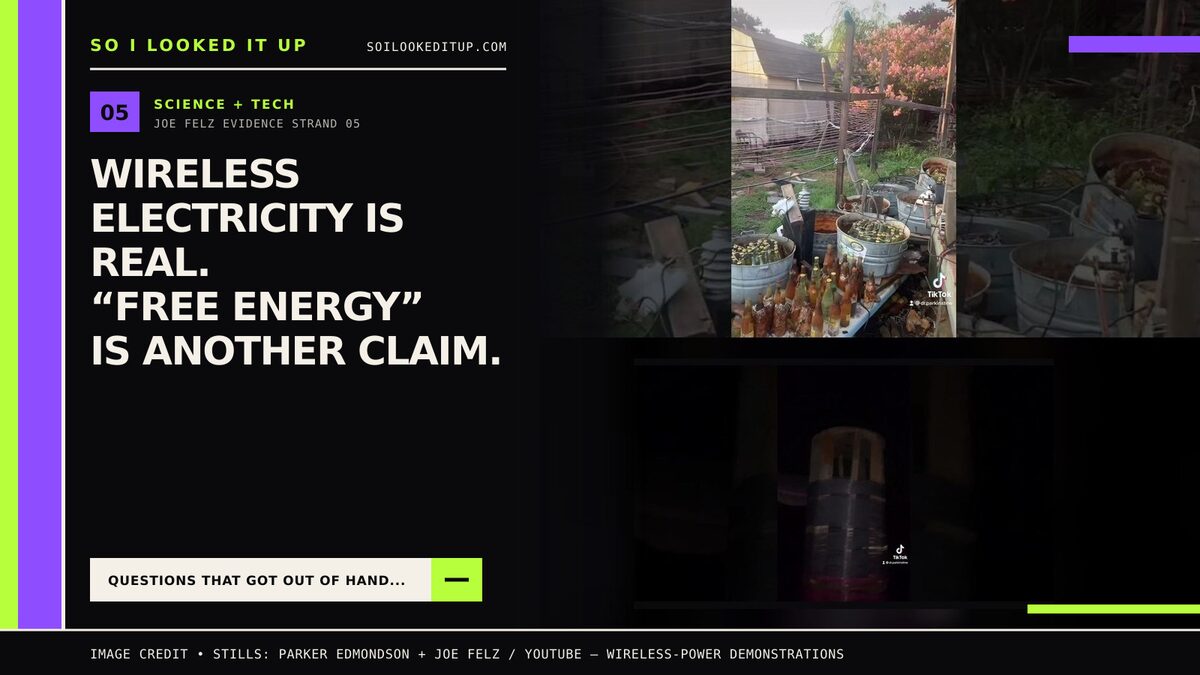
This question emerged during the larger reconstruction of Joe Felz’s energy and ancient-technology research. Joe filmed and promoted experiments associated with Parker Edmondson, whose public demonstrations use resonant high-voltage apparatus and Tesla-style coils.
The recoverable primary record includes Joe videos titled “Transmitting electricity wirelessly”, “Wireless electricity part 2” and “Transmitting electricity wirelessly over 50ft”. An older Parker video, “Wireless electricity”, describes a transmitter tuned around 168 kHz and invites viewers to build a suitably tuned receiving coil. Parker’s channel also contains demonstrations framed as transmission over much greater distances.
These records establish that real apparatus was built and that lamps and coils visibly responded. They do not establish the stronger propositions that useful electrical power travelled fifty feet with measured efficiency, that energy was generated rather than transmitted, or that a receiver hundreds of miles away obtained power from that specific transmitter rather than from a local electromagnetic source.
Attribution confidence is high. Factual confidence depends on the claim: wireless coupling is certain; the performance and source implied by the most expansive captions remain unverified.
There is more than one kind of “wireless electricity”
| Method | How energy crosses the gap | Typical strengths | Main limitation |
|---|---|---|---|
| Inductive coupling | A changing current in one coil creates a magnetic field that induces voltage in another | Efficient at very short range; mature consumer use | Alignment and distance strongly affect coupling |
| Resonant magnetic coupling | Transmitter and receiver resonate at compatible frequencies | Can extend useful near-field range and tolerate some separation | Still loses energy; sensitive to coil quality, tuning, geometry and load |
| Capacitive coupling | Alternating electric fields couple across conductive plates | Thin geometries and specialised systems | Small capacitance, field exposure and alignment constraints |
| Radio/microwave beaming | An antenna radiates electromagnetic waves; a receiving antenna and rectifier convert them | Longer range and directional transfer are possible | Spreading, aiming, conversion efficiency, regulation and safety |
| Optical/laser transfer | Light is aimed at a photovoltaic receiver | Long distance and narrow beams | Line of sight, atmospheric losses, beam safety and conversion losses |
The Qi charger on a desk is the easiest proof. The Wireless Power Consortium explains that alternating current in a transmitter coil creates a magnetic field, inducing voltage in the receiver coil. Its published introduction says coupling is strongest when the coils are closely aligned, similar in size, separated by less than roughly a coil diameter and appropriately shielded.
That is wireless electricity in ordinary commercial form. It also exposes the central trade-off: convenience is not free energy. The charging pad still plugs in, and some input becomes heat rather than battery charge.
What resonance really does
A resonant system stores and exchanges energy between electric and magnetic forms. Push it at the right frequency and successive inputs add coherently, rather like timed pushes on a swing. A high-quality resonator loses relatively little energy per oscillation.
In 2007, André Kurs and colleagues reported in Science that strongly coupled self-resonant coils could transfer power non-radiatively across several times the coils’ physical scale. Their public summary reported 60 watts transferred with about 40% efficiency in one demonstration. Later research has improved robustness and control.
The experiment is important because it demonstrates exactly what the internet often treats as forbidden: useful power can cross open space between tuned resonators. It also reports the number the mythology drops: efficiency. If 60 watts reaches the load at 40% end-to-end efficiency, the source supplied substantially more than 60 watts.
Resonance concentrates the response at selected frequencies and can increase voltage or current at particular points. It does not multiply total energy. A large resonant voltage can coexist with tiny available current. A dramatic spark can contain little energy. A bulb can glow faintly from milliwatts while a transmitter consumes hundreds or thousands of watts.
Why a lit bulb is a weak power measurement
“The bulb lit” answers one question: enough energy reached that particular load to produce visible light. It does not tell us how much, how efficiently or from where.
- Modern LEDs can become visible at very low power.
- Gas-discharge and fluorescent lamps respond dramatically to high-frequency electric fields.
- An unloaded receiving coil can show high voltage that collapses when a useful load is connected.
- Near a high-voltage resonant transmitter, conductors can couple capacitively as well as magnetically.
- A local radio station, induction source, mains field or concealed battery can energise a receiver independently of the claimed transmitter.
- The transmitter’s wall consumption, amplifier losses and tuning network may be outside the shot.
The evidential upgrade is simple: connect a known load, measure real input and real output simultaneously, and publish distance, geometry, frequency, bandwidth and uncertainty.
Voltage, current and reactive power can fool the wrong meter
Alternating-current systems make casual energy accounting especially treacherous. Multiplying a peak or RMS voltage by a current reading does not always give the real power consumed or delivered. If voltage and current are out of phase, part of the apparent power circulates between the source and reactive components instead of doing net work in the load.
High-frequency waveforms can also be non-sinusoidal, spiky and outside a cheap meter’s bandwidth. Probes can alter the resonant circuit they are measuring. Common grounds and oscilloscope connections can accidentally provide a return path. Radio-frequency metrology exists because “put a multimeter on it” is not adequate at 168 kHz, let alone at microwave frequencies.
A proper test distinguishes:
- source power drawn from the wall, battery or generator;
- transmitter power delivered to the resonant network or antenna;
- field power actually radiated or coupled;
- receiver power available before rectification;
- DC or AC load power doing useful work.
Efficiency can be quoted between any two of those points. A receiver that converts 90% of captured RF power may still collect only a tiny fraction of the transmitter’s input. The boundary must travel with the percentage.
Can you harvest electricity that is already in the air?
Yes. A rectenna—an antenna plus a rectifier—can collect energy from radio transmissions. Battery-free tags, sensors and specialised wearable devices use versions of this principle.
But “ambient” does not mean sourceless. Broadcast towers, routers, phones and power lines paid the energy bill. The limiting resource is power density: how much electromagnetic energy crosses the receiver’s collecting area. Peer-reviewed ambient-RF work routinely describes low available levels and designs for ultra-low-power electronics. A 2025 Nature Communications study summarised conventional high-frequency ambient harvesting as commonly producing around nanowatt levels, while demonstrating a specialised body-coupled low-frequency system reaching milliwatts near powered equipment.
That can be technologically useful. It is not a hidden supply for ordinary household loads. If a remote receiver lights a bulb brightly, either a substantial transmitter is coupling to it, a strong local field is present, energy was stored beforehand, or the measurement/story needs another look.
What would a fifty-foot or 918-mile claim need?
The farther the claim, the more important it is to identify the channel. At fifty feet, a large near-field resonator, radiated RF, capacitive coupling or a conductive return through earth and building wiring could each matter. At hundreds of miles, ordinary near-field coil coupling is not a plausible description; the proposed path would have to involve radiated electromagnetic waves, a conducting network, or a local source at the receiver.
- Publish the circuit: transmitter, receiver, grounding, antennas, matching networks and every power source.
- Declare the frequency and bandwidth: then monitor the spectrum at both locations.
- Use coded switching: turn the transmitter on and off according to a concealed random sequence and test whether the receiver follows it.
- Measure input and load output: with calibrated instruments rated for the waveform and frequency.
- Eliminate local sources: batteries, mains pickup, nearby transmitters and test-equipment coupling.
- Vary distance, alignment and frequency: a real transfer mechanism should produce a predicted response curve.
- Repeat blind: the receiving team should not know the transmitter state during collection.
- Address safety and authorisation: U.S. RF-emitting devices are subject to operating and equipment-authorisation rules, including 47 CFR Part 15 where applicable.
Coded on/off trials are particularly powerful. If a remote receiver reproduces a random switching sequence unknown to its operators, at the claimed frequency and with a quantified energy transfer, coincidence and local ambient pickup become much harder explanations. A matching glow captured in two separately edited videos does not achieve that.
“Free energy” contains two different ideas
Joe often used free morally or economically: sunlight is not invoiced, and he wanted people to have access to energy without exploitation. In that sense, rooftop solar can produce electricity with no fuel bill after installation. The equipment, land, storage and maintenance still have costs.
In physics, “free energy” is often heard as energy without a source or output exceeding total input. That is a different claim. Wireless transfer can support the first social ambition while providing no evidence for the second physical proposition.
The same distinction applies to Joe’s water-and-gravity proposal. A clever transmission or storage mechanism may be real and useful. It does not settle where the energy originated.
Evidence status: the Joe/Parker demonstrations
| Proposition | Current assessment |
|---|---|
| Parker built working high-voltage resonant apparatus | Visibly well supported |
| Joe genuinely investigated and filmed it | High attribution confidence |
| Wireless power transfer is scientifically real | Established |
| A receiver responded across an air gap in the demonstrations | Plausible and visually supported; power not fully characterised |
| The public clips establish end-to-end efficiency over fifty feet | No adequate measurement recovered |
| They demonstrate sourceless or over-unity energy | No |
| A specific transmitter powered a receiver 918 miles away | Unverified; requires a controlled coded test and channel analysis |
The conclusion
The striking part of wireless electricity is not that it evades physics. It is how much physics can do while still keeping the books.
Joe was right to treat the apparatus as worth investigating. Coils really can exchange energy without wires; resonance really can extend and sharpen that coupling; distant receivers really can harvest transmitted fields. What the public record does not show is the measurement that turns those facts into the larger “free energy” conclusion.
A bulb is a beautiful detector. It is not an energy balance.
Sources & further reading
- Parker Edmondson — “Wireless electricity” (primary demonstration record)
- Joe Felz — “Transmitting electricity wirelessly” (primary public claim record)
- Joe Felz — “Wireless electricity part 2”
- Joe Felz — “Transmitting electricity wirelessly over 50ft”
- Kurs et al. — Wireless Power Transfer via Strongly Coupled Magnetic Resonances
- Kim et al. — Wide-range robust wireless power transfer using heterogeneously coupled and flippable neutrals
- Wireless Power Consortium — Principle of Inductive Power
- Wireless Power Consortium — Qi Specification Introduction
- Electronic Code of Federal Regulations — 47 CFR Part 15, Radio Frequency Devices
- Li et al. — body dielectric polarisation for ambient electromagnetic harvesting
Related rabbit holes: can a water-and-gravity generator produce more than it uses? · why a plausible mechanism does not prove the bigger claim · how extraordinary claims mutate online