Read carefully.
Follow the sources.
Change the conclusion when the evidence changes.
HISTORY / SIGNAL / NOISE / JOE FELZ SATELLITE 03
A spectacular object can survive without context. The knowledge cannot. Provenance is the chain that connects an artefact to a place, a layer, a discovery, a legal history and the exact specimen that reached the laboratory.
The object is right there in the photograph. You can see the carved face, the strange symbols, the metal glinting through a break. Surely the physical thing is the evidence?
It is evidence that an object existed in front of a camera. That turns out to be much less than evidence of where it came from.
So I looked up the boring word that keeps wrecking the exciting stories: provenance.
The short answer
Provenance is not decorative paperwork added after an artefact has impressed everyone. It is part of the evidence.
For a museum object, provenance usually means its history of discovery, ownership and transfer. Archaeologists also use provenience for the precise three-dimensional find spot and association within a site. In practice, an extraordinary claim needs both:
- Discovery context: where the object was, in which layer or feature, beside what, and under whose controlled observation.
- Custody history: who handled, stored, transported, sold, sampled or altered it from discovery to the present.
- Legal history: whether excavation, possession, transfer and export complied with the relevant heritage law.
- Identity continuity: proof that the thing tested, displayed or X-rayed is the same thing shown coming out of the ground.
Lose those connections and the object may still be beautiful, unusual or even genuinely old. What disappears is the ability to use it confidently as evidence for a particular civilisation, site, date or discovery.
The Joe Felz objects came from more than one story
This question emerged from the larger investigation into Joe Felz’s lost-city and ancient-technology claims. The post-death internet often presents “the Joe Felz artefacts” as one collection from one discovery. The recoverable record does not justify that merger.
At least four provenance streams need to remain separate:
- The Central American garage: Joe said his search for “frequency energy” led to a dusty garage in Central America, where the first clock-like object entered the public story.
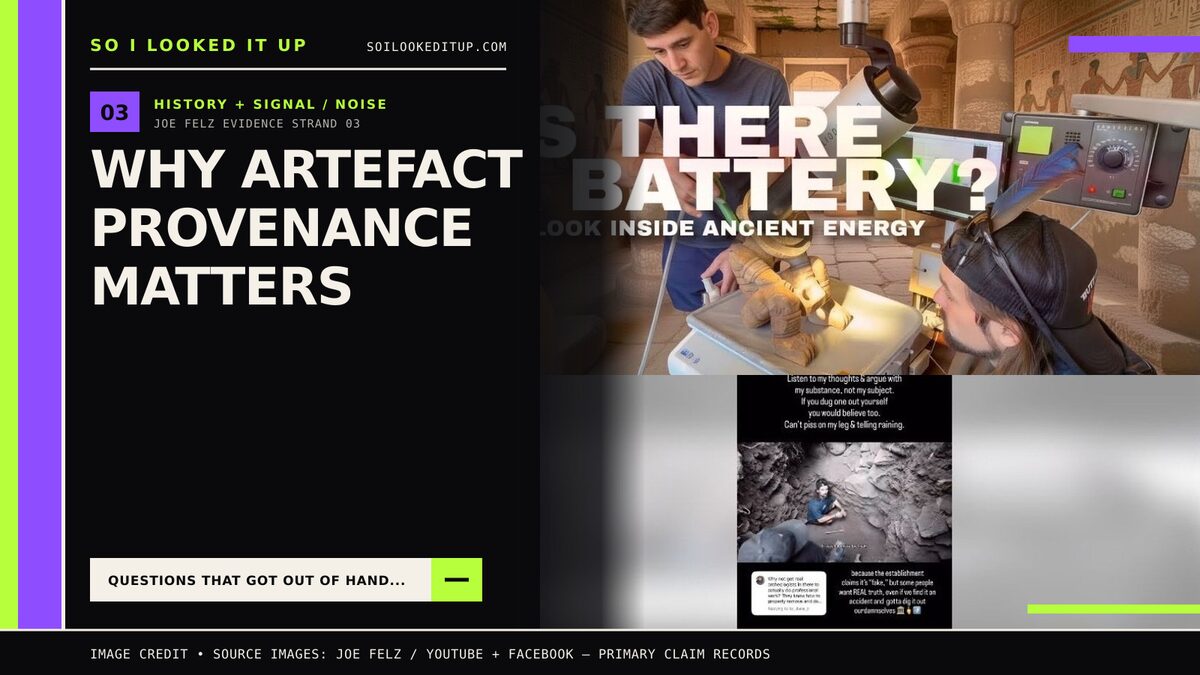
- The excavation material: Joe later posted footage of digging, including a claimed Horus-like figure beneath “12 strata” of laid rock and the developing “lost city” hypothesis.
- The Tula / Arturo Hernández network: later objects and people were associated with Tula in Hidalgo, UFO Webcam and a proposed Museum of the Unknown.
- The glowing and X-rayed objects: physical objects were demonstrated and imaged, but the public record does not securely establish that every one came from the same source, site or excavation.
“Joe handled all of these” is not a provenance chain. It is one person standing at the junction of several chains.
Why the exact find spot matters
An artefact is rarely most informative by itself. Its relationships are the archaeology.
A pot sealed beneath a floor means something different from the same pot in recent topsoil. A carved object inside a documented burial can be related to human remains, offerings and the construction sequence. The same object bought from a dealer arrives without those relationships. It can still be studied as material culture, but the questions it can answer have changed.
Stratigraphy supplies relative order only when the layers retain integrity. Pits can cut through older deposits. Roots, burrowing animals, water, erosion and rebuilding move material. People can deliberately backfill holes. That is why archaeologists record the section, soil changes, interfaces, coordinates, scale, orientation, surrounding finds and the moment of removal—not just the reveal.
The dating companion makes the consequence explicit: a laboratory dates a sample, not a story. If the sample-to-layer-to-object association is weak, a technically correct measurement can support the wrong historical claim.
Why “I dug it up myself” is important—but not enough
Joe repeatedly leaned on personal excavation after viewers questioned whether the objects were replicas. That is rational as far as it goes. Watching something emerge from soil is stronger than accepting a dealer’s unsupported story.
The remaining questions decide how much stronger:
- Who selected the exact place to dig?
- Who controlled the land and access to it?
- Was the location independent of the people supplying the earlier objects?
- Was the ground undisturbed before filming began?
- Does continuous footage show the object in situ, or only the final moments of removal?
- Were the “12 strata” independently identified and recorded?
- Was the excavation authorised and supervised?
- Were field notes, plans, samples and find numbers created at the time?
If an artefact supplier controlled the site, knew the dig location or had prior access, personal digging would not rule out planting. If Joe chose an independent location, recorded an undisturbed context and recovered material under professional supervision, the evidential position would be dramatically stronger. The public material recovered so far does not settle that fork.
A photograph proves less than it feels like
| A photograph can support | A photograph usually cannot establish |
|---|---|
| The object’s visible appearance at a particular moment | Where it was originally found |
| Approximate scale, if a trustworthy scale is present | Whether the soil context was undisturbed |
| Visible damage, markings and surface features | What is inside the object |
| That a particular person possessed or handled it | Who manufactured it or when |
| Sometimes date/location metadata, if an original file survives | Whether metadata is complete, original or sufficient to prove the archaeological claim |
| A basis for comparing later condition | Legal excavation, ownership or export |
A viral image often strips away even the limited information the original held. It is cropped, compressed, mirrored, captioned and re-uploaded. The reverse side disappears. Scale disappears. The filename and metadata disappear. Several objects are placed in a montage and presented as one discovery.
The image becomes more persuasive as the evidence around it becomes less recoverable.
Chain of custody: proving the tested object is the discovered object
Suppose a laboratory report appears tomorrow. Provenance still matters.
A defensible custody record should connect the find to the sample through identifiers that are difficult to swap:
- a unique object or find number;
- images from multiple sides, dimensions, weight and distinctive damage;
- sealed or witnessed packaging where appropriate;
- dated transfer records naming sender and recipient;
- the sampler, sampling location and quantity removed;
- the laboratory’s own intake photographs and code;
- records of conservation, cleaning, repair or coatings;
- the present custodian and storage conditions.
Without that continuity, a result can “float”. The document may be authentic while its relationship to the headline object remains unproven. This is particularly important when several visually similar objects circulate among collectors, collaborators and museums.
A museum name does not automatically authenticate an object
Museums can hold authentic masterpieces, teaching replicas, modern art, disputed objects, study material and items still under investigation. “It is in a museum” tells you where an object is; it does not, by itself, answer what the museum has concluded about it.
The useful records are the accession file, acquisition date, donor or seller, previous owners, excavation or export documentation, scientific reports, catalogue entry and the institution’s own attribution language. Attributed to, possibly, modern reproduction and authenticated are not interchangeable.
The International Council of Museums’ Code of Ethics says due diligence should establish the full history of an item since discovery or production. It advises museums not to acquire objects where there is reasonable cause to believe recovery involved unauthorised or unscientific fieldwork or failure to report the find to the proper authority.
That standard applies directly to the proposed Joe-era custody trail. To link a museum-held object back to a particular object in Joe’s hands, we would need matching identifiers and transfers—not resemblance, a collaborator’s name or a social-media caption.
Provenance is also a legal and ethical question
The legal details depend on the country, object, discovery date and movement across borders, so this is not a legal finding about any particular Joe-linked item. It is the due-diligence problem the claim creates.
Mexico’s current federal heritage framework is administered through the Instituto Nacional de Antropología e Historia. INAH describes archaeological objects as national property held by private custodians through an official registration system, and its public procedures include registration, excavation, transport and export. The Mexican Chamber of Deputies maintains the official amendment history of the Federal Law on Archaeological, Artistic and Historic Monuments and Zones.
The 1970 UNESCO Convention also asks states to supervise excavations, prohibit unauthorised export and use export certificates for covered cultural property. The ethical question is not solved by saying an object was purchased in good faith. ICOM explicitly warns that legal ownership in one country may still be insufficient without the item’s full history.
For any object claimed to be archaeological material from Mexico, the verification list therefore includes INAH registration, excavation authority, lawful custody, export permission where relevant, customs/import records and the receiving institution’s accession file. Their absence would not prove modern manufacture. It would create a serious provenance and legal uncertainty that responsible publication cannot ignore.
Why publishing the exact site can be the wrong kind of transparency
Verification requires precise site information. Publicity does not.
Publishing coordinates, access routes or recognisable landmarks for a vulnerable unprotected site can facilitate looting and destroy the context that would answer the question. The responsible route is to preserve exact coordinates and original metadata, supply them confidentially to the competent heritage authority and qualified researchers, and publish only the level of location detail that does not increase the risk.
That is why this investigation can ask for the site record without posting a treasure map.
The provenance stress test
Before treating any extraordinary artefact as evidence, try to fill every link below.
- Origin: Who first produced or discovered the object?
- Place: What is the secure, non-public site identifier?
- Context: What layer, feature and associations were recorded?
- Authority: Who authorised and supervised recovery?
- Contemporaneous record: Are there continuous files, field notes and original metadata?
- First custody: Who took possession immediately after removal?
- Transfers: Is every handoff dated and documented?
- Alteration: Was the object cleaned, broken, repaired, coated or sampled?
- Testing identity: Can the laboratory specimen be matched to the object?
- Legal movement: Are registration, export and import records present where required?
- Current location: Can an independent specialist inspect the exact object now?
A chain does not have to be perfect to be useful. Archaeology constantly works with incomplete older records. But the confidence of the conclusion must shrink at every unresolved break. An undocumented story cannot be repaired by adding confidence to the caption.
Evidence status: the Joe-linked provenance chains
| Proposition | Current assessment |
|---|---|
| Joe genuinely handled and investigated physical objects | Confirmed |
| He genuinely posted excavation footage | Confirmed activity; context incompletely documented |
| All objects came from one Central American or Tula excavation | Not established; later merger of distinct streams |
| The “clock”, excavated figure, glowing objects and X-rayed objects share one custody chain | Unverified |
| A museum-held object can be traced to a specific Joe-era object | Open; requires accession and transfer records |
| The objects have secure archaeological provenance | Not demonstrated by the recovered public record |
What would materially change this conclusion?
The most valuable evidence is not another close-up. It is the uncut excavation file with metadata; the site and permit record; an object register; the transfer from discoverer to Joe; matching laboratory and X-ray identifiers; INAH registration or other relevant heritage documentation; and the current custodian’s accession file.
If those records exist, they can turn several vague stories into separate testable histories. If they do not, the objects may remain intriguing—but they cannot carry the historical weight being placed on them.
The conclusion
A spectacular photograph concentrates attention on the thing. Provenance restores everything the crop removed: the ground, the layer, the people, the paperwork, the law, the handoffs and the possibility that the story changed on the way.
That is why context can matter more than appearance. The object may survive a broken provenance chain. The claim usually does not.
Sources & further reading
- Joe Felz — Dusty Garage / Frequency-Energy Origin
- Joe Felz — Excavation / Lost-City Post
- Joe Felz — Figure Beneath “12 Strata” Claim
- International Council of Museums — Code of Ethics for Museums
- UNESCO — 1970 Convention on Illicit Import, Export and Transfer of Cultural Property
- Cámara de Diputados — Federal Heritage Law Amendment Record
- INAH — Official Cultural-Heritage Procedures
Related rabbit holes: can an artefact be dated to 45,000 years? · what an X-ray can actually tell you · what lost-city evidence looks like