Read carefully.
Follow the sources.
Change the conclusion when the evidence changes.
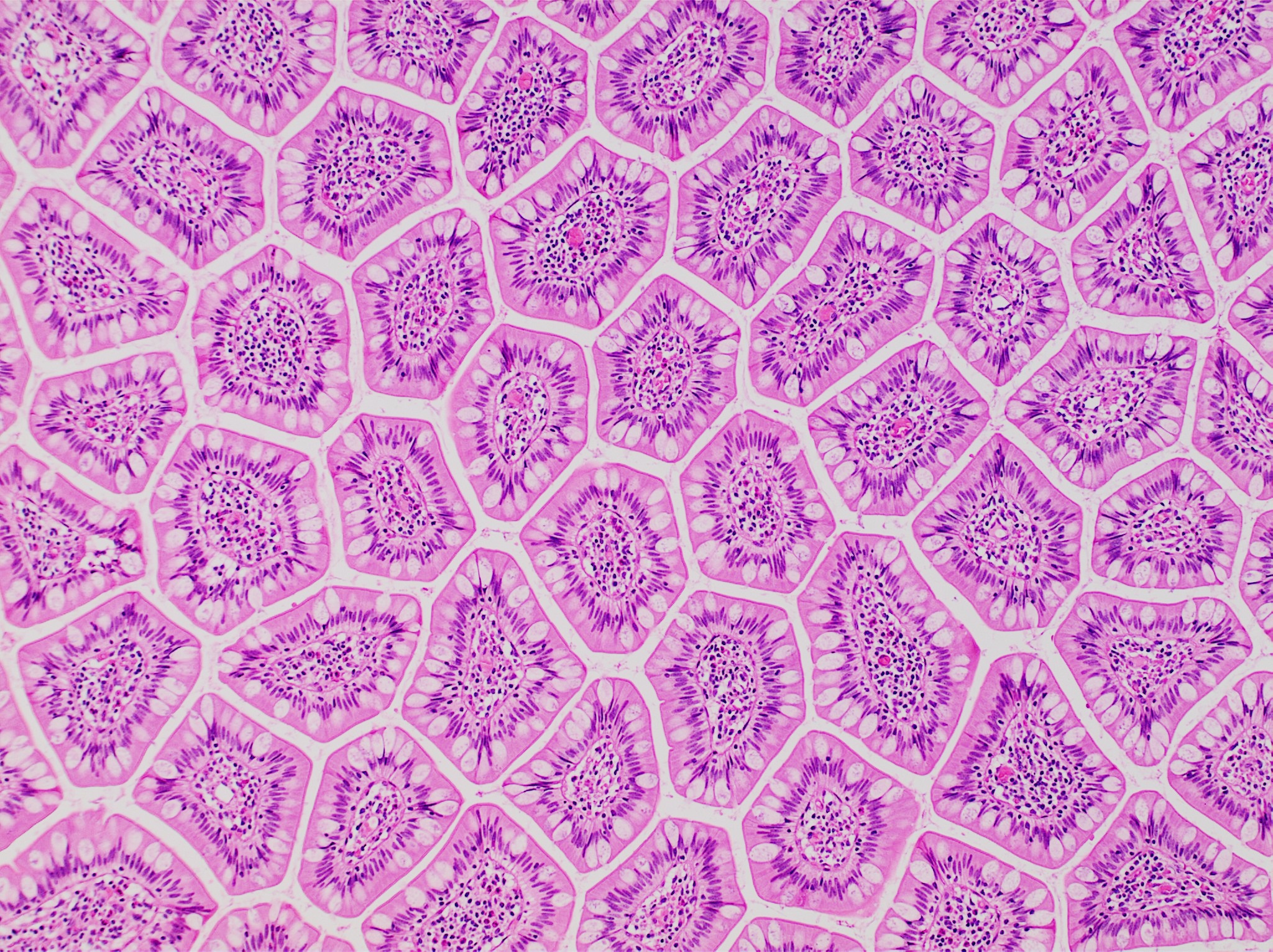
Image: Human terminal-ileum villi, H&E-stained cross-section. Mikael Häggström, M.D. / Wikimedia Commons · CC0 1.0.
The most repeated fact about serotonin is true enough to cause trouble.
Most of the body’s serotonin—often quoted as about 90%, sometimes 95%—is associated with the gut and the rest of the peripheral body. That sounds like a map of where mood comes from. It is not.
The serotonin in your gut does not simply pour into your brain. Under ordinary conditions, serotonin itself does not readily cross the blood–brain barrier. The brain makes a largely separate supply.
That seems to end the gut–brain story. Instead, it reveals the more interesting one: the barrier separates serotonin inventories, but it does not block every message. The gut can turn chemistry into nerve signals, change which raw materials are available, and send immune, endocrine and microbial-metabolite information onwards. What travels is usually not the serotonin molecule people are talking about.
Evidence status
Most peripheral serotonin is made by host enterochromaffin cells, while the brain uses a largely separate synthetic system. Serotonin does not readily cross the intact blood–brain barrier. In the gut and circulation it has important local and systemic jobs.
Gut changes can influence brain function through sensory nerves, immune and endocrine signalling, microbial metabolites and movable precursors such as tryptophan. The component routes are real, but their contribution to a particular human mental-health outcome is often uncertain.
Which microbiome interventions produce durable clinical benefits, who responds and whether peripheral serotonin mediates any benefit. A change in mood after a probiotic would not, by itself, show that brain serotonin was “refilled.”
The percentage counts inventory, not influence
“Ninety percent of serotonin is in the gut” is usually offered as though the largest warehouse must run the company. Biology does not organise authority by tonnage.
The precise percentage varies with what researchers count, which tissues they include and whether they are describing synthesis, tissue content or storage. The useful core is less dramatic: the gastrointestinal tract contains a very large peripheral serotonin system. Specialised host cells called enterochromaffin cells, scattered through the intestinal lining, make much of it.
Some of that serotonin acts close to where it is released. Some reaches the circulation, where platelets take it up and store it. Platelets are couriers and cupboards here, not the main factory.
None of those measurements tells us how much serotonin is available at a synapse in the brain. It is the same molecule in two compartments, doing different work under different controls. This is the same location problem that complicates claims about histamine and the brain: naming the chemical is not enough. You have to say where it is.
Two factories use the same raw material
Gut and brain serotonin start with the amino acid tryptophan, but they rely mainly on different versions of the rate-limiting enzyme that begins the conversion.
Peripheral tissues, especially enterochromaffin cells, principally use tryptophan hydroxylase 1, or TPH1. Serotonergic neurons in the brain principally use TPH2. The discovery of the second isoform helped make sense of an awkward fact: blocking one serotonin system need not affect the other in the same way.
The separation is reinforced by the blood–brain barrier. Circulating serotonin is not a normal delivery supply for the brain. A peripheral drug can even be designed not to cross the barrier and inhibit TPH1-dependent serotonin synthesis while largely sparing central synthesis.
Tryptophan is different. It can cross through a transporter also used by other large neutral amino acids. That means the brain’s access depends not just on how much tryptophan exists, but on competition, metabolism and how much has been diverted into other pathways before reaching the gate. “Eat tryptophan, make happiness” is not a metabolic equation. It is a slogan with several missing denominators.
Gut serotonin already has a job
The popular story treats peripheral serotonin as central serotonin stranded in the wrong place. It is not stranded.
In the gastrointestinal tract, serotonin helps regulate motility, secretion and sensation. It participates in nausea and visceral pain pathways. Beyond the gut, platelet-carried serotonin is involved in haemostasis and vascular responses, and peripheral serotonin interacts with immune, metabolic and other tissue systems.
Those effects are context-dependent. More serotonin is not automatically better, either centrally or peripherally. Different receptors, tissues, concentrations and timings can produce different—and sometimes opposing—effects.
So the large gut supply is not evidence that the gut is secretly manufacturing mood. It is evidence that the digestive and peripheral systems make extensive use of the molecule themselves.
Microbes can tune the factory. They do not own it
A second version of the claim says that gut bacteria make most of your serotonin. That quietly swaps the host cells out of the story.
Two influential 2015 studies found something more precise. Christopher Reigstad and colleagues compared germ-free mice with colonised mice and found that microbiota increased expression of the host’s Tph1 gene, TPH1 protein and colonic serotonin. Short-chain fatty acids—products of microbial fermentation—also increased TPH1 transcription in a human enterochromaffin-cell model.
Jessica Yano and colleagues found that selected spore-forming bacteria from mouse and human microbiota promoted serotonin biosynthesis by the host’s colonic enterochromaffin cells in mice. The resulting peripheral changes affected gut motility and platelet function. Microbial metabolites could reproduce parts of the effect in cell culture and germ-free mice.
That is a genuine host–microbe connection. But look closely at the direction of work: microbes changed the settings; host cells made the famous supply. The experiments concerned peripheral physiology, chiefly in mice and model systems. They did not show bacterial serotonin crossing into a human brain and changing a mood.
A wall is not silence
If gut serotonin cannot enter the brain, how can it be part of gut–brain communication at all?
One answer begins only a few micrometres from where it is released.
In 2017, Nicholas Bellono and colleagues studied enterochromaffin cells using intestinal organoids, single-cell recordings and ex-vivo nerve preparations. These rare cells behaved less like passive storage jars than sensory transducers. They were electrically excitable, detected irritants, microbial metabolites and other chemical cues, released serotonin and modulated nearby serotonin-sensitive primary afferent nerve fibres through synaptic-like contacts.
In other words, a chemical event in the gut can become an electrical message without a serotonin molecule ever needing a passport into the brain.
This is strong direct evidence for a local link. It is not a completed chain to human depression, cognition or personality. The preparation tells us that the first relay exists; it does not tell us how much that relay contributes to a particular experience in a living person.
The traffic that moves is something else
The gut–brain axis is not one pipe. It is a set of overlapping, bidirectional routes.
- Neural relays: gut sensory signals can travel through vagal and spinal pathways, with many processing steps between the intestinal wall and the brain.
- Immune and endocrine signals: inflammation, cytokines, stress hormones and other circulating messengers can alter neural function without carrying serotonin across the barrier.
- Precursors and metabolites: tryptophan can cross the blood–brain barrier, while host and microbes compete to route it through serotonin, kynurenine and indole pathways. Short-chain fatty acids and other microbial products can also affect host cells and signalling systems.
- Brain-to-gut traffic: autonomic output, stress, sleep, behaviour and medicines can change motility, secretion, diet and microbial ecology.
That last route matters whenever a study finds a microbiome difference in people with depression or anxiety. The difference might contribute to symptoms. It might result from symptoms, diet, stress or treatment. Both directions may operate together. A stool sample taken once cannot sort them out.
The phrase “gut–brain axis” is therefore accurate but dangerously roomy. It names a communication system; it does not identify which message travelled, in which direction, or whether the effect was large enough to matter.
Do probiotics improve mood?
Human intervention trials are the point where an attractive mechanism has to become a useful outcome.
A 2025 systematic review found 23 randomised controlled trials involving 1,401 patients in clinically diagnosed samples. In pooled analyses, probiotic interventions reduced depression and anxiety symptom scores compared with controls. Prebiotics did not produce a statistically significant pooled reduction in depression.
That sounds like the answer. It is not quite.
Heterogeneity was high. Trials used different organisms, combinations, formulations, treatment lengths, diagnoses and background therapies. Duration and formulation helped explain why effects varied. Most evidence concerned short treatment periods. A pooled “probiotic” effect cannot tell you that the next product on a supermarket shelf contains the relevant strain, dose or even the same kind of intervention.
Nor does an improvement reveal the mechanism. A probiotic might alter microbial metabolites, inflammation, gastrointestinal symptoms, sleep, expectations or several pathways at once. The trial does not become a serotonin experiment merely because serotonin makes a good headline.
The most responsible reading is that defined microbiome interventions are a plausible and actively studied adjunct in some clinical settings—not that a generic probiotic balances brain serotonin or replaces established care.
Blood serotonin is not a brain gauge
The compartment problem returns whenever a blood test is offered as a window into “your serotonin level.”
Most serotonin in blood is handled by platelets. Results can change depending on whether a study measures serum, whole blood, platelet-rich plasma or genuinely platelet-poor plasma. A systematic review of platelet-poor plasma methods found striking discrepancies and concluded that many reported values were erroneously high.
Even a perfectly measured peripheral value would still belong to the peripheral system. A 2023 review of peripheral serotonin in depression found no consistent relationship adequate for diagnosis or treatment monitoring. Blood cannot be treated as a convenient sample of a brain compartment it does not share.
That does not make peripheral serotonin unimportant. It makes the question more specific. A useful biomarker must predict a defined outcome in a defined population using a validated method; it cannot borrow significance from a different organ.
The gut–brain connection is a translation network
So, does the gut make most of your serotonin? Broadly, yes: host cells in the gut make most of the large peripheral supply, although the viral percentage is more approximate than it sounds.
Does that serotonin fill the brain, set a simple mood level or explain why probiotics sometimes change symptom scores? No.
The stranger truth survives both the hype and the debunking. Gut serotonin does not need to cross into the brain to participate in communication. An enterochromaffin cell can sense chemistry and turn it into nerve activity. Microbes can tune the host factory. Tryptophan and other metabolites can move where serotonin cannot. Immune, endocrine and neural signals can carry context across compartments—and the brain sends instructions back.
The famous percentage tells us where a lot of one molecule is. The useful investigation starts when we stop asking it to explain everything else.
When someone says the gut changed the brain, ask: which signal, travelling by which route, changed what—and in whom?
This article is general information, not medical advice. Do not replace prescribed treatment with a supplement without discussing it with a qualified clinician.
Sources & further reading
- Jones et al. (2020): The ever-changing roles of serotonin
- Bader (2020): Two serotonin systems and peripheral synthesis as a drug target
- Walther et al. (2003): Discovery of the second tryptophan hydroxylase isoform
- Mawe & Hoffman (2013): Serotonin signalling and function in the gut
- Reigstad et al. (2015): Microbes, short-chain fatty acids and host colonic serotonin
- Yano et al. (2015): Indigenous bacteria regulate host serotonin biosynthesis
- Bellono et al. (2017): Enterochromaffin cells couple gut chemistry to sensory nerves
- Roth et al. (2021): Tryptophan metabolism and gut–brain homeostasis
- Cryan et al. (2019): The microbiota–gut–brain axis
- Asad et al. (2025): Prebiotics and probiotics for depression and anxiety
- Li et al. (2023): Can peripheral serotonin be a depression biomarker?
- Brand & Anderson (2011): Problems measuring platelet-poor plasma serotonin