Read carefully.
Follow the sources.
Change the conclusion when the evidence changes.
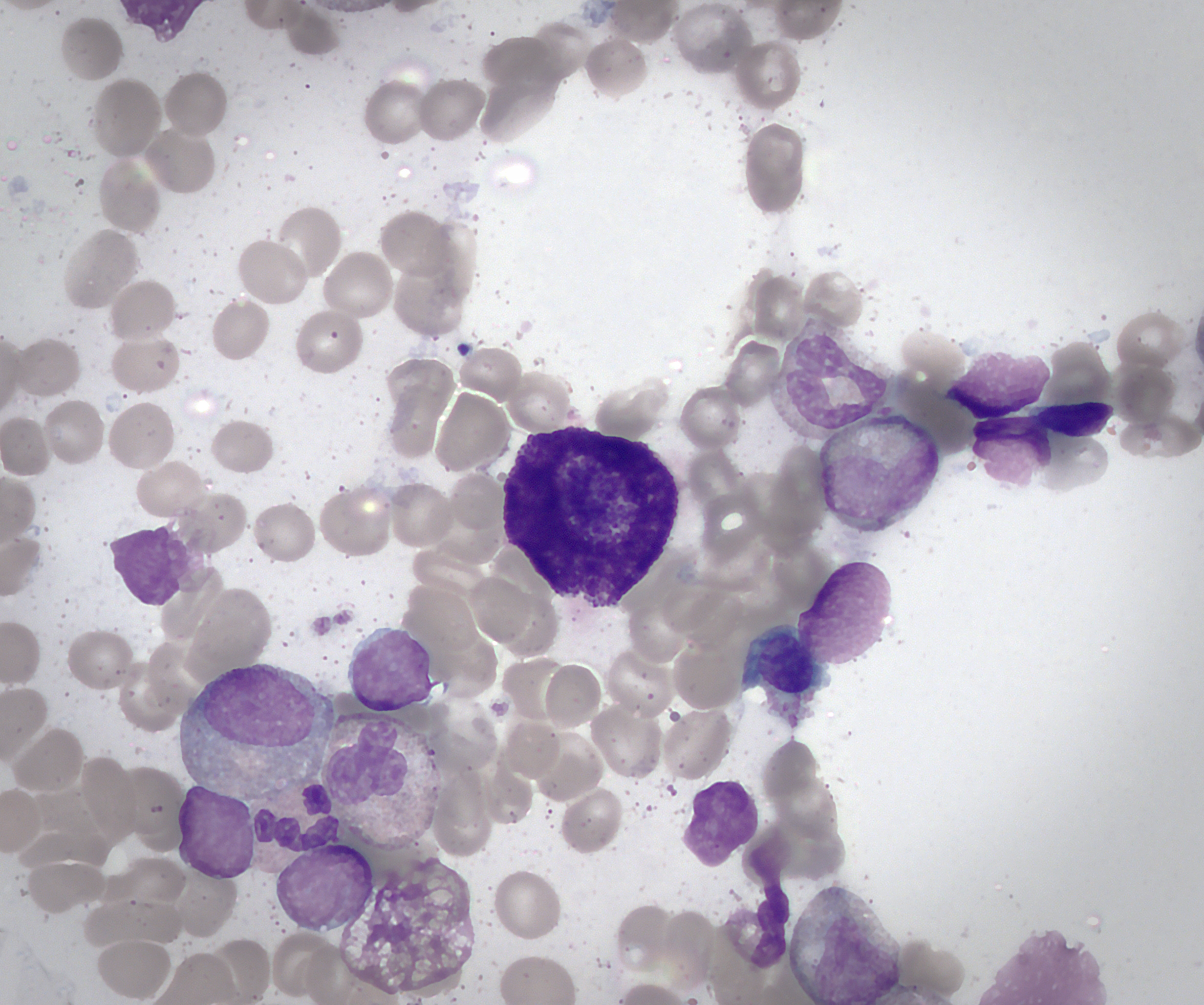
Image: Mast cell among bone-marrow cells. Makysm / Wikimedia Commons · CC0 1.0.
Ask whether histamine causes ADHD and one familiar molecule is suddenly being asked to do several different jobs. Histamine is involved in hives, food reactions and stomach acid. It is also a neurotransmitter that helps the brain regulate wakefulness, attention and behaviour.
That makes the online theory sound almost inevitable: if histamine affects attention, perhaps ADHD is a state of “high histamine”—and perhaps an intolerance test, antihistamine or low-histamine diet can reveal or fix it.
There is a real research trail here. But it does not lead to one body-wide histamine level. It leads in the opposite direction: towards particular receptors, cells, circuits and times in development.
Evidence status
Histamine is a brain neurotransmitter involved in arousal and cognition. Drugs that block brain H1 receptors can cause drowsiness and impair performance.
Specific histamine receptors and neural circuits may contribute to ADHD traits or define useful treatment targets in some people. The strongest newer evidence is still early and heavily preclinical.
Whether histamine dysfunction causes ADHD in any identifiable subgroup, which direction it operates in, and whether a safe receptor-targeted treatment can improve symptoms.
First problem: “histamine” is not one interchangeable pool
The histamine released by immune cells during an allergic reaction and the histamine used by neurons share a chemical identity. They do not share a single open reservoir.
In the adult brain, most neuronal histamine is made from the amino acid histidine by a small group of cells in the hypothalamus called the tuberomammillary nucleus. Their fibres project widely. A normally functioning blood–brain barrier sharply limits the movement of circulating histamine into the brain, while the brain relies mainly on a different enzyme—histamine N-methyltransferase, or HNMT—to clear its own supply.
So a urine histamine result, a skin flare or a reaction after food does not directly measure histamine signalling between neurons. It may be medically relevant on its own terms. It is not a window into the tuberomammillary nucleus.
The receptors also matter. H1 and H2 receptors generally receive histamine signals on target cells. H3 receptors act largely as brakes, regulating the release of histamine and several other neurotransmitters. The same molecule can therefore increase one circuit’s activity, restrain another signal indirectly, or do very little, depending on where and when it lands.
Brain histamine really does affect attention
The everyday pharmacology is hard to miss. Older, first-generation H1 antihistamines cross into the brain and commonly cause sleepiness. Controlled studies and safety reviews have also found reduced vigilance, slower reaction time and impaired learning or performance. Newer agents were designed to have much lower central penetration precisely to reduce those effects.
This establishes that blocking brain histamine can change arousal and attention. It does not establish that ADHD is caused by too much histamine, too little histamine or an allergy. Sedation after a receptor-blocking drug is evidence that the system participates in wakefulness; it is not a diagnostic test for why a neurodevelopmental condition exists.
Still, the mechanism offered a tempting treatment idea. If H3 receptors put a brake on histamine and other transmitters, perhaps blocking H3 could release that brake and improve attention.
The cleanest human test did not work
Two placebo-controlled trials put that idea into people with adult ADHD.
In a 2012 trial involving 430 adults, the H3 antagonist bavisant was not significantly better than placebo on the primary ADHD symptom measure. Atomoxetine and extended-release methylphenidate, included as active comparators, were better than placebo. Higher bavisant doses also caused more adverse effects.
A separate crossover trial of the H3 antagonist MK-0249 reached the same practical answer. Among 72 adults, MK-0249 did not beat placebo, while methylphenidate did. Insomnia was more common on the experimental drug.
Those failures do not prove that histamine is irrelevant to ADHD. A drug can target the wrong receptor, dose, circuit, developmental window or patient subgroup. But they are a useful reality check: a plausible neurotransmitter story was not enough to produce a working treatment when tested in humans.
The newer result is more specific—and mostly in mice
In 2025, researchers reported a narrower mechanism involving H2 receptors in parvalbumin-positive neurons in the substantia nigra pars reticulata, a deep-brain output region involved in controlling behaviour and movement. They found reduced H2-receptor expression in post-mortem brain material from people with ADHD, then used mice to investigate what that change might do.
Removing H2 receptors from that specific mouse-cell population produced hyperactivity, impulsivity and attention-related deficits. Restoring the receptor, changing the circuit’s activity, or delivering an H2-receptor agonist directly into the relevant brain region improved the measured behaviours.
That is strong evidence for a mechanism in the mouse model. It is not a human treatment result. Mouse tasks are proxies for parts of ADHD, not the condition in its full developmental and social complexity. A drug injected into a mouse brain region is also a long way from a safe medicine that reaches the right human cells without altering H2 receptors elsewhere in the brain and body.
The finding nevertheless changes the useful question. “Is histamine high or low?” may be too crude. The biologically meaningful problem could be that one receptor is under-expressed in one inhibitory circuit—even while histamine signalling elsewhere is normal.
A 2026 brain map adds relevance, not causation
A newer study approached the system from above rather than isolating one circuit. Researchers combined human gene-expression atlases, single-cell data, developmental patterns, brain-imaging databases and PET measurements to map histamine signalling across the brain.
They found an uneven system: H1 and H2 receptors were enriched in excitatory neurons, while H3 showed preferential expression in inhibitory neurons. Histamine-related patterns lined up with brain functions including sleep, memory, reward, decision-making and impulsivity. The spatial pattern also overlapped with maps of structural differences reported in several psychiatric conditions, including ADHD.
That overlap is interesting because it gives researchers places and cell types to investigate. It is not evidence that histamine produced those structural differences. The study assembled patterns from multiple existing datasets rather than manipulating histamine in people with ADHD, and the authors explicitly described the results as descriptive and hypothesis-generating. Brain regions can share a map for many reasons, including their cell composition, connectivity or vulnerability to a third process.
What about allergies, food and “histamine intolerance”?
Here the evidence becomes easier to overread.
A 2025 nationwide matched study found urticaria recorded in 5.00% of people with ADHD and 4.22% of controls, an odds ratio of 1.19. That is a real but small association. It cannot tell us whether immune biology contributes to both conditions, itching and poor sleep worsen attention, medication or healthcare contact changes what gets diagnosed, ADHD changes exposure, or some unmeasured factor creates the link.
A much smaller cross-sectional study asked a more direct peripheral question. In 83 children with ADHD or emotional dysregulation, urinary histamine was not associated with inattention, hyperactivity/impulsivity, emotional dysregulation or reported intake of high-histamine foods in the main analyses. One sensitivity comparison found a small inattention difference in the high-urine-histamine group, but not a broad pattern across outcomes. The study had no typically developing comparison group and cannot close the question; it does puncture the idea of an obvious peripheral histamine signature.
There is also a much-cited 2010 reanalysis of a controlled food-additive challenge. Variants in the HNMT gene appeared to moderate behavioural responses to certain additive mixtures in some age and challenge combinations. That is an intriguing gene-by-environment clue. It was not a trial of dietary histamine, did not show that the children had histamine intolerance, and does not establish that removing histamine-rich foods treats ADHD.
“Histamine intolerance” itself has a measurement problem. A multi-society allergy guideline concluded that serum DAO activity is not conclusive, symptoms are non-specific and suspected reactions often fail to reproduce under controlled conditions. There is still no validated biomarker that can turn a collection of symptoms into a reliable diagnosis. That does not mean every food-triggered symptom is imaginary; it means several gastrointestinal, allergic, mast-cell and medication-related explanations can look similar and need proper differential diagnosis.
No controlled clinical evidence currently shows that a low-histamine diet treats core ADHD symptoms. Broad restriction can also make an already limited diet harder to nourish. If food repeatedly triggers flushing, swelling, wheeze, faintness or gastrointestinal symptoms, that deserves individual medical assessment—not an ADHD theory assembled from a DAO number.
The answer is not “no histamine.” It is “which signal, where?”
Histamine belongs in ADHD research. It regulates systems that ADHD affects; two human brain studies now point towards specific spatial and cellular relationships; and one mouse circuit offers a testable mechanism. Calling the entire idea nonsense would throw away the interesting part.
But “ADHD brains have a histamine problem” is still too broad to be useful. The failed H3 trials show that changing the system in a theoretically sensible direction can do nothing for symptoms. The peripheral studies do not support a simple high-histamine signature. Allergy associations cannot establish direction. And the most compelling positive experiment required a particular H2 receptor on a particular cell population in a particular brain region.
The stranger truth is that the same molecule best known for making skin itch also helps organise wakefulness and behaviour—while being divided into biological compartments that online explanations routinely collapse.
The next decisive study is not another survey asking whether people with ADHD feel worse after tomatoes. It is a human study that measures a defined histamine receptor or circuit, before and after a selective intervention, in a well-characterised subgroup—and shows that changing it improves attention without simply sedating or stimulating the participant.
Until then, the strongest answer is precise: brain histamine is part of the attention machinery. ADHD has not been shown to be a body-wide excess of histamine, a DAO deficiency or a condition treatable with a low-histamine diet.
Sources & further reading
- Martins et al. (2026): Mapping histamine pathway networks in the human brain across cognition and psychiatric disorders
- An et al. (2025): H2-receptor deficiency in parvalbumin-positive neurons and ADHD-like behaviours
- Weisler et al. (2012): Placebo-controlled trial of the H3 antagonist bavisant in adult ADHD
- Herring et al. (2012): Placebo-controlled crossover trial of MK-0249 in adult ADHD
- Magen et al. (2025): Urticaria and antihistamine use in people with ADHD
- Bruton et al. (2024): Urinary histamine, diet and ADHD symptoms in children
- Stevenson et al. (2010): HNMT variants and behavioural response to food-additive challenges
- Reese et al. (2021): Guideline on suspected adverse reactions to ingested histamine
- Church et al. (2010): Risks of first-generation H1 antihistamines