Read carefully.
Follow the sources.
Change the conclusion when the evidence changes.
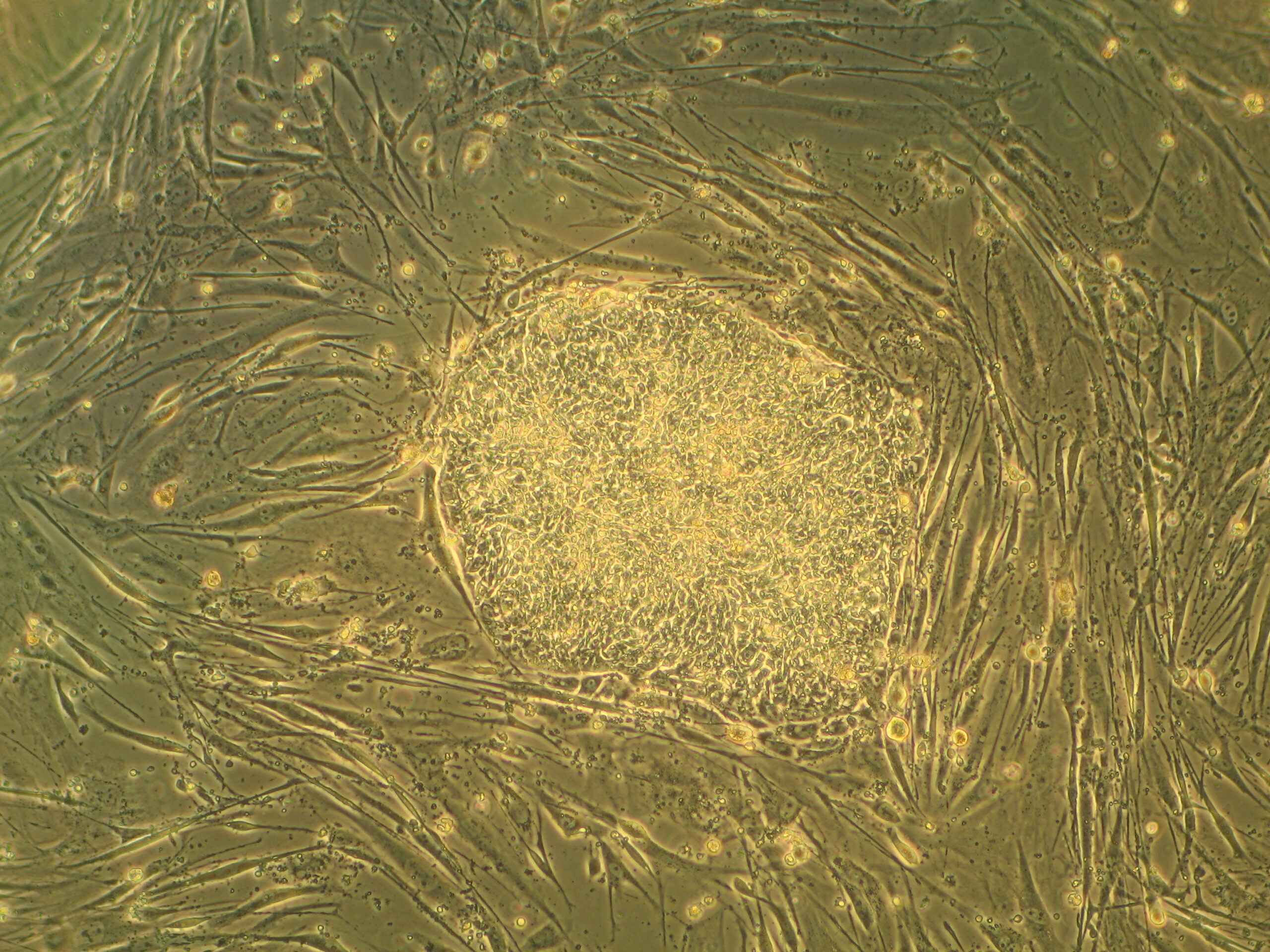
Image: Human embryonic stem-cell colony (H9 line), with mouse fibroblasts in the background. Ryddragyn / Wikimedia Commons · public domain.
If your body replaced every cell every seven years, a 29-year-old would already be using body number five. It is a pleasingly tidy idea: old material out, new material in, complete biological reset.
Human biology has not agreed to the schedule.
A 2021 census estimated that an adult turns over about 330 billion cells a day—roughly four million every second. That sounds as if the seven-year claim might actually be too cautious. Divide an estimated 30 trillion human cells by 330 billion and you get the equivalent of an entire body’s cell count in about 90 days.
But you do not become a new person four times a year either. Nearly 90 per cent of that daily turnover is blood cells. Gut-lining cells supply much of the remainder. The same enormous, short-lived populations keep cycling while many other cells last for years, decades or a lifetime.
The arithmetic gives us the first answer: there is no synchronised seven-year replacement. Then it creates the more interesting question. If billions of cells really are replaced every day, why does an old body remain old?
Evidence status
Human cell turnover ranges from days to decades. Some cell populations renew rapidly, some slowly and some identified cells persist for a lifetime. There is no whole-body seven-year reset.
A tissue’s continuity and ageing are carried not only by individual cells, but by long-lived stem-cell lineages, mutations, molecular damage, extracellular structure and the signals surrounding new cells.
Exact renewal rates for every rare human cell type, how much they vary among people and conditions, and the extent of new neuron production in parts of the adult human brain.
A turnover rate is not a replacement date
“Your cells replace themselves” compresses several different measurements into one sentence.
A cell’s lifespan is the interval between its birth and death. A turnover rate describes how much of a population is lost and generated during a period. An average cell age describes the population present at one moment. None of these supplies a date on which every member has gone.
Imagine a hotel that replaces 100 guests a night. That tells you the traffic, not whether the one resident in the penthouse ever checks out. Whole-body arithmetic has the same problem. Cell counts are dominated by small blood cells; cellular mass is dominated by much larger, longer-lived cells in muscle and fat. Count the departures and the body looks frantic. Weigh what is being replaced and it looks much slower.
The 330-billion estimate is also a model for a reference adult, assembled from the best available counts and lifespan estimates—not a meter attached to every person. Age, body size, health, injury and cell subtype all change the rates. Even a precise average would still not create a universal timetable.
Nuclear tests accidentally gave cells a date stamp
Directly measuring the age of a human cell is difficult. Researchers cannot label someone at birth and wait 80 years to see which cells remain. Cold War weapons tests provided an unintended alternative.
Above-ground nuclear testing sharply increased atmospheric carbon-14, which then declined after the 1963 test-ban treaty. Plants absorbed that changing signal; food carried it into people. When a cell divided and synthesised new genomic DNA, the carbon in that DNA recorded the atmospheric pattern at roughly that time.
By measuring carbon-14 in carefully separated cell nuclei and matching it to the “bomb pulse”, researchers can estimate when their DNA was made. The method birth-dates DNA synthesis, which is not always identical to cell division: some cells copy DNA without dividing, contain multiple genome copies or repair DNA. Studies therefore need purified cell types and models that account for those complications.
In 2005, the method showed that non-neuronal cells in adult human cortex had turned over, while neurons from the occipital cortex were as old as the people from whom they came. The brain is not wholly static—different cell types and regions follow different rules—but those cortical neurons had not joined a seven-year exchange.
One body contains several timescales
At the fast end, a human red blood cell circulates for about 120 days on average. Much of the intestinal epithelium is renewed in roughly four to five days, although specialised gut cells can last longer and disease can alter the pace.
Adult fat cells sit in the middle. Carbon-14 dating found that about 10 per cent of adipocytes are renewed each year, implying an average lifespan near a decade. Their contents run on a different clock: a later study estimated that the triglycerides stored inside an adipocyte are renewed about six times during that cell’s life. An old cell can contain younger material.
The adult liver is younger than its owner in another sense. A 2022 carbon-14 study estimated an average hepatocyte age below three years. But even within that one cell type, diploid hepatocytes had annual birth rates more than seven times those of polyploid hepatocytes, which carry extra sets of chromosomes. “How old is the liver?” has different answers depending on which hepatocyte population is being counted.
The heart is not one clock either. A 2015 study estimated that endothelial cells in the heart turn over at more than 15 per cent a year, adult mesenchymal cells at less than 4 per cent and adult cardiomyocytes—the contracting muscle cells—at less than 1 per cent. Earlier modelling suggested that fewer than half of a person’s cardiomyocytes are exchanged over a normal lifetime.
At the extreme, the core of the eye’s lens contains fibre cells formed during embryonic development. They lose their nuclei and most organelles as they mature, then remain in place. Some insoluble proteins in those cells show little or no carbon turnover. Intriguingly, carbon-14 measurements found younger carbon in soluble crystallins from the same old cells, consistent with slow protein transport, exchange or repair. Even a lifelong cell is not necessarily made of lifelong molecules.
The age of a cell is not the age of its parts
This is where the neat replacement story starts to fall apart in both directions.
A neuron can remain the same cell while replacing proteins, membrane lipids, messenger RNA, mitochondria and other components on timescales from minutes to months. Its identity does not require every original molecule to stay. Conversely, a newly divided cell can inherit old DNA mutations, altered epigenetic regulation and damaged cellular machinery from its parent lineage.
So at least four clocks are hiding inside the phrase “how old is my body?”
Cell age asks when this particular cell was generated. Molecular age asks when its components were made or last repaired. Lineage age tracks the history inherited from the stem or progenitor cells that produced it. Tissue age includes the architecture, extracellular matrix, blood supply, immune environment and signals in which those cells operate.
Those clocks interact, but they are not interchangeable. Replacing one layer does not reset the others.
A brand-new blood cell can come from a decades-old clone
Blood makes the paradox unavoidable. Mature blood cells are constantly removed, yet lifelong haematopoietic stem and progenitor cells in bone marrow keep producing replacements. Their descendants are new cells; the family history is not new.
A 2022 study sequenced 3,579 genomes from single-cell-derived blood colonies across ten people from birth to age 81. The stem and multipotent progenitor cells accumulated an average of about 17 mutations a year after birth. In adults younger than 65, blood production was supported by an estimated 20,000 to 200,000 contributing stem and progenitor cells.
In the four donors older than 75, the picture had narrowed dramatically. Between 30 and 60 per cent of blood production came from just 12 to 18 expanded clones. Most of those clones had begun expanding before age 40, even though their dominance became obvious much later.
That does not mean most older people have blood cancer. The donors were few, and an expanded clone can remain compatible with normal blood production. It does mean that rapid replacement can preserve and amplify an old lineage event. A cell born this morning can carry a mutation acquired by an ancestor decades ago.
Fast-renewing skin keeps its own archive
Skin supplies a second, less comfortable example. The surface is continually shed, but replacement cells arise from proliferating populations below it. Sun exposure and time leave mutations in those lineages.
In 2015, researchers deeply sequenced small biopsies of normal, sun-exposed eyelid skin from four people. They found a patchwork of competing clones. An estimated 18 to 32 per cent of the cells carried positively selected mutations in genes also implicated in skin cancer, at a density of roughly 140 such driver mutations per square centimetre.
The tissue still looked and functioned as normal skin. A cancer-associated driver mutation is not a cancer diagnosis; context, additional changes and clonal behaviour matter. But shedding the outer layer had plainly not erased the underlying evolutionary history. New epidermal cells kept inheriting it.
This is the stranger truth under the myth: turnover is one of the ways a body maintains continuity. Replacement cells are produced by an existing system. They enter old structures, receive old signals and often descend from old lineages. Renewal can repair damage, but it can also copy history forward.
Why doesn’t turnover stop ageing?
Because ageing is not a contaminant stored in one disposable population of cells.
Stem cells themselves acquire mutations and epigenetic changes, alter their metabolism and can lose regenerative range. Their niches change. Extracellular proteins can stiffen or accumulate damage. Chronic inflammation changes the instructions arriving at new cells. Long-lived neurons, lens cells and cardiomyocytes have their own maintenance problems. In high-turnover tissues, clonal competition can progressively change which stem-cell lineages supply the replacements.
Not every age-related change is irreversible, and replacing cells can be medically transformative: blood and bone-marrow transplantation are obvious examples. But “the cells are new” is not enough to demonstrate that the tissue, lineage or organism has been rejuvenated. A genuinely younger system would need more than a recent cellular birthday.
There is no scientific seven-year law
A single, documented origin for the seven-year number is difficult to trace. It is often defended as an “average”, but modern counts show why that rescue fails. An average weighted by cell number is overwhelmed by blood and gut turnover and produces an absurdly short whole-body equivalent. An average weighted by mass produces another answer. Averaging lifespans across named cell types would depend on which types were included and whether each counted once or by abundance.
None of those calculations means that every cell has been replaced. The statement quietly swaps “a quantity equal to the total has turned over” for “every original member has gone”. Those are different claims.
The strongest conclusion that survives is not that your body is the same material forever. It is a mosaic of renewal rates. Some cells are days old, some decades old; some ancient cells contain recently made molecules, and some newborn cells carry decades of lineage history.
That makes the familiar philosophical question—“are you still the same person if your parts are replaced?”—slightly premature. Biology first asks what counts as a part. A cell, its molecules, its ancestry and its place in a tissue all persist on different schedules.
The better question is not “when do I get a new body?” It is “which histories does a body erase, and which ones does renewal keep copying?”
Sources & further reading
- Sender & Milo (2021): The distribution of cellular turnover in the human body
- Sender, Fuchs & Milo (2016): Revised estimates for the number of human cells
- Spalding et al. (2005): Retrospective carbon-14 birth dating of human cells
- van der Flier & Clevers (2009): Turnover and stem cells in intestinal epithelium
- Spalding et al. (2008): Dynamics of fat-cell turnover in humans
- Bergmann et al. (2015): Cell generation and turnover in the human heart
- Heinke et al. (2022): Diploid hepatocytes drive adult human liver renewal
- Stewart et al. (2013): Carbon turnover in proteins of the adult human lens
- Martincorena et al. (2015): Somatic mutation and clonal selection in normal skin
- Mitchell et al. (2022): Clonal dynamics of blood production across the lifespan