Read carefully.
Follow the sources.
Change the conclusion when the evidence changes.
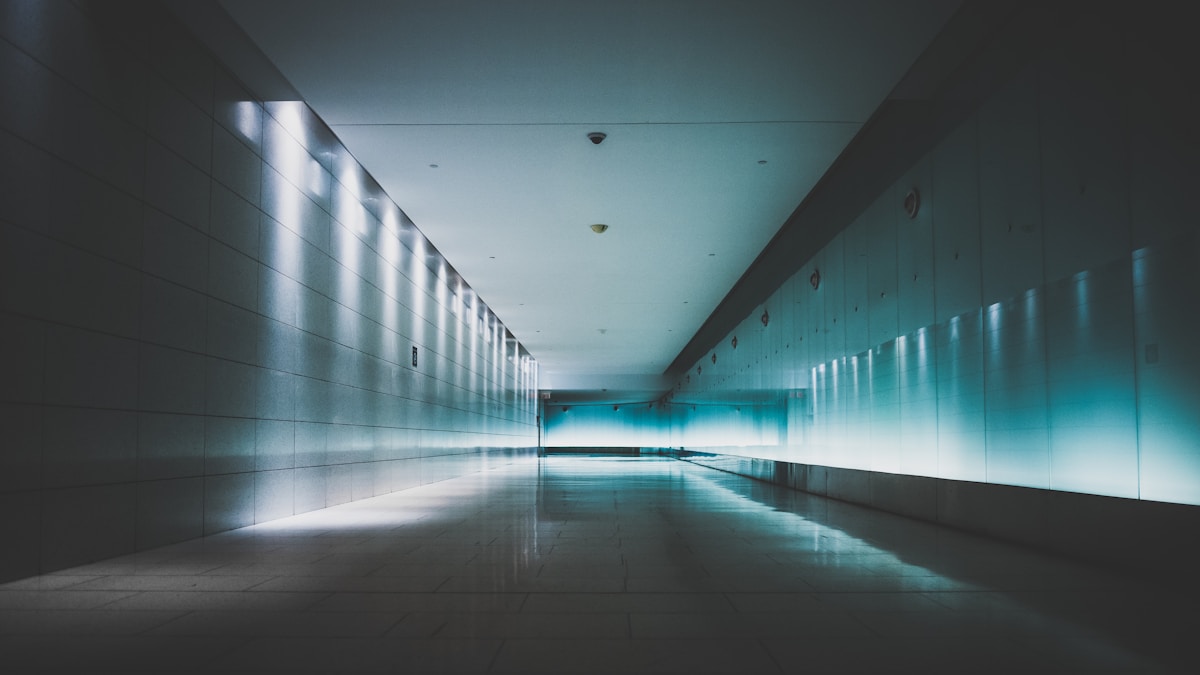
Image: Blue-lit corridor at Square-Victoria–OACI in Montreal. Marc-Olivier Jodoin / Unsplash · Unsplash License. Cropped to 16:9; no generative alterations.
The screenshot arrived in the middle of a completely different rabbit hole.
A commenter was describing a place reached on DMT: not merely colours or shapes, but an environment with the logic of a threshold. There was somewhere to arrive, somewhere to wait and the unnerving sense that the place had been there before the person entered it.
I am not reproducing the username or the screenshot. One person’s account is a lead, not proof, and attaching an identity to an intimate drug experience adds nothing to the evidence.
What mattered was the phrase it led me to: the DMT waiting room.
Search for it and the accounts seem to rhyme. People describe white rooms, pods, nurseries, lobbies, examination spaces, reception areas, corridors and chambers occupied by beings who appear busy, amused, welcoming or indifferent. Some say it is a staging area before a “breakthrough”. Others insist they have returned to the same place.
That sounds like the psychedelic version of Mall World: strangers independently entering one piece of impossible architecture.
So I looked for the earliest trace, the largest dataset and—most importantly—the map.
Evidence status
DMT can produce intense immersive visual-spatial experiences with measurable changes in brain activity. Rooms, tunnels and apparently autonomous entities recur in reports. “Waiting room” language predates the current social-media cycle.
A common threshold motif could arise from shared perceptual and social machinery, then be strengthened by expectation, community vocabulary and reconstructive memory. This combined explanation has not been tested directly.
Whether unexposed participants independently report matching topology; whether any personal environment stays stable across visits; and how much prior knowledge changes what people experience or later recall.
The waiting room is older than TikTok
The phrase did not begin with a recent video, but its history is less tidy than internet folklore makes it sound.
The earliest public trace I could locate appears in Rick Strassman’s 2001 book DMT: The Spirit Molecule, which drew on clinical sessions conducted in the 1990s. One participant described finding himself in a very large waiting room before being taken elsewhere and observed. That establishes an early waiting-room description. It does not establish that “the waiting room” was already a standard category.
By 1 October 2007, Erowid had published a first-person report titled The Waiting Room. Two years later, a DMT-Nexus thread proposed “The Waiting Room”, “the playpen” and “the white room” as names for a supposedly common location. The same post also proposed a control room, a machine and a white void.
The replies are revealing. One person described a circus, another an ornate opera house, another a luminous jungle and another a golden cathedral. Even at the point where a shared lexicon was being assembled, the alleged geography was proliferating rather than converging.
This is the first important distinction. The motif clearly existed before today’s short-form algorithms. But an old motif is not automatically an independent one, and a shared name is not a shared floor plan.
The largest dataset found a pattern—not one room
The best numerical evidence comes from a 2022 Scientific Reports paper. Researchers screened 30,652 posts made to r/DMT between 2009 and 2018 and manually coded 3,778 distinct descriptions of inhaled DMT experiences.
Rooms appeared in 582 reports, or 15.4%. Tunnels appeared in 390, or 10.3%. The specific “waiting room” code appeared in 105 reports: 2.8%, roughly one in 36.
That is too frequent to dismiss as one isolated anecdote. It is also far from universal. Another 477 accounts contained some kind of room without being coded as a waiting room, while the large majority contained neither label.
Entity encounters were more common, appearing in 1,719 reports, or 45.5%. But those entities ranged across feminine figures, deities, aliens, creatures, mythological beings, jesters and other forms. Rooms varied too: clean or clinical spaces, colourful geometric rooms, bright rooms and many less classifiable interiors.
The researchers were careful about what those figures mean. These were self-selected Reddit posts, not a representative sample of everyone who has used DMT. People are more likely to publish an experience that is vivid, meaningful or unusual. Basic information about context was often missing. And, crucially, the paper says earlier Reddit reports may influence later experiences and descriptions through recurring community terms.
The dataset therefore proves something narrower than “people visit the same place”. It proves that a connected online population repeatedly used room and waiting-room language to describe part of an intense altered state.
The details refuse to settle into a map
A genuine shared place should converge as descriptions become more precise. Here, precision often pulls the accounts apart.
The 2009 lexicon post alone allowed its waiting room to range from a huge edge-free white space to a small enclosed pod, with visible beings, invisible observers or nobody present. Modern accounts add tiled clinics, cartoon playrooms, mechanical chambers, hotel lobbies, alien processing areas and spaces with no ordinary walls at all.
A 2021 field study helps show the breadth. Researchers interviewed 36 experienced users immediately after naturalistic high-intensity DMT experiences. All 36 described entering another environment, and 34 described beings. Yet the environments included natural worlds, recognisably human worlds, artificial spaces, childlike scenes, nebulous realms, geometric structures and technological objects.
That study deliberately asked for concrete features before forcing accounts into familiar cultural categories. It found striking recurrent themes, but it did not find a single room with independently matching entrances, landmarks and routes.
This is the same measurement trap that appears in recurring-dream communities. Two people can both report a lobby, an examiner and a door without describing the same place. A map requires relationships: where the door is, what lies beyond it, which route returns to the entrance and whether those connections persist.
In the research I could locate, nobody had prospectively collected unprimed waiting-room maps and shown that their topology matched above chance. That is a literature-search result, not proof that no attempt exists anywhere. It is, however, a large gap in the claim.
Why does a drug experience feel like architecture?
Controlled studies establish that DMT causes an extraordinary brain state. They do not establish that the contents of that state exist outside the person experiencing them.
In a placebo-controlled EEG study of 13 healthy participants, DMT reduced alpha and beta activity, increased spontaneous signal diversity and produced changes that tracked the intensity of visual and other subjective effects. Earlier clinical work also found clear dose-related changes across perception, emotion, cognition and bodily experience.
Those findings give us a biological event strong enough to generate immersive experience. They do not tell us why the event is sometimes organised as a room.
One possibility is that the mind translates transition into spatial form. “Not here but not there yet” becomes a corridor, lobby, gate or waiting area. An encounter with apparent agency becomes a receptionist, guide, examiner or observer. A temporary failure to move further becomes the story of being delayed or refused entry.
That is an interpretation, not a demonstrated mechanism. It is attractive because threshold architecture appears in dreams, near-death narratives, religious visions, alien-abduction stories and ordinary fiction too. Human minds already possess a rich library of entrances, checkpoints, backstage areas and officials.
The alternative interpretations range from Jungian archetypes to a literally inhabited external realm. The current data do not choose between every metaphysical possibility. What they do show is that ordinary sources of convergence—shared brains, shared culture and shared language—have not been controlled well enough to justify the extraordinary one.
The entities feel autonomous. That is not the same as proving autonomy
The waiting room often comes with staff.
A 2020 survey asked 2,561 people about their single most memorable DMT entity encounter. Respondents commonly described beings, guides, spirits, aliens and helpers, and many attributed lasting changes in belief to the experience.
The survey is valuable for understanding how vivid and consequential these encounters can be. But it recruited people who had already had an entity encounter and asked for the most memorable one. It cannot tell us how often entities occur among all DMT experiences, and it cannot independently verify what an entity was.
“It acted independently of me” is a report about phenomenology—how the experience felt. “It was an independent being” is an ontological conclusion about what exists. The first is strongly documented. The second remains untested.
That distinction matters because agency detection is one of the most automatic things a human brain does. We routinely experience thoughts, dream characters and intrusive images as surprising or not fully authored. Under a state that radically alters perception and the sense of self, surprise can arrive wearing a face and carrying apparent intentions.
The community is part of the phenomenon
Once a person has read the phrase “DMT waiting room”, the cleanest version of the evidence is gone.
The person may still have an intense and sincere experience. But if a white chamber, a jester or a reception desk appears, we cannot know whether prior exposure changed the experience, the recall, the label—or none of them.
Psychedelic research has long treated expectation and setting as important. Reviews of placebo and expectancy work show that context can shape subjective effects, while the 2022 Reddit analysis explicitly identifies community terminology as a possible source of influence.
Memory adds another complication. The same large report study found partial or complete amnestic events in 15.4% of accounts. A fleeting, overwhelming experience must be reconstructed into a story after ordinary awareness returns. As with dreams, remembering can rewrite what is remembered. Community discussion can then supply a coherent name for fragments that originally had none.
This does not make the reports fake. It makes independence difficult to establish.
The waiting-room experiment that would actually count
A useful study would not begin by showing volunteers a gallery of popular DMT motifs.
It would recruit participants before exposure to the community vocabulary, record that exposure carefully and collect immediate, time-stamped descriptions and drawings using neutral prompts. Researchers would code structural features rather than evocative labels: boundaries, corners, colour, scale, openings, transitions, occupants, objects and route order.
The similarity rules would be registered before anyone compared reports. Blind raters would test exact spatial relationships, not merely shared nouns. Results would be compared with shuffled pairs, ordinary dream reports and other altered-state accounts to learn how often an impressive “match” appears by chance.
Three tests would then be kept separate:
- Does one person’s environment remain topologically stable across separate experiences?
- Do different unexposed people produce matching maps above measured base rates?
- Does learning the standard vocabulary change later reports?
The possible results are all interesting. Stable personal maps would suggest persistent internal geography. Broad similarities without topological matches would support a recurring cognitive motif. A jump in matching language after exposure would reveal cultural shaping. And independently recorded maps with repeated, unlikely structural agreement would give the shared-place claim evidence it does not currently possess.
That last result would deserve attention. It has not yet been shown.
So, is the DMT waiting room real?
It is real as a recurring report.
The name is at least two decades old. A large corpus contains more than a hundred explicit examples. Rooms, tunnels, observers and seemingly autonomous beings are all documented parts of DMT phenomenology.
But the stronger claim—that strangers are entering one external waiting room—runs ahead of the evidence. The motif appears in a minority of reports, its architecture varies, and the data come from communities where people can learn the same language before comparing experiences.
The most defensible answer is less cinematic and more revealing: DMT can make transition feel like a place, uncertainty feel like waiting and unowned mental activity feel like company.
Perhaps one day a clean mapping study will find something harder to explain. Until then, the mystery is not that everybody reaches the same room.
It is that a human brain can make “not yet” feel as solid as a door.
Sources & further reading
- Lawrence et al. (2022), “Phenomenology and content of the inhaled N,N-dimethyltryptamine experience”, Scientific Reports.
- Michael, Luke and Robinson (2021), “An Encounter With the Other”, Frontiers in Psychology.
- Davis et al. (2020), survey of DMT entity encounters, Journal of Psychopharmacology.
- Timmermann et al. (2019), neural correlates of the DMT experience, Scientific Reports.
- Strassman et al. (1994), controlled study of subjective DMT effects, Archives of General Psychiatry.
- Excerpt from Strassman’s DMT: The Spirit Molecule, hosted on the author’s site.
- Erowid (1 October 2007), “The Waiting Room”. Anecdotal source used for phrase provenance, not scientific evidence.
- DMT-Nexus (1 October 2009), “locations” thread. Community source used for vocabulary history.
- Pronovost-Morgan et al. (2023), “Harnessing placebo: Lessons from psychedelic science”, Journal of Psychopharmacology.