Read carefully.
Follow the sources.
Change the conclusion when the evidence changes.
SCIENCE & STRANGE / JOE FELZ SATELLITE 04
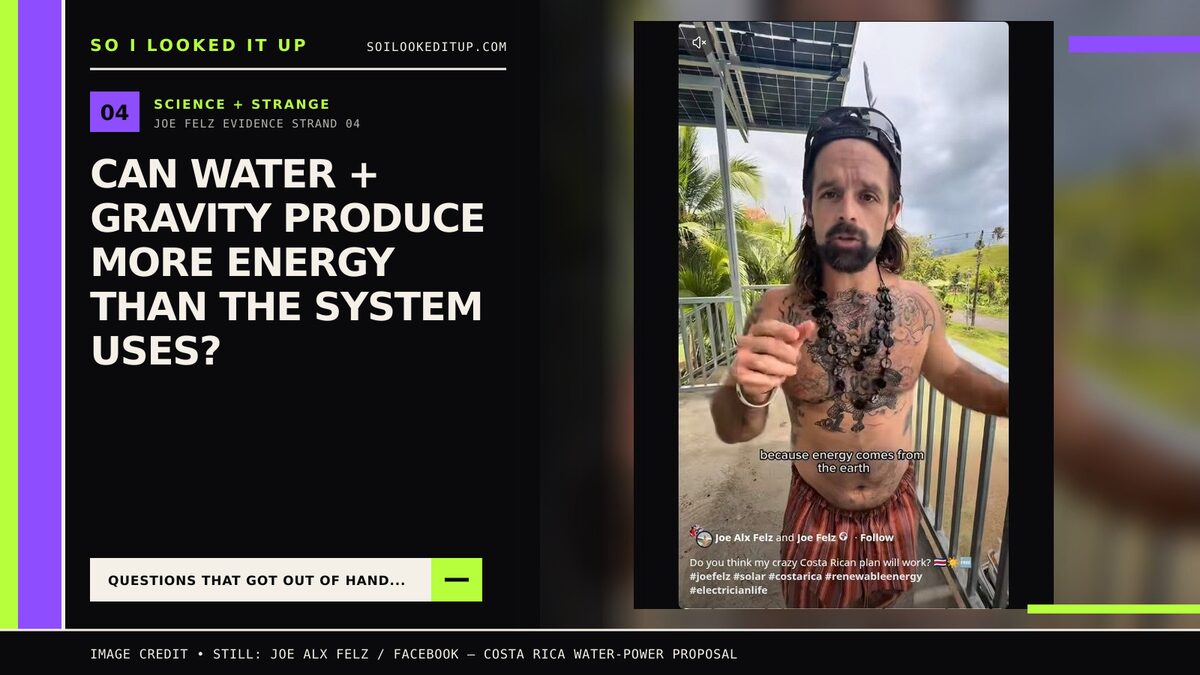
Water falling through a height can generate electricity. The same water can be pumped back up and used again. What it cannot do is return with all the energy it gave away. The decisive question is not whether the machine moves, but what restores its height.
A tank empties through a turbine. The turbine turns a generator. Some of the electricity drives a pump that returns the water to the top. Once the loop is running, could gravity keep producing the rest as useful surplus power?
It is an extraordinarily persistent idea because every visible part is real. Water has gravitational potential energy. Turbines make electricity. Pumps lift water. Flywheels, pressure vessels, siphons and hydraulic rams can make the motion look almost self-sustaining.
So I looked at the whole loop.
The short answer is: an open system can generate continuously when an external source keeps replacing the water or restoring its height. A closed water-and-gravity loop cannot produce more energy than it consumes. If a demonstration appears to do so, the next job is to locate the unmeasured input, the changing stored energy or the measurement error.
The Joe Felz proposal that made the question concrete
This branch belongs to the larger investigation into what Joe Felz was actually working on. Joe had substantial, visible experience with ordinary off-grid solar systems. He also pursued a much more ambitious device he described as a water-and-gravity “perpetual generator”.
A 2026 profile in The Costa Rica News, apparently based on an interview with Joe, said a proposed hybrid water, wind and solar system would include that generator and was designed to produce 80–110 kWh per day while the complex used 10–20 kWh. Joe also posted about putting turbines inside PVC pipes as water moved under gravity.
Those are recoverable claims and plans. They are not, by themselves, a performance test. I could not find a public engineering schematic, simultaneous pump-input and generator-output measurements, recorded head and flow, start-and-end reservoir levels, a long closed-loop run or independent replication of a device producing net surplus energy.
So the two confidence judgements separate cleanly: high confidence that Joe genuinely pursued and publicly described the system; very low confidence that a closed-loop over-unity result was demonstrated.
Where hydroelectric power actually comes from
Water at height stores gravitational potential energy. In an idealised hydro system, the available power is:
P = ρgQHη
- ρ is the density of water;
- g is gravitational acceleration;
- Q is the flow rate;
- H is the usable vertical head;
- η is the combined efficiency of the waterway, turbine, generator and electrical conversion.
More water per second and more vertical drop mean more available power. But the water leaves the turbine lower than it entered. The machine has converted part of the water’s stored height into electricity. Gravity did not supply a consumable fuel; the elevated water did.
The US Bureau of Reclamation uses head and flow in its hydropower assessments and explicitly includes turbine, transformer, waterway and transmission losses. Even an assessment assumption of 83.5% “water-to-wire” efficiency is described as optimistic away from a turbine’s best operating point. Friction, turbulence, leakage, electrical resistance, motor losses and pump inefficiency all turn some of the recoverable energy into heat.
The system boundary decides whether the machine looks impossible
Draw a box around only the turbine and generator and energy appears to emerge from gravity. Widen the box to include the upper reservoir and the source becomes visible: the reservoir is losing both water and stored height.
Widen it again and several perfectly legitimate continuous systems appear:
- A river or stream continually delivers water that rainfall and terrain placed at elevation.
- A dam releases stored inflow accumulated over time.
- Rainfall refills an upper tank; solar heating and the global water cycle did the lifting.
- A solar or wind pump returns water uphill using an identifiable renewable input.
- A pressurised municipal supply has already had pumping energy put into it elsewhere.
- A hydraulic ram uses the fall of a larger quantity of water to lift a smaller quantity higher.
None violates conservation of energy. They merely hide the input outside the camera frame or outside the device’s popular name. A rain-fed “gravity generator” is ultimately solar-powered. A pipe turbine on a pressurised supply recovers pressure energy that another pump or elevation created. A river turbine uses the continuous gravitational descent of new water through the landscape.
Closed-loop pumped storage is a battery, not a generator
The closest established technology is pumped-storage hydropower. The US Department of Energy describes it plainly: electricity is used to pump water uphill when demand is low; the water later flows downhill through a turbine when electricity is wanted.
That is extremely useful. It can shift renewable electricity through time, stabilise a grid and store enormous quantities of energy. It still returns less electrical energy than was used to charge it. In one Department of Energy–reported modular experiment, round-trip efficiency reached 82%. A separate Department example calculated 235 MWh to fill a reservoir and 177 MWh recovered: 72% round-trip efficiency.
If the generated electricity drives the return pump, the loop therefore shrinks on every circuit. Even before powering a house, the water comes back with an energy deficit. Adding a better turbine or pump can reduce the deficit; it cannot reverse it beyond 100%.
| Configuration | What restores the upper water? | What the system is |
|---|---|---|
| River below a natural drop | New watershed inflow | Renewable generation |
| Rain tank and turbine | Atmospheric water cycle | Intermittent stored generation |
| Solar pump plus upper reservoir | Solar electricity | Solar-powered storage |
| Lower-to-upper pump using grid power | Grid electricity | Pumped-storage battery |
| Generator powers its own pump in a sealed loop | Nothing external | A system that must slow, drain or contain an unmeasured input |
What about a hydraulic ram?
A hydraulic ram can lift water without electricity or fuel, which makes it look like an exception. It is not.
The US Natural Resources Conservation Service defines a hydraulic ram as a device that uses the energy of flowing water to lift a portion of that flow to greater elevation or pressure. A larger quantity of source water falls through a modest height. Water hammer converts some of that energy into pressure, delivering a smaller quantity uphill while the rest exits as waste flow.
The accounting works because the device sacrifices volume. It might lift one part high by allowing several parts to fall low. Put the delivered water back through a turbine and try to use that output to restore all the waste water as well, and the missing energy reappears.
Siphons, vortices, buoyancy and other apparent loopholes
Most gravity-loop concepts add a clever-looking stage. Each can move energy around; none resets the system for free.
- A siphon transfers liquid from a higher free surface to a lower one. It does not lift the entire supply back to the original height.
- A vortex can change turbine behaviour and flow geometry. It does not add head or flow that was not already available.
- Buoyant floats rise because the surrounding fluid does work on them. For a cycle, they must be forced back down, re-flooded, de-gassed or otherwise reset.
- Magnets and counterweights can reshape forces and smooth movement. Returning them to their starting configuration costs energy.
- Pressure tanks and flywheels release stored energy. A short demonstration can run while those stores quietly discharge.
- Check valves control direction. They do not provide the pressure difference that drives the flow.
The reset is where an apparent perpetual mechanism usually fails. Watching only the impressive downward half of a cycle is like judging a pendulum from its first swing.
Power is not energy: kW is not kWh
Joe’s reported target was 80–110 kilowatt-hours per day: an amount of energy. A generator’s 10 kilowatt rating is a maximum or nominal rate of producing energy. It would make 10 kWh only if it actually delivered 10 kW for one hour.
This sounds pedantic until a demonstration quotes voltage, current, peak power, inverter rating, battery capacity and daily energy as though they were interchangeable. They are not. A 10 kW inverter connected to a dwindling battery does not demonstrate a 10 kW continuous generator. A meter briefly displaying high voltage under no load says almost nothing about usable energy.
The test that would settle it
A serious test does not have to begin with a verdict. It has to close the accounting.
- Define the boundary: include every pump, controller, inverter, battery, pressure vessel, starter and auxiliary load.
- Separate the sources: disconnect solar, grid, hidden chargers and pressurised feeds unless they are being measured as declared inputs.
- Measure head and flow: log the water level at both reservoirs and calibrated flow continuously, not from design estimates.
- Measure true electrical power: use calibrated power analysers that capture real power, power factor and time—not volts multiplied by a favourable current reading.
- Track stored energy: record battery state using validated charge accounting, reservoir volumes, pressures, flywheel speed and temperature before and after.
- Reach steady operation: run long enough for start-up energy and declining reservoirs to stop masquerading as continuous output.
- Apply a known load: a resistive load bank or independently metered consumption is more informative than a spinning motor or glowing LED.
- Publish raw time-series data: input and output must be simultaneous and timestamped.
- Repeat after reconfiguration: swap meters, alter reservoir levels, inspect hidden connections and repeat under independent control.
- Let someone else reproduce it: an extraordinary efficiency result needs independent equipment and operators.
At the end, all energy leaving the boundary must be compared with all energy entering it plus the change in stored energy inside. If the tanks, batteries and pressures finish where they started while the load receives more energy than every measured input, then there is a genuinely anomalous result worth urgent replication. A video of recirculating water is several evidential steps short of that.
Could Joe’s idea still contain a useful machine?
Yes—without being perpetual.
A hybrid Costa Rican site with abundant rain, steep terrain, solar panels and battery storage could use water intelligently. A rain-fed reservoir could recover genuine natural head. Solar could pump water when the batteries were full. A turbine could supply power during cloudy periods. Pressure reduction points could recover otherwise wasted energy. Controls could coordinate wind, sun, water and demand.
That would be an engineering optimisation problem, not a free-energy revolution. It could still be valuable. The mistake is allowing the plausible renewable configuration to serve as evidence that its most extraordinary label has been proved. This is the same reasoning trap explored in why a plausible mechanism does not prove the bigger claim.
Evidence status: the Felz water-and-gravity system
| Proposition | Current assessment |
|---|---|
| Joe had real practical off-grid solar experience | Well supported |
| He genuinely pursued a water-and-gravity generator | High attribution confidence |
| The reported design target was 80–110 kWh/day | Reported in a 2026 profile; not independently measured |
| A natural or externally powered water system can generate useful electricity | Established engineering |
| A closed loop can pump all its water back and still export net energy | Contradicts the established energy balance |
| Joe publicly demonstrated that extraordinary performance | No adequate test recovered |
What would change the assessment?
A complete schematic, component specifications and raw data from a declared-boundary test would move this from story to engineering claim. A continuous independent run showing every reservoir, electrical path and storage state would matter far more than another clip of the turbine turning.
Until then, the fairest conclusion is not that Joe did nothing real. It is that real renewable work and an unverified perpetual-generator conclusion were allowed to occupy the same sentence.
Sources & further reading
- The Costa Rica News — Joe Felz profile and water/gravity proposal (contemporary secondary claim record)
- Joe Felz — Costa Rica water/turbine proposal (primary public claim record)
- US Department of Energy — Solar Energy and Storage Basics
- US Department of Energy — modular pumped-storage experiment and round-trip efficiency
- US Department of Energy — FAST pumped-storage concepts and energy accounting
- US Bureau of Reclamation — Potential Hydroelectric Development at Existing Federal Facilities
- USDA Natural Resources Conservation Service — Irrigation Guide, including hydraulic ram definition
Related rabbit holes: wireless electricity is real—but “free energy” is a different claim · whether microwaves can turn waste plastic into fuel · why a plausible mechanism does not prove the bigger claim