Read carefully.
Follow the sources.
Change the conclusion when the evidence changes.
SCIENCE & STRANGE / JOE FELZ SATELLITE 01
An object does not have one scientifically accessible age. It can have the age of its raw material, its manufacture, its last firing, its burial, its repair and the thing found beside it. “45,000 years old” is therefore not a result until you know exactly what was tested.
It sounds like the simplest question in archaeology: how old is this thing?
Then somebody shows you a stone or metal object, says a laboratory dated it to 45,000 years ago, and the question quietly changes. Did the laboratory date the object? A crust on it? A piece of charcoal from the same hole? The sediment around it? An organic residue that may have been added much later? And did any of those things date the moment the object was made?
So I looked it up.
The short answer is that an artefact can sometimes be dated directly, often only indirectly, and occasionally not at all. A credible age is not a number extracted from an object. It is a chain of reasoning that joins a suitable sample, a documented context, a valid method, a laboratory result and an archaeological interpretation.
The Joe Felz claim that started this question
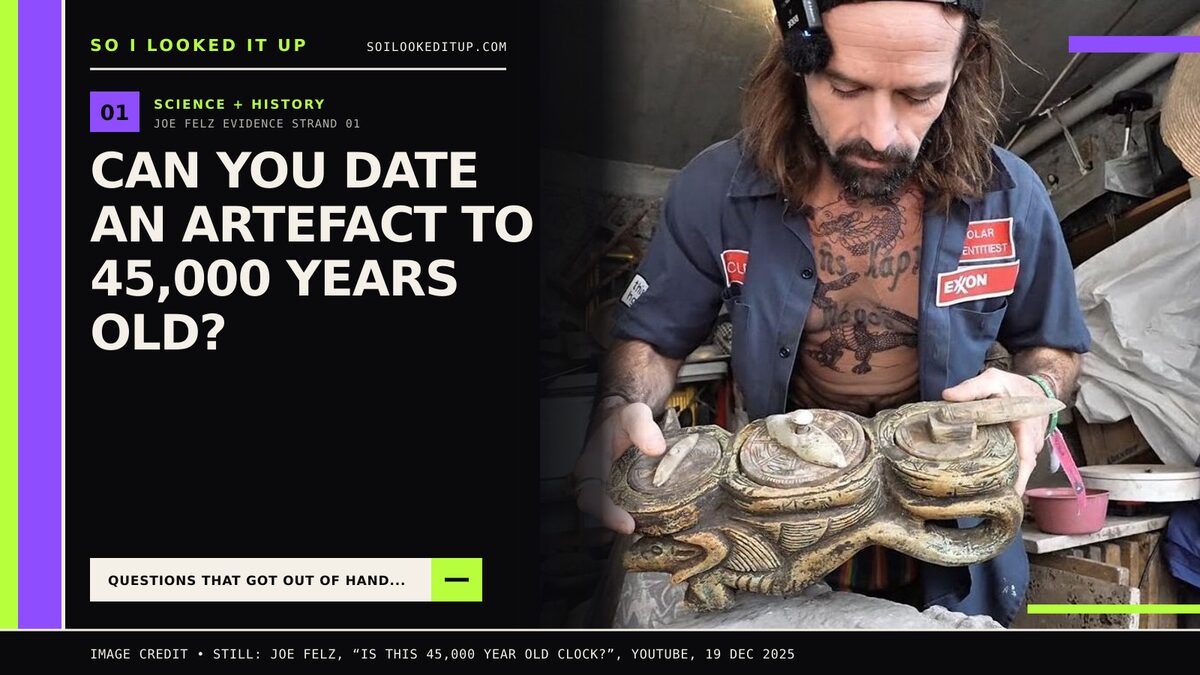
This branch came out of the larger investigation into what Joe Felz was actually researching. On 19 December 2025, Joe uploaded a video titled “Is This 45,000 Year Old Clock?” while developing a theory about unusual objects, “frequency energy” and a possible lost city.
The age is securely attributable to Joe’s public material. The scientific support is a different question. In the recoverable public record, I could not find a laboratory report, a laboratory name, a sample identifier, a dating method, a description of the material tested, an uncertainty range or a documented chain of custody.
That distinction matters throughout the Joe story. “Joe really circulated the 45,000-year figure” has high attribution confidence. “The object really is 45,000 years old” has very low factual confidence. One does not become the other through repetition.
An artefact can carry several different clocks
The first surprise is that “the age of the object” may not be one event.
- Raw-material age: when the stone formed, the tree grew or the ore entered a geological deposit.
- Manufacture age: when a person shaped, cast, fired or assembled it.
- Use age: when it was handled, burned, filled, repaired or coated.
- Deposition age: when it entered the layer where it was found.
- Excavation age: when it was removed, documented and placed into a custody chain.
A stone may be millions of years old but carved last Tuesday. A genuinely ancient piece of wood can be built into a younger object. An old pot can acquire a modern adhesive. A modern object can be buried beside ancient charcoal. A later burial can cut down through earlier layers. The job is not simply to measure an age; it is to show that the measured event is the event you are claiming.
What the main methods actually date
| Method | Suitable target | What the clock usually represents | The trap |
|---|---|---|---|
| Radiocarbon | Suitable carbon-bearing material such as short-lived plant remains, charcoal, bone collagen or textile | When the organism stopped exchanging carbon | It does not automatically date a stone, metal object or the layer where the sample was found |
| Thermoluminescence | Fired mineral material, commonly ceramics or burnt stone | Time since sufficient heating reset the stored radiation signal | A later firing or insufficient original heating can change what the result means |
| Optically stimulated luminescence | Mineral grains in sediment | Time since the grains were last sufficiently exposed to light | It dates sediment deposition, not automatically the manufacture of an object inside it |
| Dendrochronology | Wood with enough preserved growth rings and a matching regional sequence | When individual rings formed; sometimes a felling estimate | Old timber can be stored, reused or incorporated later |
| Uranium-series | Suitable carbonate deposits such as calcite layers | When the dated carbonate formed | A crust above or below an object constrains its age only if the physical relationship is secure |
| Stratigraphy | Undisturbed layers and features | Relative sequence: lower is generally earlier than upper | Pits, roots, animals, erosion, rebuilding and staging can disturb that order |
Historic England’s guidance puts the central point unusually plainly: radiocarbon dating dates samples, not contexts. Archaeologists then have to establish whether the sample was freshly deposited, residual from something older or intrusive from something younger.
That is why a result can be analytically accurate and archaeologically irrelevant. A laboratory may measure the carbon in a charcoal fragment perfectly. If that charcoal came from old timber reused in a later fire, or slid into the layer from somewhere else, the number does not date the event you hoped it would.
Why 45,000 years is a particularly difficult number
Radiocarbon dating works because living organisms exchange carbon with their environment. After death, radioactive carbon-14 decays. Measuring what remains provides a radiocarbon age for suitable material.
But by about 45,000 years, very little carbon-14 remains. Historic England describes roughly 50,000 years as the method’s practical detection limit and compares the analytical problem to identifying one particular hair among all the hair on all the people alive. Its guidance for Pleistocene sites warns that even tiny amounts of contamination can produce misleading finite ages in material near or beyond the method’s limit.
At that age, sample preparation is not a technical footnote. Modern carbon can make a very old sample appear younger. Conservation glue, soil carbon, handling and laboratory contamination all matter. The Oxford Radiocarbon Accelerator Unit also flags reservoir effects, in which carbon from a marine or freshwater source can offset the apparent date.
There is another complication: a radiocarbon age is not automatically a calendar date. Atmospheric carbon-14 has varied through time, so measurements must be calibrated against independently dated records. The current internationally used IntCal20 Northern Hemisphere curve extends to 55,000 calibrated years before present. “Present” in conventional radiocarbon reporting means 1950, and a responsible report gives a probability range, not a supernatural-looking exact birthday.
Can stone or metal be dated directly?
Usually not by radiocarbon. Stone contains no useful clock for when somebody carved it, and the geological age of the stone is not the age of the carving. Metal similarly does not come with a simple radioactive timer for manufacture.
Researchers therefore build an age from several kinds of evidence:
- organic material securely embedded in or attached during manufacture;
- charcoal, bone or short-lived plant remains sealed in the same undisturbed feature;
- a fired ceramic component whose luminescence clock was reset during manufacture;
- sediment that demonstrably buried the object and was not later disturbed;
- corrosion, patina, tool marks, alloy composition and manufacturing technique compared with authenticated material;
- inscriptions, style and wear interpreted by specialists;
- documented excavation records and an unbroken chain of custody.
None is infallible alone. A patina can be manufactured. Style can be copied. Ancient organic material can be attached to a modern object. A composition may be historically plausible without proving a date. The strongest conclusion comes from independent lines of evidence agreeing while the object’s provenance remains intact.
This is also why the companion question—why provenance matters more than a spectacular artefact photograph—cannot be separated from dating. Without context and custody, even an authentic laboratory number may date the wrong thing.
What a real 45,000-year report should let us inspect
If somebody says an artefact was scientifically dated to 45,000 years, the useful response is not immediate belief or ridicule. Ask for the chain.
- The exact object: inventory number, dimensions and photographs that make substitution difficult.
- The exact sample: what material was removed, from which part, by whom and how much.
- The claimed event: is the test intended to date biological death, manufacture, firing, deposition or a later coating?
- The laboratory: an identifiable accredited or specialist facility, not “a scientist” or “it was tested”.
- The laboratory code: the unique identifier that allows the result to be traced. Historic England recommends publishing laboratory codes, measurement and uncertainty.
- The method and pretreatment: including how contamination was assessed and removed.
- The raw and calibrated result: uncertainty, probability range, calibration curve and relevant corrections.
- The archaeological context: field notes, stratigraphic drawings, scale photographs, coordinates held securely where looting is a risk, and evidence that the deposit was undisturbed.
- The custody record: every transfer from discovery to sampling to storage.
- Independent interpretation: ideally replication or review by specialists who did not supply, own or market the object.
A screenshot showing “45,000” is not enough. Neither is a cropped certificate without the sample description. The report has to connect the measured material to the physical object and the physical object to the archaeological claim.
The excavation claim does not solve the dating problem
Joe later emphasised that he had dug objects from the ground, including a claimed figure beneath “12 strata” of deliberately laid rock. Personal excavation is relevant evidence, but “I dug it up” does not establish 45,000 years.
We would still need to know who controlled the site, whether the dig location was independent of the object suppliers, whether the layers were natural or constructed, whether the object was continuously visible in situ, whether an archaeologist recorded the section, and whether samples were collected before the context was disturbed. The deeper companion investigation asks what lost-city evidence would actually look like.
Evidence status: the 45,000-year object
| Question | Assessment |
|---|---|
| Did Joe publicly associate an object with a 45,000-year age? | Yes — high attribution confidence. |
| Has a named dating method been recovered? | No. |
| Has a laboratory report or laboratory code been recovered? | No. |
| Do we know what material was sampled? | No. |
| Is the sample-to-object-to-site chain documented? | No. |
| Is the artefact’s age scientifically established? | No — currently unverified, with very low factual confidence. |
The right conclusion is deliberately narrow. The missing paperwork does not prove the object is modern. It means the spectacular age has not crossed the evidential bridge from a circulated claim to a scientific result.
What would change the conclusion?
An original report could materially change this assessment—especially if it identifies a suitable sample, a reputable laboratory, a traceable result and a secure archaeological association. Original excavation files and independent object custody would matter just as much. If those records surface, this article should be updated rather than defended.
Until then, “45,000 years old” is not a property of the photograph, the markings or the story told about the object. It is a hypothesis waiting for its sample.
Sources & further reading
- Joe Felz — “Is This 45,000 Year Old Clock?” (primary claim record, 19 December 2025)
- Historic England — Radiocarbon Dating
- Historic England — The Bayesian Process
- Historic England — Scientific Dating Methods for Pleistocene Sites
- Oxford Radiocarbon Accelerator Unit — Radiocarbon Dating
- Reimer et al. — IntCal20 Northern Hemisphere Radiocarbon Age Calibration Curve
Related rabbit holes: what an X-ray can actually tell you about an ancient object · why artefact provenance matters · what lost-city evidence looks like