Read carefully.
Follow the sources.
Change the conclusion when the evidence changes.
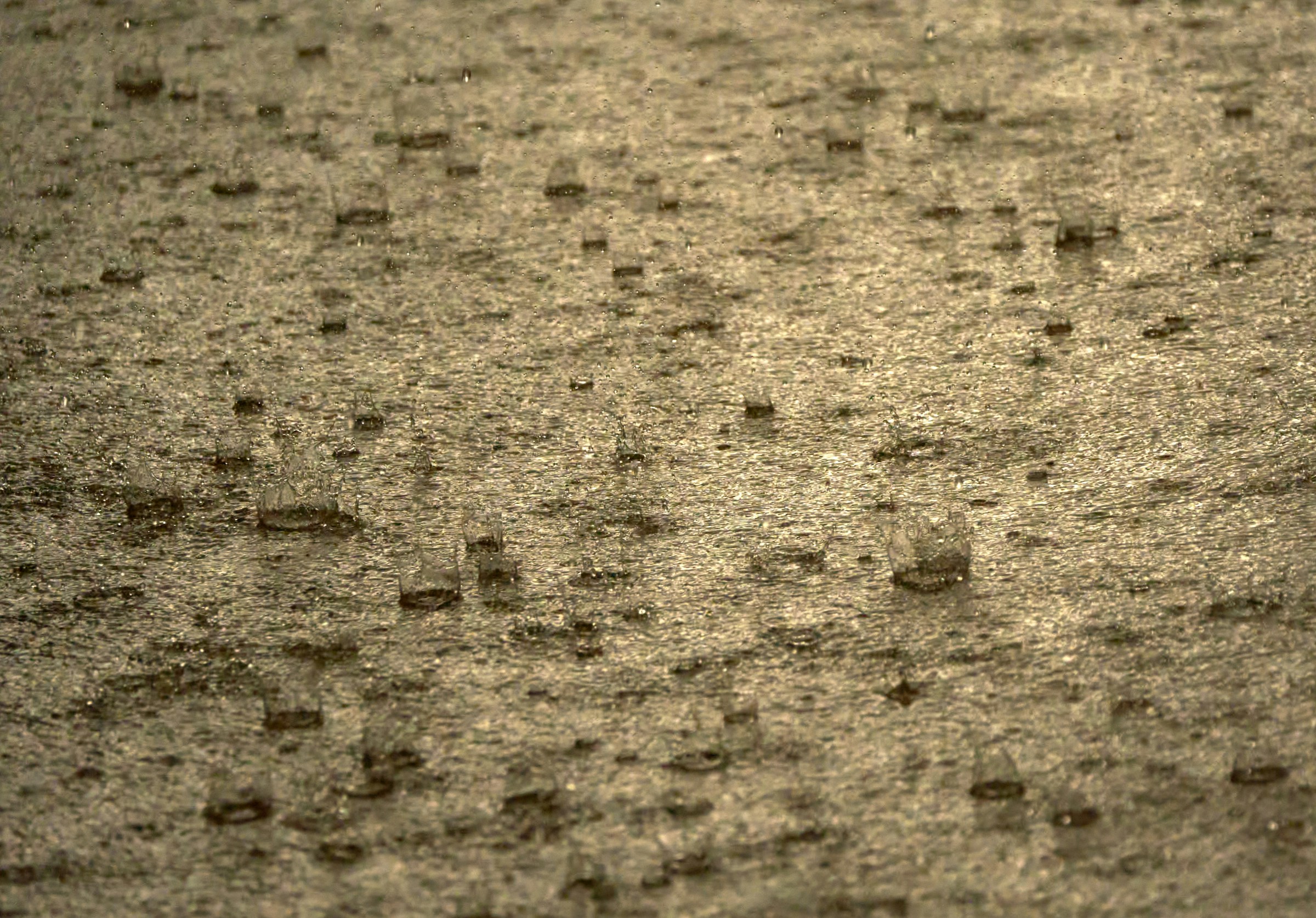
Image: Rain striking the ground. Wolfgang Hasselmann / Unsplash · Unsplash License.
It is possible to smell rain before it reaches you. But that sentence cheats with the word before.
You are standing on dry ground. A few kilometres upwind, the first drops are already striking dusty soil. Air spreads out from the shower or thunderstorm, carrying earthy molecules towards you faster—or along a different route—than the rain itself. Your nose gets the message while your pavement is still dry.
That is not smelling the future. It is smelling something that has already happened somewhere else.
The distinction matters because the neat explanation has several pieces people routinely weld together: petrichor is not just geosmin; a famous raindrop experiment did not actually measure geosmin; and ozone is a possible storm smell, not the explanation for every earthy gust before rain.
The real question is better: what history can an arriving parcel of air reveal—and how reliably does that history predict what the weather will do next?
Evidence status
Wetting dry ground releases earthy volatiles. Drops striking suitable porous surfaces can trap bubbles and eject soil material as aerosols. Humans have a receptor responsive to geosmin, and thunderstorm outflow can arrive before local rain.
Geosmin and other rain-released compounds from wet ground upwind can travel in ordinary wind or storm outflow and be detected before the local rain shaft. Ozone may add a separate sharp note in some storms.
How often each compound explains a real pre-rain report, how far detectable plumes travel, and whether smell adds reliable forecasting skill once misses, false alarms and visible weather cues are counted.
Petrichor is not one molecule
The word petrichor arrived in a 1964 Nature paper by Australian researchers Isabel Joy Bear and Richard Thomas. They were investigating the characteristic odour released when dry clay-rich materials and rocks were wetted. Their account involved odorous, largely plant-derived oils that accumulated in mineral material during dry conditions and were released by moisture.
Geosmin is a different but overlapping part of the story: a volatile compound with an unmistakably earthy, musty odour, made by several kinds of microbes. Streptomyces and related soil bacteria are famous producers; cyanobacteria, some fungi and other organisms can make it too. It can flavour beetroot and spoil the taste of drinking water without a raincloud being anywhere nearby.
So “petrichor equals geosmin” is tidy and wrong. The smell after rain is a mixture whose balance changes with soil, vegetation, microbial community, temperature and how long the ground has been dry. Geosmin can be the loud earthy note without being the entire chord.
A drop can turn soil into air
In 2015, Young Soo Joung and Cullen Buie filmed drops striking wettable porous surfaces with high-speed cameras. On impact, a drop spread across the surface and trapped tiny pockets of air. Those bubbles rose through the drop and burst, firing much smaller droplets into the air.
It is a miniature version of bubble-bursting sea spray, performed by a single raindrop on soil. Material in the pores can be carried into the ejected aerosol.
Two years later, Joung, Zhifei Ge and Buie seeded soils with bacteria and showed that the mechanism could move living cells. Under the tested laboratory conditions, one drop could transfer roughly 0.01% of the bacteria at the surface into aerosols, and some remained viable for more than an hour. Transfer depended on soil type, surface temperature, bacterial density and impact speed.
This is strong evidence that rain can make soil contents airborne. It is not direct evidence that the 2015 aerosols contained geosmin, travelled across a landscape and were smelled by a person before their local rain. The original paper proposed the petrichor connection; the experiment established the physical launch mechanism.
That distinction is easy to lose because the proposed application is more memorable than the measurement.
The first drops can matter more than the downpour
If rain-impact aerosols help carry earthy odours, more rain should mean more smell. That sounds like a testable prediction. It is also where the mechanism becomes conditional.
Bubble trapping works best within a range of impact speeds and surface conditions. A suitably wettable, porous soil contains air that a drop can capture. Once repeated drops leave a water film or saturate the pores, there is less air to trap in the same way. Faster, heavier impacts can splash dramatically without producing more of the particular fine aerosol made by rising bubbles.
So a light or moderate first shower after a dry spell can be more effective than a sustained deluge. The familiar intensity of petrichor is partly a contrast effect—dry ground meeting its first water—and partly a question of fluid mechanics.
This also explains many non-events. Rain over an already soaked field, sealed pavement, dense vegetation or the wrong soil may produce little noticeable earthy plume. There is no rule that every shower must announce itself to a nose.
Before your rain can be after somebody else’s
Now the timing problem.
A volatile released from wet soil does not need to be inside a raindrop to move. It can mix into air and travel with the wind. Aerosol droplets and particles can travel too, although their size, evaporation and settling matter. The source only needs to be upwind and active before the precipitation reaches your point on the map.
Thunderstorms provide an especially clear route. Rain-cooled air descends, hits the ground and spreads out. The US National Weather Service calls the leading edge a gust front: a shift to cool, gusty wind that often precedes the thunderstorm’s rain by several minutes.
That leading air can have passed over wet ground beneath the storm. If it carries geosmin or other released volatiles, a dry observer ahead of the rain shaft could smell the storm’s existing footprint.
Every component of that explanation is physically reasonable. The full chain, however, is still a mechanistic bridge. The decisive field study would measure rain upwind, soil wetness, wind trajectories and airborne geosmin while collecting blinded reports from people downwind. The foundational studies did not do that.
The difference is not pedantry. A plausible route tells us what to test. It does not grant the route a perfect attendance record in every anecdote.
Your nose can detect geosmin. That is not a rain sense
Humans are sensitive to geosmin. In water-based tests, detection thresholds can fall in the low nanograms-per-litre range under specified conditions, although a value measured in warm water or a shower stall is not an outdoor air threshold.
In 2024, Lena Ball and colleagues identified a human odorant receptor, OR11A1, that responded selectively to geosmin in a cell-based assay. Related versions of the receptor responded in six other mammal species. The desert kangaroo-rat version was more than 100 times as sensitive as the human version in that experimental system.
That gives the molecule a biological detector. It does not tell us why human sensitivity evolved, whether the receptor works alone in real odour mixtures, or how well a person can locate an outdoor source. A receptor is one component of perception, just as a candidate molecular sensor is not by itself a complete explanation for how animals detect magnetic fields.
Calling OR11A1 a “rain receptor” would be especially misleading. It also responds when geosmin comes from disturbed soil, water, food or microbial growth. The receptor reports a molecule, not a weather forecast.
Ozone is possible. It is not petrichor
The other standard answer is ozone: the sharp, electrical smell supposedly made by lightning and pushed down before a storm.
There is real atmospheric chemistry underneath that story, but the viral version runs ahead of it. Thunderstorms can change surface ozone through several processes, including downward transport of ozone-rich air and electrical activity. Lightning-produced nitrogen oxides mostly affect ozone through chemistry that depends on place, altitude, sunlight and time; they do not amount to an instant universal ozone spray at ground level.
A 2025 study at the Amazon Tall Tower Observatory found that stronger storm electrification and downdrafts were associated with higher surface ozone. In highly electrified, lightning-linked conditions, the mean maximum increment attributed beyond the downdraft relationship was about five parts per billion. The researchers could not identify the exact production mechanism and explicitly framed the result within that region and observing period.
Ozone therefore belongs in the “can contribute under some conditions” box. It has a pungent odour at sufficient concentrations, but the amount reaching the surface varies, people’s thresholds vary, and no field study has established that ozone explains the familiar pre-rain report across ordinary storms.
It is also not a harmless fragrance ingredient to seek out. Ground-level ozone is an air pollutant and respiratory irritant. Your nose is not a calibrated ozone monitor.
The weather can change what an odour means
Suppose the chemistry is weak or mixed. You also see a dark cloud, feel the temperature drop and hear leaves turn in a gust. Does the nose remain an independent witness?
Not entirely. Smell is unusually dependent on context and learning. In a 2005 experiment, the same isovaleric-acid odour was rated differently and produced different brain responses when participants were shown the label “cheddar cheese” rather than “body odour.” The label did not manufacture molecules, but it changed the experience and evaluation of them.
That study was not about rain. It supports a narrower point: recognition is not a chemical readout untouched by expectation. Weather cues can make an ambiguous earthy, dusty or sharp smell easier to identify as “rain.”
This creates two ways to be right at once. A real storm-associated compound may be present, and non-olfactory cues may improve or bias its interpretation. The alternatives are not “perfect nose” or “pure imagination.” Perception routinely combines evidence.
The smell may be a message for something else
Geosmin becomes stranger when we stop treating humans as its intended audience.
In 2020, Paul Becher and colleagues investigated Streptomyces bacteria and springtails, tiny soil-dwelling arthropods. In their tested system, the genes producing geosmin and a second earthy volatile, 2-methylisoborneol, were controlled with bacterial sporulation. Springtails detected the compounds with their antennae, were attracted to them and fed on the colonies.
The bacteria’s spores then travelled on the springtails’ water-repellent cuticles and through their faecal pellets. The earthy odours were part of a dispersal arrangement: the springtails found food; the sporulating bacteria found transport.
This does not give geosmin one universal purpose. Other producers and animals use or avoid it in different contexts. But it supplies the rabbit-hole payoff the weather story misses. At least in this microbial–arthropod relationship, the molecule humans call “the smell of rain” participates in somebody else’s logistics.
We may not be sensing a message about rain at all. We may be overhearing a message that rain happens to release.
What can the smell actually predict?
To know whether your nose is a useful forecaster, count more than the satisfying hits.
- How often did you smell rain and then get rain?
- How often did you smell it and stay dry?
- How often did rain arrive with no warning smell?
- How often did neither occur?
Then compare the nose with what the clouds, wind and local rain base rate already predicted. This is the same accounting problem that makes coincidences feel more impossible than they are: memorable matches are not the whole opportunity set.
A prospective phone log matched to radar and wind would be more informative than a lifetime of “I knew it” memories. The likely result would not be zero skill. It would be conditional skill: better after dry weather, downwind of the first wet soil, with an outflow that reaches you before a storm that continues along the right track.
And sometimes the air will tell the truth about where it has been while misleading you about where the rain is going. A shower can pass beside you. A gust front can outrun a weakening storm. Irrigation can imitate the source. Ozone or dust can supply a false familiar note.
The nose reads history, not prophecy
Can you smell rain before it arrives? Yes, in the everyday local sense: you can plausibly smell products of wet ground or storm chemistry before the first drop reaches you.
But the strongest explanation contains a quiet correction. Petrichor begins after water meets dry material. If you smell it while your own ground is dry, the interesting question is not how your nose detected rain from the future. It is where the rain has already fallen, what the first drops released, and which moving air brought the evidence to you.
The smell can be real. The transport can be real. The later rain is still conditional.
Your nose may be reading the recent history of the atmosphere—soil, microbes, water and wind compressed into one earthy gust. Whether that history becomes your next few minutes of weather is a second question, and the clouds do not owe the smell a matching ending.
Sources & further reading
- Bear & Thomas (1964): The paper that introduced petrichor
- Joung & Buie (2015): Aerosol generation by raindrop impact on soil
- Joung, Ge & Buie (2017): Raindrops can aerosolise viable soil bacteria
- Jüttner & Watson (2007): Biological sources and release of geosmin and 2-MIB
- Ball et al. (2024): Human OR11A1 responds selectively to geosmin
- Omür-Ozbek et al. (2007): Human detection of geosmin under defined water and air conditions
- US National Weather Service: Gust fronts can precede local rain
- Unfer et al. (2025): Storm electrification, downdrafts and surface ozone
- de Araujo et al. (2005): Semantic context changes olfactory evaluation
- Becher et al. (2020): Geosmin, springtails and Streptomyces spore dispersal