Read carefully.
Follow the sources.
Change the conclusion when the evidence changes.
SIGNAL / NOISE / JOE FELZ SATELLITE 10
AI can reveal faint writing, transcribe hostile typefaces and make millions of old pages searchable. It can also “correct” an author into saying something they never wrote.
The pitch is irresistible: scan the forgotten books, let artificial intelligence decode them and recover the knowledge history tried to erase.
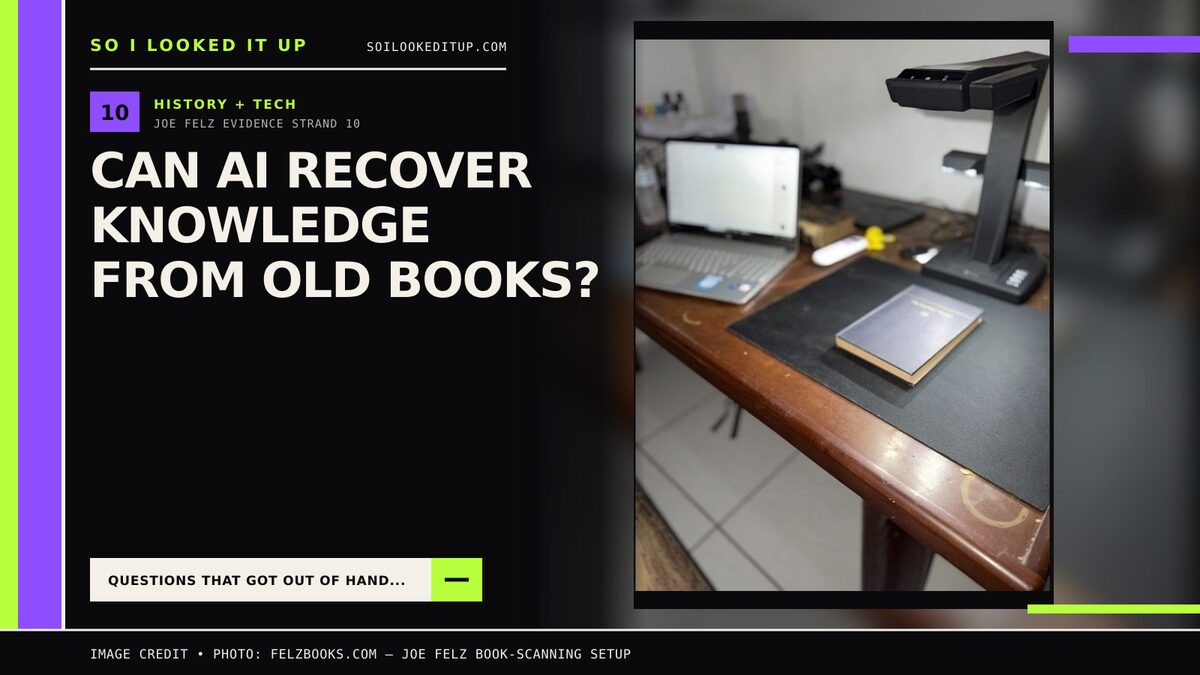
Joe Felz was trying to build something recognisably real beneath that language. FelzBooks would turn old Bibles, apocryphal works, Judaica, Masonic texts, maps and other rare material into a searchable database. The surviving site says AI-assisted optical character recognition makes the scans readable and discoverable.
That is technically plausible. It is also much narrower than an AI recovering truth from history.
To see why, we need to separate four jobs that are usually fused into one magical verb: reveal, transcribe, reconstruct and interpret.
What “recover” can mean
| Task | What the system does | Main danger |
|---|---|---|
| Reveal | Makes physically present but faint, overwritten or visually obscured marks more visible | Image processing creates contrast that is mistaken for certain reading |
| Transcribe | Converts visible characters into machine-readable text | Wrong characters, reading order or word boundaries |
| Reconstruct | Proposes missing letters, words or damaged passages | A plausible completion is presented as recovered text |
| Interpret | Translates, classifies, summarises or relates the text to other sources | The model supplies context, motive or meaning not supported by the page |
The first two can be measured against an image. The third is an editorial hypothesis. The fourth is historical argument. Changing tools does not erase those boundaries.
Start with the object, not the chatbot
A trustworthy digital text begins before OCR. The physical object must be identified and photographed well enough that another researcher can inspect it.
- title page, colophon, publisher, place and date;
- edition, volume and copy-specific marks;
- complete page order, including blank leaves and inserts;
- scale and colour target;
- sharp, evenly lit master images at preservation resolution;
- file identifiers connecting every image to the right object and page;
- rights, custody and provenance metadata;
- unaltered master files retained alongside processed derivatives.
A phone photograph can preserve information that might otherwise vanish. It is not automatically a preservation master. Curved pages distort lines. Gloss, shadow and gutter loss conceal characters. Compression invents edges. Cropping can remove marginalia, page numbers and the evidence needed to reconstruct sequence.
The archival principle is simple: never let the cleaned image replace the source capture.
Sometimes technology really does reveal writing nobody can see
Multispectral and hyperspectral imaging photograph an object under different bands of light. Inks, pigments, paper and parchment respond differently across ultraviolet, visible and infrared wavelengths. Processing can separate a crossed-out line from the ink above it, enhance faded writing or expose undertext on a reused manuscript.
The Library of Congress has used multispectral imaging to read words obscured in an Alexander Hamilton letter. Cambridge researchers recovered undertext from a palimpsest that was largely illegible to the naked eye. This is genuine recovery: the physical signal was present on the object, and controlled imaging made it measurable.
AI can help select, combine and classify spectral information. But the decisive evidence remains an object’s response under documented capture conditions. A generated image of what a page “probably” said is not the same thing.
OCR is not one button
Optical character recognition turns images of print into encoded characters. Handwritten text recognition performs the related job for handwriting. Modern systems may use neural networks or multimodal language models, but the pipeline still has separate failure points:
- Image preparation: crop, de-skew, dewarp, reduce show-through and preserve meaningful marks.
- Layout analysis: identify columns, headings, notes, illustrations, page numbers and text regions.
- Line and reading order: decide which fragment follows which.
- Character recognition: map shapes to letters, numerals and punctuation.
- Language modelling: prefer sequences that resemble words in the expected language.
- Post-correction: flag or repair likely errors.
- Human review: compare uncertain output against the image.
- Publication: preserve the relationship among page, coordinates, transcription and revision history.
Historical pages attack every stage. Blackletter and the long s confuse character models. Spelling predates standardisation. Pages mix Latin, Greek, Hebrew and vernacular languages. Marginal notes cross printed text. Ink bleeds through from the reverse. Decorative initials resemble pictures. A two-column Bible with verse numbers, footnotes and cross-references is a layout problem before it is a language problem.
The Library of Congress warns users of its digitised newspaper collection that OCR inevitably contains errors that cannot all be corrected automatically. It nevertheless remains enormously useful because imperfect text can unlock discovery across millions of pages.
Searchable is not the same as exact
OCR quality is commonly measured with character error rate and word error rate against a human-verified “ground truth” transcription. A character accuracy that sounds excellent can still create many errors across a book.
At 99% character accuracy, one character in every hundred is wrong on average. Across 500,000 characters, that is roughly 5,000 errors. Their importance is uneven. Turning not into now, changing a measurement, merging a name or dropping a minus sign can reverse meaning while leaving the page apparently readable.
Search also has asymmetric failure. An OCR error may make a real passage invisible to a keyword query. A false recognition may create a passage that looks relevant but is not. If a researcher only sees the search result and never the page, both failures disappear from view.
This is why standards such as ALTO store recognised text together with layout coordinates and confidence information, while IIIF can align transcriptions and annotations with exact regions of a page image. The architecture keeps the claim close to the evidence.
Large language models can improve OCR—and quietly falsify it
A language model is very good at recognising what a damaged sentence is likely to say. That can be a genuine advantage. A 2024 study using nineteenth-century British newspaper material found that an adapted Llama 2 system substantially reduced character error rate during post-OCR correction. Newer multimodal systems can inspect the page image and the transcription together, and some historical-document benchmarks report dramatic improvements.
The same fluency creates the core archival hazard. OCR tries to copy marks. A generative model tries to produce a likely sequence. When the page is unclear, “likely” can defeat “present”. It may modernise spelling, resolve an abbreviation incorrectly, regularise a name, invent a missing line or replace an unfamiliar claim with a familiar quotation.
Recent research on historical OCR has found precisely these errors: hallucinated words, script switching and even “over-historicisation”, where a model inserts archaic forms that look period-correct but are not on the image. NIST treats confabulation and content provenance as central generative-AI risks.
A particularly current caution comes from a preprint released on 25 August 2026. Comparing thirteen digitisation pipelines on historiographical sources, the authors found that LLM post-correction did not produce systematic improvements and often degraded already accurate extraction. It is a preprint rather than a peer-reviewed result, but it reinforces the operational rule: validate correction against human-checked ground truth before deploying it across an archive.
For casual search, a fluent correction may be helpful. For a contested sentence in a rare religious text, it may manufacture the discovery.
There are three texts, not one
A serious digital edition should keep these layers distinct:
| Layer | Rule | Example |
|---|---|---|
| Diplomatic transcription | Represent what is visibly on the page, including original spelling and meaningful abbreviation | “ſheweth” remains “ſheweth” or is explicitly encoded |
| Normalised text | Make a separate, declared reading layer for modern search | “ſheweth” indexed as “showeth” |
| Interpretation | Provide translation, expansion, summary and commentary as annotations | A note explains the word and its context |
If AI silently normalises the diplomatic layer, later researchers cannot tell whether a surprising word came from the author, the printer, the OCR engine or the chatbot.
Can AI discover knowledge inside the books?
Yes, in the ordinary and powerful sense of helping humans find patterns they could not feasibly find by hand.
- search names and phrases across thousands of volumes;
- link spelling variants and aliases;
- identify repeated passages and possible textual borrowing;
- extract dates, places, people and relationships into a candidate dataset;
- cluster similar diagrams or page layouts;
- compare editions and flag variant readings;
- translate a first-pass reading for a specialist to review;
- retrieve relevant pages in response to a natural-language question.
Those functions can produce new scholarship. The novelty comes from comparison, scale and human argument—not from treating the model as an oracle.
A retrieval system can also answer questions using the collection rather than the model’s unauditable memory. But retrieval-augmented generation is not self-validating. It can retrieve the wrong edition, misread the OCR, omit the counterexample and produce a confident synthesis that no page actually supports. Every material assertion still needs a page-level citation.
The Joe Felz test case
Joe’s public record supports a more grounded account than either dismissal or mythology.
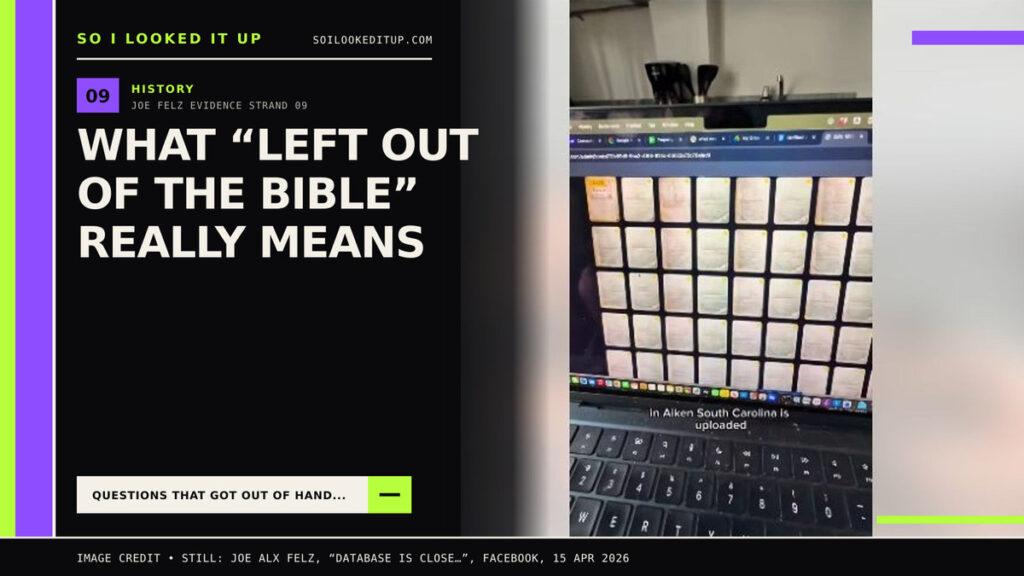
He showed an old Bible, photographed portions of First and Second Esdras, said an Apocrypha PDF had been scanned and continued seeking help to scan the larger collection. FelzBooks was registered months before his death and went live as a tiered search product. Its current site describes AI OCR, searchable text, watermarked downloads and protected access.
So the project was not invented after his death. Nor was it simply a folder of mysterious images. It was an attempt to turn photographed pages into a usable information system.
However, the public-facing version does not currently provide the audit trail needed to assess its strongest implications:
- complete bibliographic records for each object;
- full-resolution page facsimiles linked to each search result;
- OCR confidence or uncertainty markings;
- a declared transcription and normalisation policy;
- software and model versions;
- human correction status;
- edition comparison;
- stable downloads or manifests for independent review.
The login route was not functioning during this investigation, so the material behind it could not be assessed. The surviving homepage proves the platform exists. It cannot prove what every inaccessible record contains.
What the posthumous mirrors do—and do not—resolve
Update, 29 August 2026: the HYVE CARES / FelzLegacy memorial shelf now lists 68 volumes, identifying 12 as Joe’s own collection and 56 as later community additions. It gives readers a useful, bibliographically labelled route to material. But the shelf was assembled after his death and many entries link to scans held by the Internet Archive, Google Books or Google Drive. It is not a captured export of the pre-death FelzBooks database or its OCR layer.
A separate 264-file GitHub mirror using the FelzBooks name explicitly says its source collection came from AwakeningEnthusiast.com and disclaims original compilation or discovery. Both projects may preserve useful books. Neither, without a pre-death manifest or backend snapshot, proves which files, scans, metadata or model outputs were inside Joe’s system.
And, as the companion article explains, a book absent from a modern Protestant Bible is not automatically a text erased from history. AI can improve access to Esdras without showing that Esdras was globally suppressed.
What a defensible AI archive would publish
- Object record: title, author, edition, date, publisher, provenance, rights and physical description.
- Preservation images: complete, colour-managed, ordered masters with checksums.
- Processing log: every crop, dewarp, enhancement and spectral combination retained as a derivative.
- Page-linked OCR: text anchored to image coordinates, with reading order and confidence.
- Model card: OCR/HTR engine, model, version, languages and date of processing.
- Ground-truth sample: human-verified pages used to estimate character and word error rates for that collection.
- Uncertainty notation: illegible, supplied and conjectural text visibly distinguished.
- Separate normalisation: original spelling never silently overwritten for search convenience.
- Revision history: corrections attributed and previous versions recoverable.
- Page citations: every AI answer links to the exact supporting image, not merely the book title.
- Adversarial testing: proper names, numbers, negations, mixed scripts and controversial passages manually checked.
- Export: images, metadata and transcriptions available in durable, interoperable formats such as IIIF, METS/ALTO or plain text plus coordinates.
A quick test for any “AI decoded this ancient text” claim
- Can I see the original image at useful resolution?
- Is the alleged wording visibly present, reconstructed or inferred?
- Was AI used for enhancement, transcription, translation or interpretation?
- What model and version produced it?
- Was the page already known and transcribed elsewhere?
- Did a qualified reader verify the language and script?
- Are alternative readings shown?
- Does the surprising conclusion survive without the AI summary?
If the only available evidence is a fluent paragraph describing what the model found, the archive has inverted the chain. The output is visible; the source has disappeared.
What survives the audit
| Claim | Assessment |
|---|---|
| AI can make old printed books searchable | Yes, routinely |
| AI can transcribe historical handwriting | Yes, with accuracy depending heavily on script, image and model |
| Imaging can reveal physically present but invisible writing | Yes, in documented cases |
| AI can safely fill every damaged passage | No; completions must remain conjectural |
| An AI summary proves a text’s historical meaning | No |
| FelzBooks was a real pre-death digitisation project | Supported by the timeline and surviving site |
| Its AI recovered knowledge deliberately erased from history | Not established by the accessible evidence |
The conclusion
AI can recover access. It can recover legibility. In carefully documented imaging projects, technology can even recover physical writing that human eyes could no longer separate from damage or overtext.
It cannot recover certainty by generating the most plausible sentence.
The deepest value of Joe’s project was not that a machine might announce the truth hidden in forgotten books. It was that readers might finally be able to search the books, inspect the pages and ask better questions of them.
Done properly, AI does not replace the archive. It builds a transparent path back to it.
Sources & further reading
- Library of Congress — Chronicling America technical information and OCR limitations
- Library of Congress — ALTO principles for OCR text and layout
- IIIF Presentation API — aligning images, transcriptions and annotations
- Library of Congress — hyperspectral imaging for cultural heritage
- Library of Congress — multispectral recovery of obscured writing in a Hamilton letter
- Cambridge University Library — spectral imaging of palimpsest undertext
- READ-COOP — ground truth in historical text recognition
- Romein et al. — assessment of modern HTR engines on historical documents
- Thomas et al. — LLM post-correction of historical newspaper OCR
- Gagnier et al. — script switching and hallucination in LLM post-OCR correction
- Gómez Rey et al. — comparative digitisation-pipeline evaluation (preprint, 25 August 2026)
- NIST — Generative AI Risk Management Profile
- FelzBooks — project description
- Outcome — annotated reconstruction of Joe’s archive timeline
- HYVE CARES / FelzLegacy — posthumous memorial shelf
- FelzBooks-named GitHub preservation mirror — source and rights notice
Related rabbit holes: the full Joe Felz reconstruction · what “left out of the Bible” means · how extraordinary claims mutate online