Read carefully.
Follow the sources.
Change the conclusion when the evidence changes.
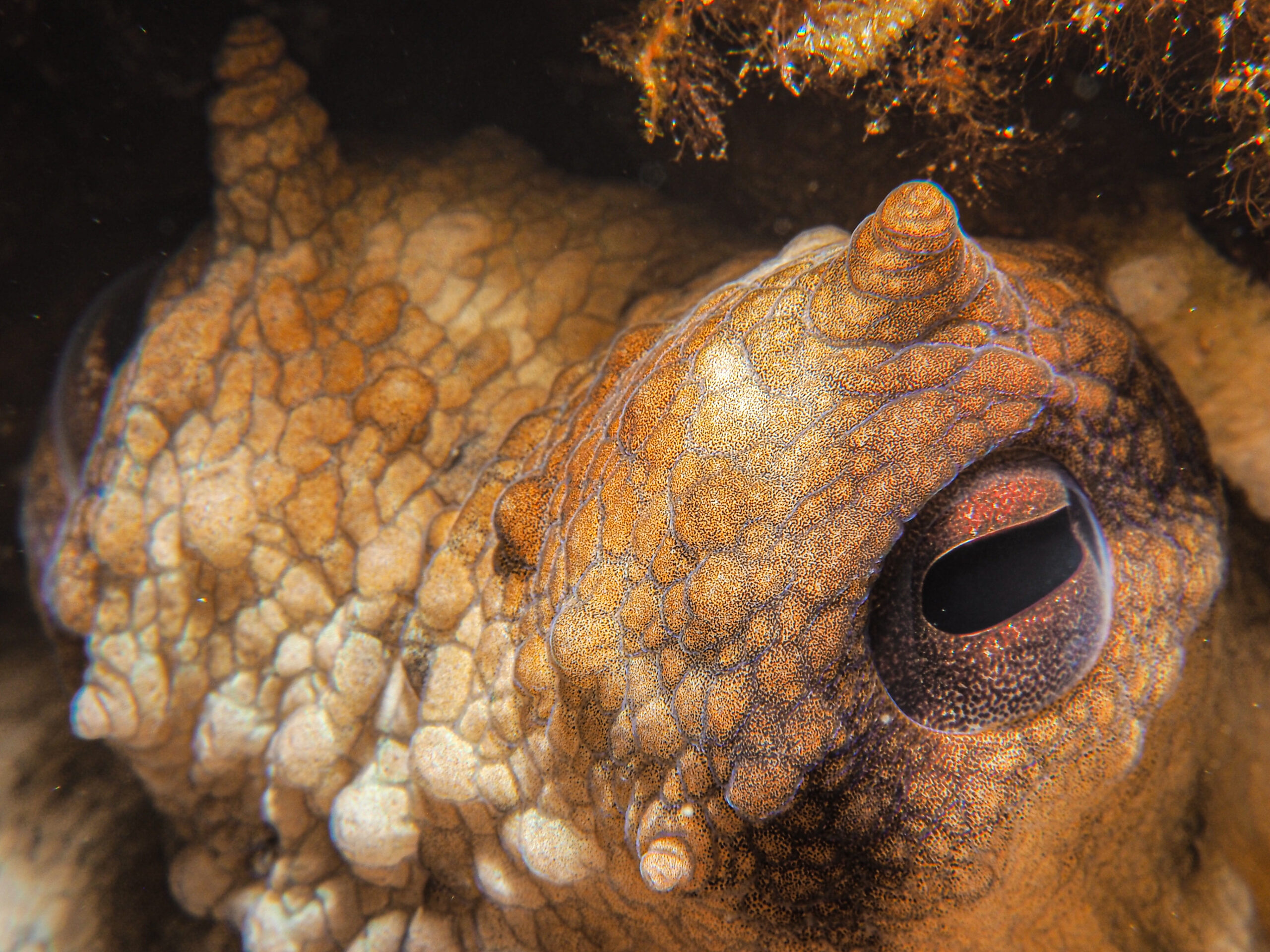
Image: Octopus close-up at Ċirkewwa, Malta. Victor Micallef / Wikimedia Commons · CC BY-SA 4.0.
“Octopuses can edit their own genes” sounds as if an octopus encounters cold water, opens its molecular settings and rewrites the DNA until everything feels reasonable again.
The real process is less intentional, less permanent and considerably more interesting. Octopuses, squid and cuttlefish leave the inherited DNA sequence in place. They alter some of the RNA copies made from it—and, at many sites, they alter only a fraction of those copies.
That fraction is the important part. It lets the same gene produce a mixture of protein versions. When the water cools, editing levels at thousands of neural sites can shift, changing the proportions in the mixture within hours.
This is not an animal improvising new code on demand. It is an evolved biochemical system full of predetermined targets, molecular constraints and unanswered questions. The rabbit hole begins when we stop asking whether an octopus “rewrites itself” and ask what all those temporary alternatives actually do.
Evidence status
Soft-bodied coleoid cephalopods use protein-recoding A-to-I RNA editing at an exceptional scale, especially in nervous tissue. Temperature changes editing levels at thousands of sites, and selected edits alter protein function.
Graded mixtures of edited and unedited proteins provide useful physiological flexibility, and natural selection has favoured diversification at many shared, strongly edited sites.
How many of the tens of thousands of candidate recoding events matter in living animals, which behaviours they affect, and whether extensive editing contributed to coleoid intelligence.
The archive stays put; the working copy changes
A gene’s DNA is transcribed into RNA. Some of that messenger RNA is then read in three-letter codons to build a protein. In A-to-I editing, enzymes called ADARs convert a particular adenosine in an RNA molecule into inosine. Cellular machinery usually interprets inosine as guanosine. If the edit falls in the right position inside a codon, the ribosome inserts a different amino acid and the resulting protein can behave differently.
The target is RNA, not the gene in DNA. The edited molecule is temporary and will eventually be broken down. An octopus does not pass that altered letter to its offspring as a new DNA mutation. What can be inherited is the system that makes the edit possible: ADAR enzymes, the target sequence and surrounding DNA that lets the RNA fold into the double-stranded shape ADAR recognises.
Nor does the animal invent a new edit in response to a problem. The editable sites are built into those sequences by evolution. Biochemistry determines which RNA molecules get edited and how often. Temperature, tissue, development and other conditions can change the editing percentage, but no evidence suggests a conscious choice or a molecular understanding of what the animal “needs”.
Humans edit RNA too. Coleoids use it differently.
A-to-I editing is not an octopus superpower absent from other animals. Humans have millions of detected editing sites, most in non-coding repetitive RNA. A major role there is helping cells recognise their own double-stranded RNA rather than mistakenly treating it as a viral threat. A small number of human edits recode important proteins, including nervous-system receptors.
The exceptional feature in coleoids—the soft-bodied group containing octopuses, squid and cuttlefish—is how often editing changes protein-coding messages. A 2015 analysis found that a majority of expressed transcripts in the longfin squid nervous system contained recoding sites. Comparative work later identified tens of thousands of conserved recoding sites across coleoid species, enriched in genes involved in neural excitability and neuronal structure.
This is not simply “what cephalopods do”. Nautiluses, which sit on another cephalopod branch, show far less recoding. Extensive neural recoding appears to be a coleoid innovation, not a requirement for having tentacles, living in the sea or belonging to the wider group.
An edit is a dial, not a switch
At one editable position, a cell might modify 10 per cent of RNA copies, 60 per cent or almost all of them. The result is not one corrected master message. It is a population containing unedited and edited transcripts, and potentially both protein versions at once.
Multiple sites in the same transcript multiply the possible combinations. They are not always independent: editing sites cluster, nearby sites can be edited together and one edit can influence another through the RNA’s structure. That limits the fantasy calculation in which every site freely combines with every other. Even so, linked editing can create a considerable range of transcript—and protein—mixtures from one stretch of DNA.
This graded system answers an obvious evolutionary objection. If the edited guanosine-like version were always better, why not put a G in the DNA and make it every time? An editable A can be useful only if producing both versions, or changing their ratio by tissue or condition, is better than permanently choosing either one.
Cold water moved more than 13,000 protein dials
A 2023 Cell study made that conditional logic visible. Researchers acclimated California two-spot octopuses to about 13°C or 22°C and sequenced RNA from the stellate ganglion, a large peripheral nervous-system centre. Of 62,661 well-covered editing sites, 20,850 were edited more heavily in the cold and 789 more heavily in the warm. Among sites that changed an amino acid, 13,285 were cold-induced.
The percentages did not merely wobble at the edge of measurement. Thousands shifted by more than five percentage points, with some changing by as much as 51 points.
A separate time-course cooled juvenile octopuses from 24°C to 14°C over 20 hours and monitored 18 especially temperature-sensitive sites. Cold-associated editing began to change within hours and approached a steady level in about four days. The reciprocal warming experiment moved the same system in the other direction. Wild-caught octopuses sampled in different seasons showed related temperature-associated patterns, suggesting that the laboratory effect was not confined to a tank.
Those results establish a responsive editome under defined conditions. They do not show that every changed site improves survival or that an octopus can tolerate any temperature by editing RNA. The main experiment used one neural tissue and a limited number of animals from one species; the time-course followed a selected set of 18 sites. Temperature also changes gene expression, protein turnover, metabolism and membranes. Editing is one part of acclimation, not a molecular wetsuit.
Two edits passed the “does it do anything?” test
Counting A-to-G differences in RNA shows potential recoding. It does not prove that the edited RNA becomes protein, or that the substituted amino acid changes physiology.
The 2023 temperature study therefore examined two strongly responsive sites. One occurred in synaptotagmin, a protein involved in calcium-triggered neurotransmitter release. Structural and biochemical experiments showed that the substitution altered calcium binding. Another occurred in kinesin-1, a molecular motor that moves cargo along microtubules inside long neuronal processes. The edited version changed transport velocity and how far the motor travelled.
A companion Cell study investigated multiple edited kinesin and dynein variants from squid. It found tissue- and temperature-associated versions with distinct single-molecule movement, including cold-specific kinesins that performed differently at low temperature. These are directly evidenced links from edit to protein behaviour. The further link—from altered motor performance to a healthier neuron and then to a fitter animal—remains plausible rather than directly demonstrated.
That boundary matters. Two functional examples cannot be multiplied by 13,285 and turned into 13,285 adaptations.
The field argued about whether the abundance is adaptive
Extensive recoding has the irresistible appearance of purpose. Conserved sites, neural enrichment and a bias towards amino-acid-changing edits all make a broad adaptive story tempting.
A 2019 analysis proposed a colder interpretation. Once a lineage has high ADAR activity, it may tolerate harmful DNA changes from G to A because editing converts some A-containing RNA back towards the old protein. In that model, many highly edited amino-acid changes are compensation or tolerated noise, not a programme selected to create useful alternatives.
A 2021 comparative analysis tested that proposal and concluded it could not explain a large fraction of shared, strongly recoded coleoid sites. At those sites, the evolutionary patterns were more consistent with selection favouring the editable A over either an uneditable A or a fixed genomic G—in other words, favouring the ability to diversify.
The dispute does not require one verdict for every edit. Some substitutions have measured functions. Some shared, heavily edited sites carry strong evolutionary signs of selection. Others may be weakly edited by-products of ADAR encountering the right RNA shape. “There are tens of thousands” is a statement about scale, not a functional annotation.
The famous evolutionary “cost” is local
ADAR does not recognise a naked letter. The RNA around a target must fold into a suitable double-stranded structure. Mutations in the surrounding DNA can disrupt that fold and abolish editing, so natural selection can conserve not only the editable site but a wider neighbourhood around it.
A 2017 study found reduced DNA sequence change around many conserved coleoid editing sites and described a trade-off between transcriptome flexibility and genome evolution. The viral translation—octopuses stopped evolving their DNA so they could edit RNA—is much too large. Their genomes plainly evolve. The constraint concerns particular sequences needed to maintain editable RNA structures, and later work found that clustered sites can extend those dependencies.
The trade is therefore specific: preserving a useful molecular dial can reduce the freedom to alter the casing and wiring around that dial. That is ordinary evolution maintaining a regulatory system, albeit a spectacularly busy one.
A new experiment is finally looking beyond the transcript
Most cephalopod editome maps infer potential protein changes from RNA. A December 2025 preprint took a different route, combining mass spectrometry, biochemical tests and cellular assays to look across the longfin squid proteome. The authors report protein-level evidence for thousands of recoding events and effects on protein stability, cellular location, post-translational modification and enzyme activity.
One case involved MARCHF5, an enzyme that helps attach ubiquitin tags to proteins at mitochondria. Recoded variants changed substrate ubiquitylation and disturbed mitochondrial homeostasis in the experimental system. If the result survives peer review and replication, it expands the story beyond ion channels and molecular motors: editing could alter how proteins are modified, interact and are removed.
Its status is preliminary. The manuscript has not yet been peer reviewed, and biochemical or cellular effects do not by themselves reveal what happens in a behaving squid. It is nevertheless aimed at the right missing comparison: not just how many RNA letters differ, but which edited products actually exist and what they do.
Does this explain octopus intelligence?
Not on present evidence. Extensive recoding is concentrated in coleoid nervous systems, and many targets participate in neural signalling and structure. That makes RNA editing a credible contributor to neural physiology.
It does not establish that editing created intelligence, explains distributed control in the arms or produces any particular clever behaviour. Coleoids also evolved unusual brain organisation, sensory systems, developmental programmes and gene-family changes. There is no experiment in which reducing a defined editing programme removes “octopus intelligence” while leaving other neural functions intact.
The correlation is made more seductive by the contrast with nautiluses, but the two lineages differ in many other ways. At most, extensive recoding and behavioural complexity are directly co-located in the same evolutionary branch; the proposed causal bridge between them remains unproven.
The stranger truth is a controlled mixture
Octopuses do not edit their genes on command. They and other coleoids use inherited ADAR machinery to modify temporary RNA molecules at evolved sites. The most defensible adaptive examples change protein function, respond to temperature and let cells alter the ratio of protein variants without committing the DNA to either one.
That is more interesting than a self-rewriting animal. A genome normally looks like a list of available instructions; extensive RNA editing turns parts of it into a mixing board. The positions of the dials are genetically built, environmental conditions can move some of them, and the cell can play more than one molecular version at once.
The next decisive experiments need to manipulate individual editing sites or coordinated clusters in living cephalopods, then measure neural physiology, behaviour and fitness across realistic conditions. They also need proteomics that confirms which RNA variants become abundant proteins in which cells.
The better question is no longer “can an octopus rewrite itself?” It is “which mixtures are useful enough that evolution preserved the machinery to keep making both?”
Sources & further reading
- Alon et al. (2015): Extensive recoding in the squid nervous system
- Liscovitch-Brauer et al. (2017): Transcriptome plasticity and local genome constraints
- Jiang & Zhang (2019): The nonadaptive explanation for abundant recoding
- Shoshan et al. (2021): Evidence for adaptive proteome diversification
- Moldovan et al. (2022): Clusters and correlated cephalopod editing sites
- Birk et al. (2023): Temperature-dependent editing across the octopus neural proteome
- Rangan & Reck-Peterson (2023): Recoding changes microtubule motor function
- Moen et al. (2025 preprint): Proteome-scale functional effects of squid RNA editing