Read carefully.
Follow the sources.
Change the conclusion when the evidence changes.
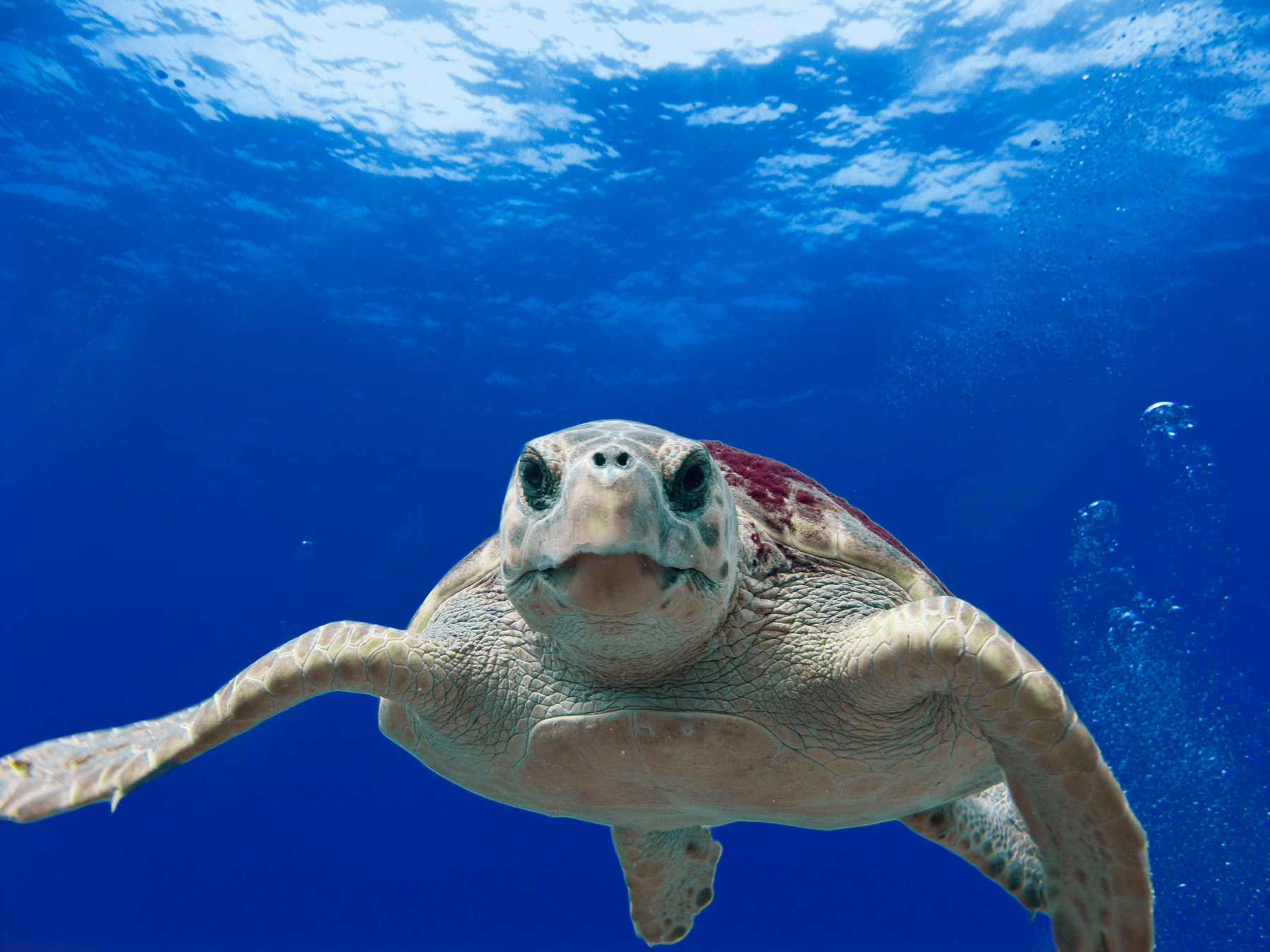
Image: Loggerhead sea turtle. T. Moore / NOAA and NIST via Wikimedia Commons · public domain.
A loggerhead turtle can be placed in a tank in North Carolina, surrounded by coils, and exposed to a magnetic field that normally exists hundreds of kilometres away. Change the field and the turtle changes what it does. A migratory bird under an artificial night sky can likewise turn when researchers rotate magnetic north.
So the remarkable part is no longer whether animals can use Earth’s magnetic field. Many can. The mystery is how a field far weaker than a fridge magnet becomes a signal in a nervous system.
For years, the most photogenic answer has been a quantum compass in the eye. Light excites a protein called cryptochrome; pairs of electrons briefly enter a state that Earth’s field might influence; the animal somehow receives directional information. It is serious science, not science-fiction garnish.
But it may answer only one part of the wrong question. Recent experiments with turtles, pigeons and competing candidate receptors suggest that “the magnetic sense” may be several senses doing different navigational jobs. And some of the newest answers have started arguments almost as quickly as they appeared.
Evidence status
Many animals detect geomagnetic information. Controlled changes to field direction, strength or inclination can change orientation, navigation or learned behaviour.
Some animals use separate mechanisms for a directional compass and a positional map. Light-sensitive radical-pair chemistry and iron-based sensing are leading candidates for different parts of that system.
No complete receptor-to-brain pathway has been established for the major vertebrate examples. New pigeon inner-ear and liver candidates remain actively disputed.
First separate the compass from the map
A compass answers which way am I facing? A map answers where am I? Human navigation normally hides the distinction because a phone supplies both at once. Earth’s field can, in principle, supply both to an animal—but through different features.
Direction can be extracted from the orientation of the field lines. Many birds use an “inclination compass”: they distinguish the poleward direction, where the field tilts down into Earth, from the equatorward direction, where it tilts up, rather than detecting magnetic north as a polarity.
Position is a different calculation. Magnetic intensity and inclination vary geographically. Their combinations create signatures that sea turtles, fish, lobsters and some birds can use as rough coordinates. The field is not a perfect grid—similar signatures occur in different places and the field drifts over time—so it is better understood as one layer of a multisensory map than an infallible internal GPS.
This distinction changes the receptor hunt. A detector well suited to the angle of a field may not be best at measuring its absolute strength. A single animal could therefore carry more than one magnetic instrument, just as we use eyes for a landmark and an inner ear for balance without calling them one sense.
The turtles performed a useful separation
In a 2025 Nature study, juvenile loggerheads learned that one experimentally generated magnetic signature predicted food. When researchers later produced that field without feeding them, the turtles began an energetic food-anticipation routine nicknamed the “turtle dance”. Some remembered the association four months later.
The clever part was not the dancing. The assay let the turtles recognise a place-like magnetic signature without having to swim in a compass direction. Researchers could now perturb the map task and the compass task separately.
Broadband radiofrequency fields disrupted the turtles’ directional orientation but not their recognition of the rewarded signature. Because weak radiofrequency fields can interfere with some radical-pair reactions, the result is consistent with a chemical compass and a differently built map sense. It does not identify either receptor by itself: radiofrequency effects are technically difficult to interpret, and an unaffected behaviour is not proof of one particular alternative.
A follow-up published later in 2025 gave 16 loggerheads a five-millisecond magnetic pulse about 1,700 times stronger than Earth’s field. The next day, pulsed turtles showed much less dancing to the learned field than they did after sham treatment. Such pulses can rearrange the magnetic state of tiny magnetite particles, so the result supports an iron-based map sensor.
Again, “supports” is doing necessary work. A pulse can induce electric fields and alter biology in other ways; it did not reveal a receptor cell. What the two turtle studies establish most convincingly is the functional split: the animals can learn magnetic location cues, and the interventions that disturb their compass and map responses are not the same.
The quantum compass is a mechanism, not yet an organ
The radical-pair proposal begins when light pushes an electron within a molecule such as cryptochrome, leaving two molecules with unpaired electrons. Their spins can occupy different quantum relationships, and an external magnetic field can slightly change how long they remain in each state. If the chemical products differ, a weak field can influence a reaction without exerting enough mechanical force to turn a tiny biological compass needle.
Important links in that chain have experimental support. In 2021, purified cryptochrome 4 from European robins formed light-induced radical pairs and responded to magnetic fields in the laboratory. The robin protein was more magnetically sensitive than versions from non-migratory chickens and pigeons. Later chemical work has shown that tightly bound radical pairs can remain sensitive at microtesla-scale fields under some conditions.
Those are directly evidenced properties of isolated proteins and chemical systems. They are not yet a demonstration that a living bird uses cryptochrome 4 to navigate. Researchers still need to show that the relevant molecules are arranged and activated appropriately in receptor cells, that Earth-strength changes produce a usable signal amid thermal noise, and that a neural pathway carries that signal into behaviour.
The popular phrase “birds see magnetic fields” also runs ahead of the evidence. Birds require visual pathways for their light-dependent compass, and magnetic information may be superimposed on visual processing. That does not tell us what the experience looks like—if it looks like anything. A magnetic shadow laid across the bird’s view is a useful modelling analogy, not a report from inside a robin.
A pigeon’s inner ear entered the competition
In late 2025, researchers exposed pigeons to a rotating magnetic field and screened activity across the brain instead of beginning with a favourite receptor. Neurons in the medial vestibular nucleus—part of the circuitry receiving balance information from the inner ear—responded, followed by activity in a forebrain region. Disrupting both inner ears removed the brain response.
The team proposed electromagnetic induction. Move a conductive fluid through a magnetic field and a tiny voltage can arise; the pigeon’s semicircular canals already contain moving fluid and exquisitely sensitive hair cells. In this account, the same anatomy used to detect head rotation could contribute to a light-independent magnetic compass.
That sounds like the missing organ. It is not quite. The study found a magnetically responsive neural route and made a specific physical mechanism testable. It did not directly measure the proposed induced current at Earth strength. A 2026 physical analysis argued that even generously estimated currents in the semicircular canals would be too small and too noisy to provide the directional information claimed.
The criticism does not make the brain response vanish. It separates an observed pathway from the explanation attached to it. The inner ear may be involved while induction is wrong, incomplete or dependent on an unrecognised amplifier. That is precisely the gap between locating a circuit and identifying a receptor.
Then researchers found magnetic cells in the liver
In May 2026, a Science paper supplied the field’s strangest new candidate. Researchers reported iron-rich macrophages—immune cells—in homing-pigeon livers with superparamagnetic properties. They then trained pigeons on a route of roughly 19 kilometres and depleted macrophages in 18 birds; 16 sham-treated birds served as controls.
Under clear skies, the treated pigeons still oriented homeward. Under complete cloud, when the sun compass was unavailable, the macrophage-depleted birds initially became disoriented and some were lost until the sky cleared. The authors proposed that liver macrophages were required for finding magnetic direction under those conditions.
The behavioural condition is the intriguing part. If depletion simply made the birds generally ill or unable to navigate, sunshine should not have rescued the route. The result instead looks like a redundant system becoming visible when another cue disappears.
But the experiment does not yet establish the liver cell as the transducer. Macrophage depletion changes immune and iron physiology beyond one candidate cell population. The study did not demonstrate a receptor-to-nerve connection that turns movement of ferritin particles into a neural signal. And in August 2026, five magnetoreception specialists published a detailed challenge arguing that the proposed macrophage mechanism was not physically or anatomically supported by the reported data.
The history makes the dispute especially awkward. Iron-rich cells in pigeons’ upper beaks were once presented as magnetosensitive neurons. In 2012, careful anatomical work showed that those cells were macrophages, not neurons, and the candidate collapsed. That history does not disprove the liver result—an immune cell could theoretically participate in sensing—but it raises the evidential bar for claiming that iron plus field-dependent behaviour equals a receptor.
Why the neat receptor stories keep failing
Magnetic sensing is an unusually hostile measurement problem. Earth’s field is weak. Iron is common in tissue and attracts contamination. Behavioural responses can depend on light wavelength, season, experience, motivation and which other navigational cues are available. A coil can change not only magnetism but heat, vibration, electric fields or experimental noise unless controls are meticulous.
There is also no guarantee that evolution found the same solution repeatedly. Bacteria grow chains of magnetite that physically align them. Sharks and rays can exploit voltage induced as they move conductive seawater through Earth’s field because they already possess highly sensitive electroreceptors. A light-dependent chemical compass is plausible in a bird or turtle without being a universal design for every magnetically responsive animal.
Even evidence within one species can refer to different jobs. A visual pathway may carry compass information while trigeminal pathways carry map information. Experienced migrants may use learned magnetic maps that juveniles have not acquired. A manipulation performed under cloud can expose a system that appears irrelevant under sun.
That is why candidate mechanisms should be asked to make narrow predictions. If a receptor is light-dependent, which wavelengths and retinal cells matter? If particles move, can the force overcome biological noise and can the signal reach a nerve? If a system provides a map, does disabling it disrupt responses to location signatures while leaving directional orientation intact? The turtle studies are powerful because they began to make that last separation experimentally.
The surviving answer is plural
Animals really can obtain usable information from Earth’s magnetic field. That conclusion no longer depends on finding the perfect microscopic compass: coil experiments, displacement studies, tracking and learned-field assays converge on the behaviour.
The mechanism is less settled. Radical-pair chemistry is a physically demonstrated route by which weak fields can affect reactions, and cryptochrome 4 is a credible avian candidate. Iron-based sensing has experimental support in magnetic-map tasks but no uncontested vertebrate receptor. New pigeon studies identify physiological dependencies in the inner ear and liver, yet their proposed transduction mechanisms face serious quantitative and anatomical objections.
The strongest version that survives is therefore more interesting than “birds have quantum eyes”. At least some animals appear to divide magnetic navigation into specialised jobs: direction versus position, innate compass versus learned map, daylight system versus backup under cloud. Those jobs may be solved by different molecules and organs, and another species may solve them differently again.
The decisive evidence will not be another iron-rich spot or magnetically active protein on its own. It will connect the entire chain at Earth strength: a defined physical interaction in a defined cell, a measurable neural signal, loss of the relevant behaviour when that link is selectively removed, and restoration when it is returned.
Until then, the right question is not “where is the magnetic organ?” It is “how many magnetic senses has navigation been hiding under one name?”
Sources & further reading
- Goforth et al. (2025): Learned magnetic map cues and two mechanisms of magnetoreception in turtles
- Mackiewicz et al. (2025): A magnetic pulse disrupts the loggerhead turtle map sense
- Xu et al. (2021): Magnetic sensitivity of cryptochrome 4 from a migratory songbird
- Nordmann et al. (2025): A global screen for magnetically induced neuronal activity in pigeons
- Kattnig (2026): Physical limits of induction-based magnetoreception in birds
- Lisowski et al. (2026): Homing-pigeon navigation and superparamagnetic liver macrophages
- Winklhofer et al. (2026): Critique of the proposed macrophage receptor
- Treiber et al. (2012): Iron-rich pigeon-beak cells are macrophages, not magnetosensitive neurons


.jpg)