Read carefully.
Follow the sources.
Change the conclusion when the evidence changes.
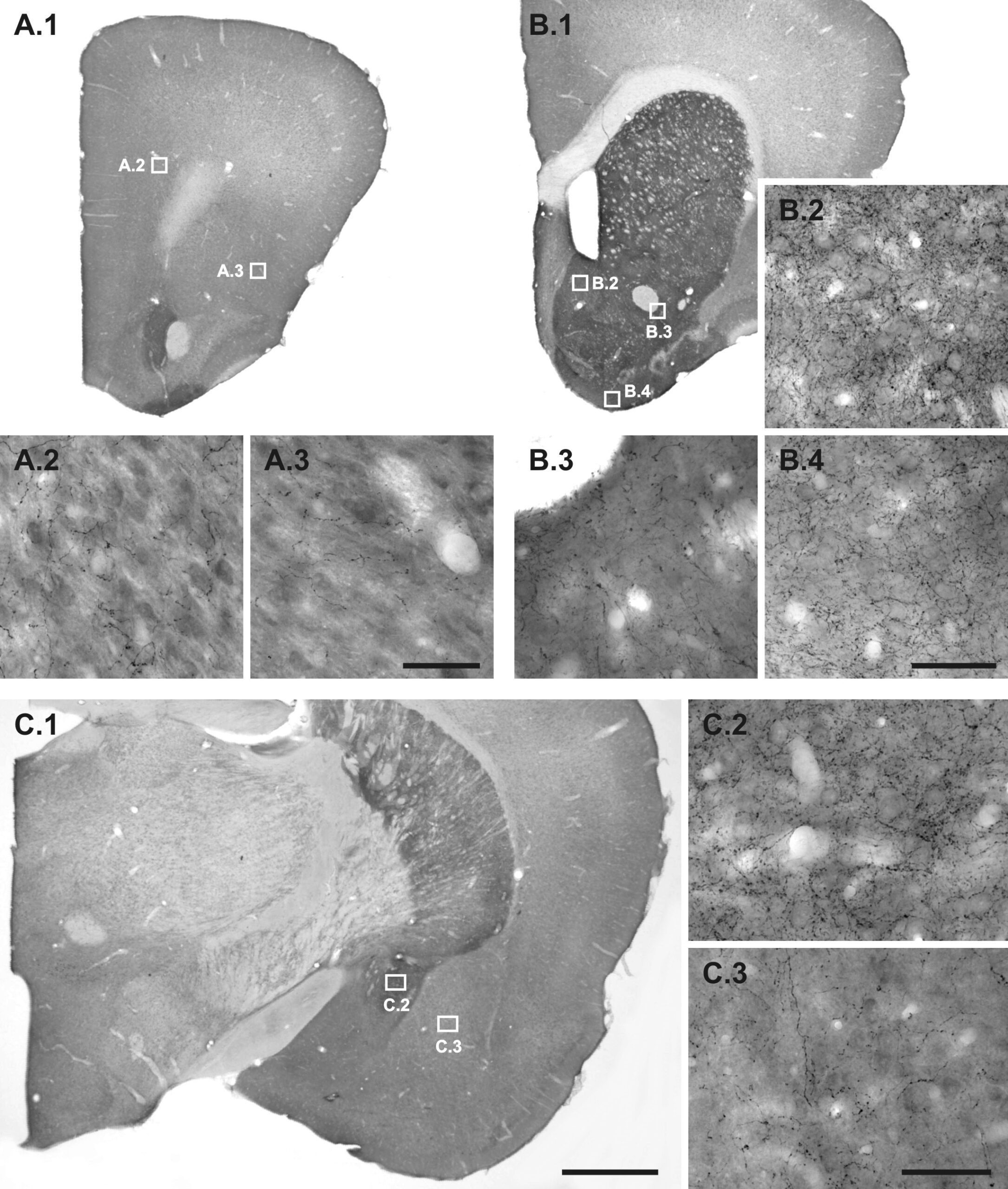
Image: Dopamine-immunoreactive fibres in gerbil brain regions. Brummelte et al. / Wikimedia Commons · CC BY 2.0.
“ADHD brains have less dopamine” has the satisfying shape of an answer. It names a molecule, points to a shortage and makes stimulant treatment sound like topping up a nearly empty tank.
There is just one problem: nobody has established that people with ADHD have one globally low supply of dopamine. There is no clinical brain-dopamine test for ADHD, brain scans have pointed in opposite directions, and conditions that really do cripple dopamine production usually produce a very different neurological picture.
Dopamine is still in the story. The more interesting question is what kind of story it is in: cause, consequence, treatment lever, developmental context—or some mixture that differs between people.
Evidence status
Dopamine participates in attention, motivation, learning and movement. Stimulant medicines alter dopamine and noradrenaline signalling and can reduce ADHD symptoms in the short term.
ADHD may involve dopamine regulation in particular circuits, developmental stages, tasks or subgroups, interacting with noradrenaline and other systems rather than one uniform shortage.
Which dopamine changes matter for which people, whether they are causes or adaptations, and how much of treatment response depends on dopamine rather than another catecholamine or network effect.
What would “less dopamine” even mean?
The brain does not have a single dopamine gauge. A small set of midbrain neurons sends dopamine into several pathways, where it can help tune movement, reward learning, motivation, attention and the selection of actions. The result depends on the brain region, receptor type, firing pattern, task, developmental stage and what other signals arrive at the same time.
“Less” could therefore mean lower synthesis, fewer molecules released at rest, smaller bursts during a task, faster clearance by transporters, altered receptor availability, or weaker downstream responses in one circuit. Those possibilities are not interchangeable. One can be low while another is high.
This matters because most human studies do not place a dipstick into a synapse. PET and SPECT scans use radioactive tracers to estimate things such as receptor or transporter availability. A tracer binding differently can reflect several biological changes, including competition with the brain’s own dopamine. The result is an inference about a component of signalling—not a direct inventory of “how much dopamine this brain has.”
The scans do not point in one direction
If ADHD were defined by a straightforward dopamine shortage, independent imaging studies ought to converge on a recognisable pattern. They have not.
A 2024 critical review found reports of decreased, increased and unchanged dopamine-related measures across PET and SPECT studies. Samples were often small, tracers differed, and previous stimulant treatment complicated the comparison. A 2012 meta-analysis of striatal dopamine transporter scans made that last problem unusually visible: drug-naive groups tended to show lower transporter density, while previously medicated groups tended to show higher density.
The transporter—DAT—is the protein that clears dopamine from the space outside a neuron. More or less DAT is not the same thing as more or less dopamine, and medication can itself alter the system being measured. A scan taken after years of treatment may partly record an adaptation to treatment rather than the untreated condition.
There are intriguing, more specific findings. One small PET study reported reduced background, or “tonic”, dopamine release but enhanced task-related, or “phasic”, release in the right caudate of adults with ADHD. That result offers a way for apparently high and low findings to coexist. But it came from one limited sample and has not turned a global deficiency into an established timing model. It is a clue about what the crude word less can conceal.
Nature has already run a harsher dopamine experiment
There is another comparison the simple theory has to survive: what happens when human dopamine production really is severely impaired?
Rare genetic and metabolic disorders can disrupt tyrosine hydroxylase, aromatic L-amino acid decarboxylase or the cofactors needed to make dopamine. Their characteristic effects include abnormal muscle tone, movement disorders, eye-movement problems and other serious neurological symptoms. Parkinson’s disease, in a different way, destroys dopamine-producing cells in the nigrostriatal pathway and is defined primarily by movement problems.
People with those conditions can have cognitive and psychiatric symptoms, and dopamine can matter to ADHD without the disorders looking identical. But the comparison imposes a boundary. A body-wide or brain-wide dopamine-production failure has a much larger motor signature than ordinary ADHD. If ADHD were generally the mild end of the same global shortage, we would expect a clearer family resemblance.
That resemblance is not what the evidence shows. The 2024 review concluded that dopamine involvement is credible but evidence for a general hypodopaminergic state as a defining feature of ADHD is limited.
The genes miss the obvious targets—and land near dopamine anyway
Genetics produces a particularly good research-driven turn.
Older studies often examined an appealing candidate: a dopamine receptor, transporter or enzyme gene. Results were inconsistent, and large modern genome-wide studies did not elevate the core dopamine machinery or the main drug targets into a neat causal list.
In 2023, the largest ADHD genome-wide association analysis at the time compared 38,691 people with ADHD with 186,843 controls. It identified 27 risk regions and highlighted 76 possible genes. The signal pointed broadly towards early brain development and several neuronal cell types—not a single dopamine-production switch.
Then the analysis curved back. The genes implicated by common variants were disproportionately expressed in prenatal midbrain dopamine neurons.
A newer exome study, published online in late 2025, looked for rarer protein-altering variants. Its three statistically significant genes were MAP1A, ANO8 and ANK2, names associated with neuronal structure, synapses and cell junctions rather than dopamine synthesis. Yet the broader rare-variant signal was again enriched in developing dopamine neurons—as well as GABA-producing neurons and neuroblasts.
This does not show that those variants lower dopamine. Gene expression in a cell type tells researchers where a risk gene may matter; it does not reveal the direction of the resulting physiological change. It also does not make dopamine neurons the only relevant cells. The rare-variant study found shared neurodevelopmental biology and several neuronal signals.
But it suggests a more defensible connection than “ADHD genes cause low dopamine.” Genetic risk may influence how certain developing neurons are built and connected, with dopamine being one language those cells later use. The molecule can be relevant without being the original defect or uniformly scarce.
Then why do stimulants work?
This is the strongest intuitive argument for the shortage story. Methylphenidate blocks dopamine and noradrenaline transporters. Amphetamines also change catecholamine transport and release. Randomised trials show that these medicines can reduce core ADHD symptoms over the short term.
But a treatment’s lever is not automatically a diagnosis of the untreated state. Pain improving after aspirin does not prove an aspirin deficiency. Stimulants can also improve aspects of attention and task performance in people without ADHD; one PET study found that methylphenidate’s attentional effects tracked poor baseline performance across both ADHD and control groups more closely than diagnosis itself.
Nor is dopamine acting alone. The prefrontal cortex, important for holding goals in mind and resisting distraction, is strongly influenced by noradrenaline. Atomoxetine targets the noradrenaline transporter, while guanfacine acts at alpha-2A adrenergic receptors; both can treat ADHD without being described as dopamine replacements.
A small 2025–26 dual-tracer PET study made the overlap visible. Twenty-one adults with ADHD were scanned before extended-release methylphenidate treatment, and 12 were rescanned after their dose had stabilised. The drug changed both dopamine-transporter binding in the striatum and noradrenaline-transporter binding in the thalamus and pons while cognitive measures improved. Within that small follow-up group, the transporter changes did not correlate with the cognitive improvements.
That study cannot tell us which transmitter caused which benefit; its size and dropout between scans sharply limit the conclusion. What it can do is retire the idea that methylphenidate performs a clean, one-molecule refill. The intervention moves more than one system, and a molecular change after treatment does not identify the condition’s original cause.
The amount may be the wrong variable
Dopamine often works less like fuel and more like punctuation. Background signalling can help set a circuit’s responsiveness; brief bursts can mark an unexpectedly important event. Too little modulation may leave a signal weak, while too much can drown out useful distinctions. The productive range can shift by brain region, task and baseline state.
That makes several apparently contradictory observations possible. A person could have ordinary total synthesis but mistimed release. One circuit could clear dopamine quickly while another compensates. A receptor could become more or less sensitive. A developmental change could alter which inputs a dopamine neuron responds to. Medication could temporarily improve the signal-to-noise ratio without repairing the process that created the vulnerability.
These are plausible mechanistic families, not a replacement slogan. Human evidence does not yet select one timing, receptor or circuit model that explains ADHD as a whole. The diagnosis is behaviourally diverse, highly polygenic and often accompanied by other developmental or psychiatric conditions. A single chemical setting would be surprising.
The better question is “where, when and for whom?”
The viral claim gets one thing right: dopamine is not a random molecule pasted onto ADHD for marketing. It participates in functions affected by the condition, dopamine neurons appear in genetic analyses, and medicines that alter dopamine signalling can be effective.
What it gets wrong is the conversion of involvement into shortage. Imaging has not established a consistent global deficit. Genuine dopamine-production disorders do not resemble ordinary ADHD closely enough to rescue that model. Genetics implicates neuronal development more strongly than an empty dopamine tank. And effective treatments move noradrenaline and wider networks as well as dopamine.
The strongest version that survives is therefore narrower and stranger: dopamine may be one important control signal in circuits whose development and moment-to-moment regulation differ in ADHD, but neither the direction nor the location of that difference is uniform or clinically measurable yet.
A decisive future study would have to do more than compare average tracer binding between two small groups. It would measure dopamine and noradrenaline dynamics during defined tasks, account for medication history and development, identify reproducible subgroups, and show that a particular abnormality predicts symptoms or treatment response.
Until then, “less dopamine” is not a biological fact about every ADHD brain. It is a tidy metaphor covering a system that appears to care more about timing, place and context than about one number on a gauge.
Sources & further reading
- MacDonald et al. (2024): Critical evaluation of the dopamine hypothesis for ADHD
- Demontis et al. (2023): Genome-wide analysis identifying 27 ADHD risk loci
- Demontis et al. (2025): Rare ADHD risk variants and neuronal biology
- Fusar-Poli et al. (2012): Meta-analysis of striatal dopamine-transporter imaging in ADHD
- Badgaiyan et al. (2015): Tonic and phasic dopamine release in adults with ADHD
- del Campo et al. (2013): Methylphenidate, dopamine and baseline attention performance
- Oya et al. (2025): Dual-tracer PET study of methylphenidate, DAT and NET
- Cortese et al. (2018): Network meta-analysis of ADHD medications